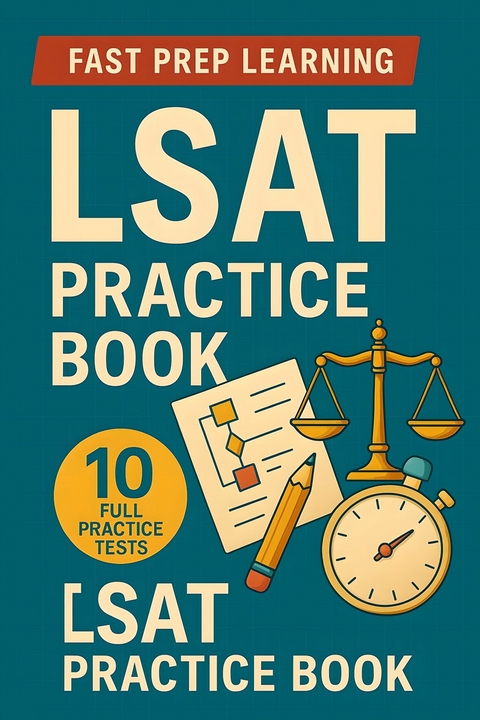
LSAT Practice Book (eBook)
317 Seiten
Publishdrive (Verlag)
978-0-00-109881-7 (ISBN)
What if I told you that preparing for the LSAT with confidence-without overwhelm, without confusion, and without doubting your reasoning ability-can actually become your reality?
If you're worried you won't reach your target score on the first attempt, or certain LSAT sections still feel unclear, then following a structured, LSAC-aligned study plan is your solution. It can dramatically strengthen your understanding of Logical Reasoning, Reading Comprehension, and Analytical Reasoning (Logic Games)-the core skills the exam truly measures.
It's so effective because every chapter mirrors real LSAT exam logic, using simple explanations, step-by-step reasoning, and targeted examples that match how top scorers think during the test.
All lessons follow the official LSAT content framework, making this guide ideal for college students, graduates, career-changers, and retakers who want a clear, predictable path to improvement.
So whether you're new to the LSAT or already familiar with its format, this guide supports every starting point. You don't need a background in logic or philosophy to benefit-but it becomes even more valuable if law school is your next major step.
You get one study guide... built for busy students, full-time professionals, and anyone who wants an efficient approach without burnout. And if you're unsure whether this can truly help-don't be. Inside this guide you'll find clean explanations, exam-aligned drills, and practical strategies that make even the toughest LSAT questions easier to approach.
You don't need marathon study sessions. Even 30 minutes a day using this system helps you build the thinking habits the LSAT rewards. This works best if you want a cost-effective prep method without overwhelming textbooks or pricey courses.
Here is just a fraction of what you'll discover inside this book:
• A complete 4-week LSAT study plan with daily goals
• Full coverage of all LSAT sections: Logical Reasoning, Analytical Reasoning (Logic Games), and Reading Comprehension
• Clear breakdowns of argument types, premises vs. conclusions, and common logical fallacies
• Step-by-step Logic Games setups with diagrams and efficient solving techniques
• Reading Comprehension strategies for tone, inference, structure, and comparative passages
• Conditional reasoning, sufficient/necessary logic, and diagramming made simple
• Proven methods for weakening, strengthening, and identifying assumptions in arguments
• Realistic LSAT-style drills with detailed explanations
• Short, focused lessons ideal for busy students and working adults
• Up-to-date content aligned with the current LSAT format
• Quick-reference charts, logic templates, and terminology lists included
To get your copy right now, just scroll up and click 'Add to Cart.'
Practice Test 4
Logical Reasoning — 26 Questions
Q1. Economist: When consumer confidence rises, spending usually increases. Yet this quarter, confidence rose but spending declined.
A) Spending may fall due to unrelated economic factors.
B) Confidence surveys can be biased.
C) Consumers travel less in winter.
D) Data was collected nationally.
E) Online shopping increased.
Correct: A
Why: A decline in spending can result from factors independent of confidence.
Q2. Researcher: People who score well on memory tests often report reading frequently. Therefore, reading frequently improves memory.
A) People with strong memory may choose to read more.
B) Memory tests vary widely.
C) Some people skim instead of reading.
D) Surveys exaggerate reading habits.
E) Genres affect retention.
Correct: A
Why: The correlation may reflect reverse causation.
Q3. Historian: City records show few crimes during the early 1800s, so the era must have been unusually peaceful.
A) Crime may have gone unreported.
B) City boundaries were smaller.
C) Population was lower.
D) Courts lacked structure.
E) Law enforcement records vary.
Correct: A
Why: Underreporting undermines inference from records.
Q4. Teacher: Students who take handwritten notes understand material better. But some students with laptops outperform handwritten note-takers.
A) Understanding may depend on factors other than note-taking method.
B) Laptops distract some students.
C) Subjects differ in difficulty.
D) Testing conditions vary.
E) Some students write slowly.
Correct: A
Why: Superior performance can be driven by variables unrelated to modality.
Q5. Nutritionist: High-fiber diets reduce cholesterol. But one patient on such a diet saw no change.
A) Individual responses vary.
B) Cholesterol tests differ.
C) Patients misreport diets.
D) Fiber sources vary.
E) Some foods contain hidden fats.
Correct: A
Why: A single exception does not invalidate a general effect.
Q6. Analyst: When interest rates fall, borrowing rises. This year, borrowing fell despite lower rates.
A) Borrowers may expect worsening economic conditions.
B) Banks changed paperwork requirements.
C) Loan types vary.
D) Rates fluctuate seasonally.
E) Consumers buy online.
Correct: A
Why: Expectations can override interest-rate effects.
Q7. Philosopher: If a claim cannot be falsified, it is meaningless. But many scientific hypotheses are difficult to falsify.
A) Difficulty of falsification does not imply meaninglessness.
B) Scientists disagree about data.
C) Experiments vary in precision.
D) Theories evolve.
E) Meaning is subjective.
Correct: A
Why: Falsifiability must not be equated with ease of testing.
Q8. Scientist: This chemical usually accelerates plant growth. But in one trial, plants grew slowly.
A) Other conditions like soil or light may have limited growth.
B) Chemicals expire.
C) Trials differ.
D) Growth varies by species.
E) Measurements can err.
Correct: A
Why: Confounding variables can obscure the chemical’s effect.
Q9. Curator: Interactive exhibits attract more visitors. But our newest interactive exhibit is rarely visited.
A) Visitors may not know the exhibit exists.
B) Interactive features malfunction.
C) Some visitors dislike noise.
D) Museum hours changed.
E) Attendance fluctuates monthly.
Correct: A
Why: Low visitation may reflect awareness, not interest.
Q10. Meteorologist: If humidity rises, fog forms. But yesterday, fog formed while humidity stayed low.
A) Fog may arise from other atmospheric conditions.
B) Sensors malfunction.
C) Fog varies by region.
D) Temperatures shifted.
E) Humidity data can lag.
Correct: A
Why: Humidity is not the only trigger for fog formation.
Q11. Developer: Our new filtering system reduced spam because spam reports decreased.
A) Users may simply report spam less often.
B) Email volumes vary.
C) Filters differ by platform.
D) Reports reset monthly.
E) Users changed settings.
Correct: A
Why: Decreased reporting does not guarantee reduced spam.
Q12. Researcher: People who spend time in nature show better focus. Thus, nature exposure improves focus.
A) People with strong focus may seek nature more.
B) Nature varies by region.
C) Focus tests differ.
D) People exaggerate time outside.
E) Weather affects outdoor activity.
Correct: A
Why: Reverse causality could explain the association.
Q13. Economist: Rising wages cause increased spending. Yet wages rose this year and spending fell.
A) Consumers may be saving due to uncertainty.
B) Wages vary by sector.
C) Prices increased.
D) Households differ in size.
E) Surveys mismeasure spending.
Correct: A
Why: Anxiety can cause reduced spending despite higher wages.
Q14. Journalist: Crime must be increasing because news outlets report more crimes.
A) Increased reporting does not necessarily reflect increased crime.
B) News cycles vary.
C) Crime classifications change.
D) Police staffing fluctuates.
E) Reports are delayed.
Correct: A
Why: Greater coverage can distort perceptions.
Q15. Psychologist: If people are stressed, they sleep poorly. But some people sleep poorly without stress.
A) Poor sleep can have multiple causes.
B) Stress varies.
C) Diet changes behavior.
D) Sleep schedules differ.
E) Beds vary in comfort.
Correct: A
Why: The conditional is not necessary.
Q16. Urban planner: Expanding bike lanes reduces traffic. But in one city, traffic rose after expansion.
A) Other factors may have increased traffic at the same time.
B) Bike lanes vary in width.
C) Weather changed.
D) Residents moved.
E) Surveys miscount cyclists.
Correct: A
Why: Coinciding factors can obscure benefits.
Q17. Philosopher: Rational choices maximize long-term benefit. Yet people often knowingly choose short-term pleasure.
A) People may value short-term pleasure more than long-term gain.
B) Rationality varies by culture.
C) Choices differ.
D) Pleasure is subjective.
E) Long-term benefits are abstract.
Correct: A
Why: Choosing pleasure over benefit undermines the theory.
Q18. Analyst: Firms that automate tasks grow faster. Our firm automated but did not grow.
A) Other conditions may be required for growth.
B) Automation levels vary.
C) Markets change.
D) Staff changed roles.
E) Technology was updated.
Correct: A
Why: Automation alone may be insufficient.
Q19. Researcher: Music increases concentration if it has a slow tempo. But one subject lost focus with slow music.
A) Individuals respond differently to stimuli.
B) Some songs repeat.
C) Background noise varies.
D) Genres differ.
E) Focus is subjective.
Correct: A
Why: Variability does not negate a general trend.
Q20. Teacher: Students who ask more questions understand the material better. Therefore, requiring more questions will improve understanding.
A) Students who understand better may naturally ask more questions.
B) Classes differ.
C) Some students fear speaking.
D) Questions vary in value.
E) Some material is intuitive.
Correct: A
Why: The claim confuses a correlation with causation.
Q21. Economist: If supply increases, price falls. Yet one product’s price rose despite increased supply.
A) Demand may have risen more sharply.
B) Suppliers misreported levels.
C) Prices shift monthly.
D) Products differ.
E) Warehouses overflowed.
Correct: A
Why: Rising demand can override supply effects.
Q22. Sociologist: Online communities strengthen social bonds. But some active members report isolation.
A) Social bonds depend on many factors beyond online activity.
B) Platforms vary.
C) Posts differ in content.
D) Isolation is subjective.
E) Metrics are unclear.
Correct: A
Why: Other influences shape social bonding.
Q23. Engineer: The machine shut down due to overheating. But sensors show normal temperature.
A) The shutdown may have another cause.
B) Sensors vary in accuracy.
C) Machines age.
D) Staff use devices differently.
E) The machine is new.
Correct: A
Why: Lack of overheating undermines the causal claim.
Q24. Strategist: Emotional appeals boost donations. But our emotional appeal failed.
A) This specific message may have been ineffective.
B) Donors vary by region.
C) Emotions differ.
D) Campaigns run seasonally.
E) Ads are limited.
Correct: A
Why: Failure may stem from content, not the strategy itself.
Q25. Scientist: If a hypothesis is correct, repeated trials confirm it. But some correct hypotheses require improved instruments to detect results.
A) Confirmation may depend on measurement capability.
B) Instruments vary.
C) Trials differ.
D) Hypotheses change.
E) Data is incomplete.
Correct:...
| Erscheint lt. Verlag | 6.11.2025 |
|---|---|
| Sprache | englisch |
| Themenwelt | Sachbuch/Ratgeber ► Beruf / Finanzen / Recht / Wirtschaft ► Bewerbung / Karriere |
| ISBN-10 | 0-00-109881-0 / 0001098810 |
| ISBN-13 | 978-0-00-109881-7 / 9780001098817 |
| Informationen gemäß Produktsicherheitsverordnung (GPSR) | |
| Haben Sie eine Frage zum Produkt? |
 EPUB (Adobe DRM)
Größe: 1,0 MB
Kopierschutz: Adobe-DRM
Adobe-DRM ist ein Kopierschutz, der das eBook vor Mißbrauch schützen soll. Dabei wird das eBook bereits beim Download auf Ihre persönliche Adobe-ID autorisiert. Lesen können Sie das eBook dann nur auf den Geräten, welche ebenfalls auf Ihre Adobe-ID registriert sind.
Details zum Adobe-DRM
Dateiformat: EPUB (Electronic Publication)
EPUB ist ein offener Standard für eBooks und eignet sich besonders zur Darstellung von Belletristik und Sachbüchern. Der Fließtext wird dynamisch an die Display- und Schriftgröße angepasst. Auch für mobile Lesegeräte ist EPUB daher gut geeignet.
Systemvoraussetzungen:
PC/Mac: Mit einem PC oder Mac können Sie dieses eBook lesen. Sie benötigen eine
eReader: Dieses eBook kann mit (fast) allen eBook-Readern gelesen werden. Mit dem amazon-Kindle ist es aber nicht kompatibel.
Smartphone/Tablet: Egal ob Apple oder Android, dieses eBook können Sie lesen. Sie benötigen eine
Geräteliste und zusätzliche Hinweise
Buying eBooks from abroad
For tax law reasons we can sell eBooks just within Germany and Switzerland. Regrettably we cannot fulfill eBook-orders from other countries.
aus dem Bereich