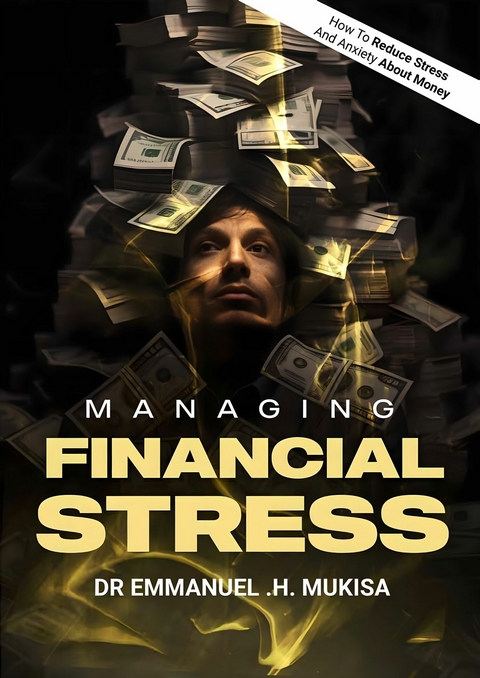
Managing Financial Stress (eBook)
155 Seiten
Publishdrive (Verlag)
978-0-00-109841-1 (ISBN)
Ease your money worries. Build a brighter future.
Managing financial stress provides actionable strategies to reduce financial anxiety, build resilience, and create lasting peace of mind. Learn to manage debt, save effectively, and develop habits that promote stability and confidence in your financial life.
Whether navigating unexpected expenses, improving your credit score, or simply seeking clarity, this guide equips you with the tools to conquer financial stress and enjoy a more secure, balanced life.
How Money Worries Affect Your Mental Health.
The level of financial stress becomes a common problem across the board. A sense of not having money instills anxiety, worries, and uncertainty within an individual's mind. This will create a self-sustaining circle; the financial burden increases under the stress, therefore reducing any opportunities to search for ways to get out from the burden. It beats a person up mentally and may depress or eventually put a person with anxiety.
Financial troubles are treated purely as a practical issue; the emotional repercussions are no less deep. Financial troubles are a fact of life, and the way one treats these finances is determined by the state of psychological well-being.
It may not only be related to having little or no money at all; it usually occurs around how an individual perceives the financial position in life and how particular stressors take over his existence. When bills, debt, and insecure jobs have taken their toll on people, their mental states can go down. Such constant stress may manifest in sleep disorders, mood swings, and inability to concentrate. Also, financial stress is manifested in a physical way: headaches, lethargicness, and heart problems. In turn, this may become self-reinforcing-the stress can actually be feeding the physical health problems.
Financial fears have a tendency to foster feelings of inadequacy. If one feels one's financial situation is out of control, then self-esteem and personal efficacy are lowered. Feelings of this nature make one not want to do anything, including taking positive steps such as getting help, for fear of worsening the situation. The chances of worsening it are debilitating for many. People consequently put off making decisions about finances, and it is these very decisions that contribute to escalating the problem. Feeling mired down in some sort of financial bog is extremely lonely.
Most people who complain about money problems also cite their feelings of shame and guilt. This is because financial success has been made to appear as the be-all of life in society, and failing at that can bring a lot of personal disappointment. This possible stigma may lead many into not talking openly about their problems and, therefore, making them suffer in silence. Sometimes, the fear of judgment might hold a person back from seeking help from either friends and family or professional resources. Shame deepens the mental problems that are associated with financial strain.
One needs to remember that financial strain is in no way a failure on a personal level with one's incompetence to fulfill their commitments.
The financial stress adds to more tension on the families' relationships and the partnership. It puts them in the battle, arguing with each other and loss of confidence against each other, gradually in emotional retreat due to too much tension in the air. Such an atmosphere is really very intolerable; it increases stress and belittles mental health. Quite often, the breakdown of communication happens under the toll of financial stress, and indeed, it does make working together toward solutions more challenging. Sometimes the tension of financial problems leads to collapses in the very relationship. Thus, financial stress is a problem not only for a person but also for the people around him.
Financial stress, of course, that is to be related to a job, is especially common in today's unstable labor market. Many people either feel job insecurity, fluctuating wages, or just the constant pressure to meet the expectations. Anxiety is multiplied when job strain comes along with the feeling of uncertainty about one's paycheck or benefits. Workers are usually found stuck between such jobs that they do not particularly enjoy, thus increasing their levels of stress further. This kind of stress inevitably leads to burnout: the person becomes physically and emotionally depleted. Long-term, job-related financial stress can erode a person's identity and self-respect.
It can be triggered even by financial stress and culminates in avoidance behavior of the individual who simply doesn't want to be confronted with anything pertaining to his or her personal finances. Among others, they avoid looking at bills, check their bank accounts or decide on resource allocation. Temporary alleviation is granted through avoidance indeed; however in a longer term, such approach contributes to rise in stress. Financial problems are overwhelming; therefore, avoidance may create an illusion of control. This behavior usually worsens the situation because no real solution is found. The first step to regaining control over finances involves admitting the problem exists.
If financial stressors continue for a long period of time, then chronic stress may occur. Anxiety disorders, major depression, and substance abuse are some of the long-term effects of chronic stress on mental health. Chronic unease may start to make persons feel under an endless siege, both psychological and physical. Inability to manage finances in a proper manner infuses a sort of continuing pressure. People feel that they could not get out of the load of stress. These can be long-lasting effects that make the vicious circle of financial stress hard to break.
Depression is among the most frequent psychological issues arising from stress due to monetary troubles. Where the problems appear impossible, there are feelings of hopelessness and despair. The general nature of depression means a depression in motivation or energy levels to apply oneself to the problem that faces the person. They are also less likely to be able to work or participate in social activities, further crippling their financial position. Matters are made worse by the fact that there is a lack of interest in seeking financial advice. Professional intervention is thus necessary in both mental health and financial matters.
There is little that can be said to deny the relationship between financial stress and physical health. It hits the body directly, and chronic financial stress results in serious health problems like hypertension, heart diseases, and digestive disorders. The financial pressure contributes to bad coping behaviors-smoking, overeating, and drinking-that worsen the physical health condition. Poor mental health quite often results in disrupted sleep, further affecting overall health. Unchecked financial stress will destroy the mind and the body. Holistic management of financial stress addresses the mental and physical sides of financial stress.
Among the strategies available for coping with financial stress are better financial literacy and realistic budgeting. There is generally something very empowering in having a clear sense of where one stands financially. Although intimidating at first, a budget is a great way to track precisely where money goes in order to reduce debt and provide a means to set realistic goals concerning money. The process of financial planning can reduce much of the mystery that feeds the majority of money anxieties. Indeed, a sense of control over one's finances can be a powerful diffuser of stress. Financial planners or counselors can also give clarity and directions.
One of the most important steps in managing financial stress is fostering open communication with loved ones. Sharing money worries with a supportive friend, partner, or family member can alleviate some of the emotional weight. Open conversations
It will help normalize the experience and let people feel that they are not alone in this. Sharing your concern with people opens either practical solutions or emotional support in the way. It helps to break that isolated, shameful feeling accompanying the happening of financial stresses. For some people, speaking about money is uncomfortable, while to others it is extremely therapeutic. The presence of a support system is another very important aspect for treading rough times.
Of note, too, is that therapy and counseling help mitigate the emotional impact caused by financial stress: how professionals can help in emotional resilience and ways of overcoming anxiety about money. Deep-rooted psychological problems may come forth, for example, those having to do with low self-esteem or traumatic experiences sometime in the past, which are causing financial stress. Perhaps it is here that CBT can be included as one of the methods of helping an individual change negative thoughts regarding money for healthier ones. It is a no-judgment area in which to explore financial stress. Such support then becomes priceless for those experiencing the psychological toll of their finances.
Financial stress also impacts work-life balance in that it has to be an exclusion of either maintaining personal relationships or taking part in self-care. In addition to all the hassles brought on by money problems, one may find less energy for giving to personal interests, family time, or social connections. Where there is further imbalance in such aspects, more feelings of burnout and frustration set in. Ultimately, general well-being is impaired since personal life and work have become unbalanced. These are actually naturally very huge and important in relation to mental health-the need to strike a balance in work and personal life. Drawing boundaries and finding time for either relaxation or time for hobbies can help restore some sense of normalcy.
The other essential ingredient for self-compassion, along with dealing with the emotional load of financial burden, is that so many people really beat themselves up over money mistakes or circumstances beyond their control. Self-compassion is treating oneself with kindness, knowing that everybody has struggles and not taking financial hardships as personal failures. A person will possibly feel less...
| Erscheint lt. Verlag | 28.10.2025 |
|---|---|
| Sprache | englisch |
| Themenwelt | Sachbuch/Ratgeber ► Beruf / Finanzen / Recht / Wirtschaft ► Geld / Bank / Börse |
| ISBN-10 | 0-00-109841-1 / 0001098411 |
| ISBN-13 | 978-0-00-109841-1 / 9780001098411 |
| Informationen gemäß Produktsicherheitsverordnung (GPSR) | |
| Haben Sie eine Frage zum Produkt? |
 EPUB (Adobe DRM)
Größe: 1,3 MB
Kopierschutz: Adobe-DRM
Adobe-DRM ist ein Kopierschutz, der das eBook vor Mißbrauch schützen soll. Dabei wird das eBook bereits beim Download auf Ihre persönliche Adobe-ID autorisiert. Lesen können Sie das eBook dann nur auf den Geräten, welche ebenfalls auf Ihre Adobe-ID registriert sind.
Details zum Adobe-DRM
Dateiformat: EPUB (Electronic Publication)
EPUB ist ein offener Standard für eBooks und eignet sich besonders zur Darstellung von Belletristik und Sachbüchern. Der Fließtext wird dynamisch an die Display- und Schriftgröße angepasst. Auch für mobile Lesegeräte ist EPUB daher gut geeignet.
Systemvoraussetzungen:
PC/Mac: Mit einem PC oder Mac können Sie dieses eBook lesen. Sie benötigen eine
eReader: Dieses eBook kann mit (fast) allen eBook-Readern gelesen werden. Mit dem amazon-Kindle ist es aber nicht kompatibel.
Smartphone/Tablet: Egal ob Apple oder Android, dieses eBook können Sie lesen. Sie benötigen eine
Geräteliste und zusätzliche Hinweise
Buying eBooks from abroad
For tax law reasons we can sell eBooks just within Germany and Switzerland. Regrettably we cannot fulfill eBook-orders from other countries.
aus dem Bereich