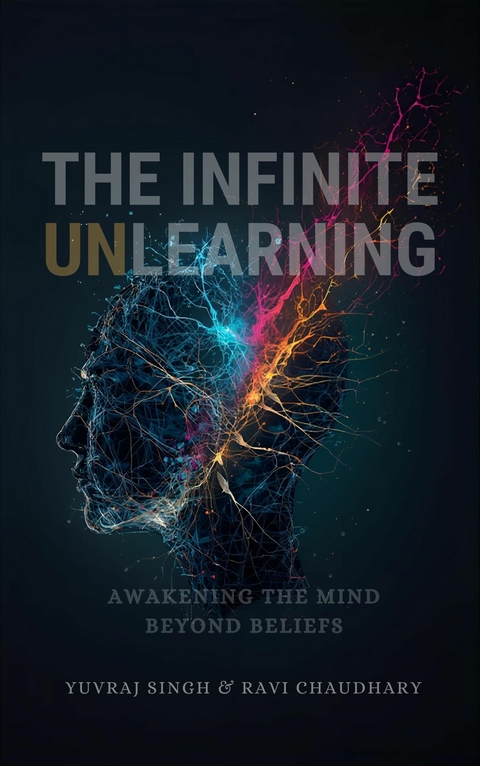
The Infinite Unlearning (eBook)
216 Seiten
Publishdrive (Verlag)
978-0-00-109511-3 (ISBN)
What if everything you 'know' is only the beginning of seeing what truly is?
The Infinite Unlearning: Awakening the Mind Beyond Beliefs is a journey into awareness - a quiet rebellion against the noise of borrowed knowledge, rigid beliefs, and conditioned thinking. It doesn't teach you what to think; it helps you see how thinking itself shapes your world.
Through nine transformative chapters, the book explores how education, culture, and self-image imprison the mind - and how awareness can set it free. It invites readers to unlearn the comfort of certainty, to question fearlessly, and to rediscover life beyond the boundaries of belief.
Written in a deeply human and reflective tone, The Infinite Unlearning blends philosophy with clarity, intellect with emotion, and questioning with peace. It speaks to the seeker, the dreamer, and the one quietly asking, 'Is there more to life than what I've been told?'
This is not a book of answers - it's an awakening. A call to return to the simplicity of being, where silence teaches more than words ever could.
Chapter 1:
The Illusion of Knowing
What if what you call ‘knowing’ is merely remembering?
What if the certainty you cling to is the very veil that hides truth?
Have you ever wondered whether what you “see” is simply what you’ve been taught to see?
We live in a world that worships knowledge. From the moment we learn to speak, we are told that to know is to be powerful, that to gather facts is to be wise, and that education is the lamp that leads us out of ignorance. Yet, beneath this glittering promise lies a quiet tragedy — we begin to mistake information for understanding and memory for wisdom. We wear our degrees like armor, our opinions like crowns, and our experiences like shields — but seldom do we ask, what if all this knowing has only deepened our blindness?
There is a story — not one written in scriptures, but in the silence of human life — of a man who spent his whole life in a dark cave. He knew the walls by heart, could name every echo, every stone, every shadow that danced upon its surface. He was proud of his mastery. Then one day, a crack appeared in the rock, and through it spilled a single beam of light. It was unbearable — sharp, disorienting, almost painful. For the first time, he realized how little he had truly seen. His “knowledge” had been nothing but shapes cast by the dark.
We are that man. Our minds are caves carved by years of conditioning, filled with the faint light of borrowed understanding. We move about confidently, quoting books, repeating theories, defending beliefs — yet few of these things are born of direct seeing. We know because someone told us; we believe because it comforts us; we agree because it feels safe. In that comfort, we call ourselves enlightened, not realizing that the comfort itself is the darkness.
Modern education, for all its sophistication, rarely teaches us to question the nature of knowing itself. It teaches us what to think, not how to see. We are handed explanations before we even encounter the mystery. The child who once wondered why the sky was blue is soon told the scientific formula — but in that instant, the wonder dies. Knowledge, when absorbed without inquiry, becomes a subtle prison. It gives us conclusions without exploration, answers without intimacy.
The illusion of knowing is not merely ignorance — it is worse. It is the arrogance of thinking one sees when the eyes are still closed. It is the comfort of believing the map is the territory, the word is the thing, the image is the truth. Our mind, in its desperate attempt to make sense of existence, builds walls of explanation — and then forgets that walls also confine.
True knowing — if such a thing can be called knowing at all — is born only in direct awareness, not in accumulation. But the mind resists this because it thrives on certainty. Certainty gives it shape, meaning, identity. To say “I don’t know” feels like death to the self-image we’ve constructed — the scholar, the intellectual, the believer, the expert. Yet that humble admission is the beginning of freedom.
There is a strange paradox: the more we fill ourselves with facts, the less space remains for truth. Truth requires emptiness — a stillness in which perception is not filtered through the lens of past conclusions. The mind that “knows” is already interpreting; the mind that sees is silent.
Walk into any room of debate, and you’ll notice — no one is listening. Each person waits for their turn to speak, eager to defend their knowledge, their beliefs, their correctness. The exchange is not for discovery but for victory. This is the disease of the modern intellect: conversation has replaced contemplation; argument has replaced awareness. We are clever, informed, articulate — yet inwardly fragmented, restless, and unseeing.
Knowing gives us an illusion of control. We name things so that we may feel safe among them — as though naming a storm could protect us from its force. We dissect love, define happiness, categorize sorrow — and by doing so, we strip them of their living mystery. What we call “understanding” is often an act of violence against wonder. We cage life in language and then wonder why it no longer sings.
To unlearn is to step out of the cave — to walk beyond the walls of certainty into the unbearable brightness of the unknown. But it is not easy. The light hurts. The darkness was familiar, after all; it gave us identity and direction. To admit we do not know is to lose the self that was built upon knowing. Yet only in that loss do we begin to see.
The world does not lack information; it lacks insight. We have multiplied our data, our books, our screens — yet the human heart remains untouched by this flood. We can explain galaxies but not our own loneliness, cure diseases but not our inner emptiness. The mind, proud of its conquests, stands baffled before the simplest question: Who am I?
Perhaps this is the great irony of our age — the more we know, the less we understand. For understanding is not born of accumulation, but of attention. The mind that ceases to chase knowledge for identity begins to perceive without distortion.
And maybe, when we finally let go of all our certainties, we will find that the universe was never hidden — only our eyes were closed.
Certainty is the most delicate narcotic the mind ever created. It quiets fear, soothes confusion, and offers the illusion that life has been mastered. The human spirit, born amidst mystery, cannot tolerate ambiguity for long; it rushes to construct meaning, to bind the infinite into language. In doing so, it trades the boundless sky for a well-decorated cage.
From childhood, we are told that knowledge is safety. A child who hesitates is corrected; a student who questions the textbook too deeply is redirected; a professional who doubts the established model is seen as disruptive. Thus begins a lifelong conditioning: that to know is to survive, and to not know is to fail. Yet, beneath that conditioning lies the quiet tragedy of our age — we become experts in answers and strangers to wonder.
Certainty is comfortable precisely because it stops movement. The mind, once convinced it has arrived, no longer explores. A settled belief gives structure to chaos, a narrative to uncertainty. It feels solid, reliable, almost holy. But if you look closely, the solidity is an illusion. It is like standing on ice that has frozen over a river — the surface appears firm, but beneath it flows an unstoppable current of change. The ice will crack sooner or later, and the current will reveal that our certainty was only temporary convenience.
Societies, too, are built on this fragile comfort. Religions promise eternal truths; nations invent heroic myths; ideologies declare themselves the final answer to human suffering. People gather under these banners, not because they understand them, but because belonging feels safer than questioning. Within the warmth of shared belief, the fear of uncertainty disappears — at least for a while. But the price of belonging is heavy: we surrender the freedom to see differently.
The mind clings to certainty because it confuses stability with meaning. When everything is questioned, the self trembles — for the self itself is woven out of what it believes. Take away its convictions, and it begins to dissolve. That is why conversations about truth so often turn into conflicts. It is not truth that people defend; it is identity. The believer and the skeptic, the patriot and the rebel, the traditionalist and the reformer — all are bound by the same thread: a desperate need for certainty to preserve who they think they are.
Yet, when certainty becomes absolute, life begins to die within us. A mind that refuses to doubt becomes rigid, unable to learn. It sees what it expects to see, and nothing more. The artist stops creating, the scientist stops discovering, the seeker stops seeking. In that rigidity, truth — which is ever-living, ever-changing — slips quietly away.
The comfort of certainty also manifests in subtle personal ways. We form opinions about people and never revisit them. We interpret past events and call it “understanding.” We construct tidy stories about love, failure, destiny, God — and then live inside those stories as if they were the entire sky. Rarely do we pause to ask whether our narratives are still true. Instead, we polish them with time, protecting them from contradiction. The longer we hold them, the more sacred they become.
But life, indifferent to our certainties, keeps changing. What we once called failure becomes the seed of growth; what we once feared becomes our teacher. If we cling too tightly to the conclusions of yesterday, we miss the revelations of today. Every insight has a lifespan; wisdom begins when we allow it to die naturally and make room for new seeing.
To live without the comfort of certainty is not to drift aimlessly. It is to walk awake, aware that every conclusion is provisional, every belief a hypothesis. It is to treat knowledge as a bridge, not a destination. The open mind is not empty; it is alive — responsive, sensitive, capable of renewal.
The ancient sages spoke of this state not as ignorance, but as innocence. The innocent mind does not claim to know; it simply perceives. It meets life without preconception, like a clear mirror reflecting what is. Such a mind is not restless for explanation, for it recognizes that understanding grows naturally from direct contact, not from accumulated opinion.
Modern civilization,...
| Erscheint lt. Verlag | 7.11.2025 |
|---|---|
| Sprache | englisch |
| Themenwelt | Sachbuch/Ratgeber ► Gesundheit / Leben / Psychologie ► Lebenshilfe / Lebensführung |
| ISBN-10 | 0-00-109511-0 / 0001095110 |
| ISBN-13 | 978-0-00-109511-3 / 9780001095113 |
| Informationen gemäß Produktsicherheitsverordnung (GPSR) | |
| Haben Sie eine Frage zum Produkt? |
 EPUB (Adobe DRM)
Größe: 860 KB
Kopierschutz: Adobe-DRM
Adobe-DRM ist ein Kopierschutz, der das eBook vor Mißbrauch schützen soll. Dabei wird das eBook bereits beim Download auf Ihre persönliche Adobe-ID autorisiert. Lesen können Sie das eBook dann nur auf den Geräten, welche ebenfalls auf Ihre Adobe-ID registriert sind.
Details zum Adobe-DRM
Dateiformat: EPUB (Electronic Publication)
EPUB ist ein offener Standard für eBooks und eignet sich besonders zur Darstellung von Belletristik und Sachbüchern. Der Fließtext wird dynamisch an die Display- und Schriftgröße angepasst. Auch für mobile Lesegeräte ist EPUB daher gut geeignet.
Systemvoraussetzungen:
PC/Mac: Mit einem PC oder Mac können Sie dieses eBook lesen. Sie benötigen eine
eReader: Dieses eBook kann mit (fast) allen eBook-Readern gelesen werden. Mit dem amazon-Kindle ist es aber nicht kompatibel.
Smartphone/Tablet: Egal ob Apple oder Android, dieses eBook können Sie lesen. Sie benötigen eine
Geräteliste und zusätzliche Hinweise
Buying eBooks from abroad
For tax law reasons we can sell eBooks just within Germany and Switzerland. Regrettably we cannot fulfill eBook-orders from other countries.
aus dem Bereich