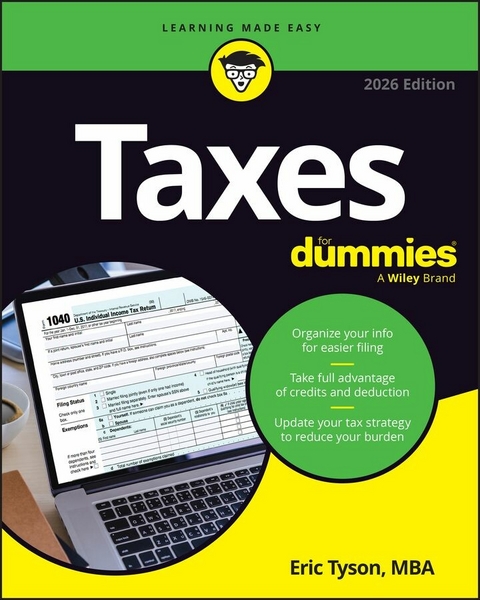
Taxes For Dummies, 2026 Edition (eBook)
995 Seiten
For Dummies (Verlag)
978-1-394-35052-0 (ISBN)
Give Uncle Sam what he's legally owed-and not a penny more!-with this trusted guide to your US taxes
Taxes For Dummies: 2026 Edition is your personal antidote to the confusing and frustrating chaos of the United States tax system. It's a straightforward and expert walkthrough of how to file your tax return while maximizing every last deduction and credit that you're legally entitled to. You'll minimize your tax bill using the clear insights and explanations contained within as the authors guide you through every step of the tax return process.
From determining what kind of taxpayer you are to identifying deductible expenses, determining your eligibility for credits, and responding to an IRS audit, Taxes For Dummies, 2026 Edition covers the issues and situations you're likely to encounter as a United States taxpayer. You'll also find:
- Step-by-step instructions on how to fill out tax forms and schedules
- Strategies for year-round tax planning so you're not swamped or overwhelmed come tax season
- Techniques and best practices for selecting and working with a tax advisor
Perfect for all US taxpayers seeking a better understanding of the US tax filing system, Taxes For Dummies: 2026 Edition will help you save money and time on your income tax return this year.
Eric Tyson, MBA is a nationally recognized personal finance writer, counselor, and educator. He's the author of Personal Finance For Dummies, Investing For Dummies, and Small Business For Dummies.
Chris Eck, CPA, is a highly skilled and dedicated financial professional with over 18 years of experience in the field. With a strong foundation in accounting principles, tax law, and financial regulations, he has become a trusted advisor to many businesses and individuals seeking to optimize their finances.
Chapter 1
Understanding the U.S. Tax System
IN THIS CHAPTER
Making sense of the U.S. tax system
Figuring out your income tax rate
Checking out recent tax laws and possible changes
Most people — including your humble authors — find taxes to be tedious. First, everyone faces the chore of gathering various complicated-looking documents to complete the annual ritual of filling out IRS Form 1040 and whatever form your state may require.
You may need to become acquainted with some forms that are new to you. Perhaps you need to figure out how to submit a quarterly tax payment when you no longer work for a company and now receive self-employment income from independent contract work. Maybe you sold some investments (such as stocks, mutual funds, or real estate) at a profit (or loss), and you must calculate how much tax you owe (or loss you can write off).
Unfortunately, too many people think of taxes only in spring, when it comes time to file that dreadful annual return. Throughout this book, you can find all sorts of tips, suggestions, and warnings that help you discover the important role that your taxes play in your entire personal financial situation year-round. In fact, we devote Part 5 of the book to showing you how to accomplish important financial goals while legally reducing your taxes.
We hope that you include our book as an understandable resource you can count on. Taxes 2026 For Dummies helps you discover how the tax system works and how to legally make the system work for you. You’ll quite possibly be bothered by some of the things this book shows you that don’t seem fair. But getting angry enough to make the veins in your neck bulge definitely won’t help your financial situation or your blood pressure. (We don’t want to see your medical deductions increase!) Even if you don’t agree with the entire tax system, you still have to play by the rules.
Figuring Out the U.S. Tax System
Whenever money passes through your hands, it seems that you pay some kind of tax. Consider the following:
- When you work and get paid, you pay federal, state, and local taxes (on top of having to deal with the migraines your bosses and difficult customers give you).
- After paying taxes on your earnings and then spending money on things you need and want (and paying more taxes in the process), you may have some money left over for investing. Guess what? Your reward for being a saver is that you also pay tax on some of the investment returns on your savings.
You’ll pay more in taxes than you need to if you don’t understand the tax system. Unfortunately, when you try to read and make sense of the tax laws, you quickly realize that you’re more likely to win the lottery than figure out some parts of the tax code! That’s one of the reasons that tax attorneys and accountants are paid so much — to compensate them for their intense and prolonged agony of deciphering the tax code!
But here’s a little secret to make you feel much better: You don’t need to read the dreadful tax laws. Most tax advisors don’t read them themselves. Instead, they rely upon summaries prepared by organizations and people who have more of a knack for explaining things clearly and concisely than the IRS does. Wolters Kluwer has compiled a Federal Tax Reporter publication that details and explains all federal tax laws. This publication now has in excess of 80,000 pages!
A BRIEF HISTORY OF U.S. INCOME TAXES
Federal income taxes haven’t always been a certainty. In the early 20th century, people lived without being bothered by the federal income tax — or by televisions, microwaves, computers, smartphones, and all those other complications. Beginning in 1913, Congress set up a system of graduated tax rates, starting with a rate of only 1 percent and going up to 7 percent.
This tax system was enacted through the 16th Amendment to the Constitution, which was suggested by President Teddy Roosevelt, pushed through by his successor (President William H. Taft), and ultimately ratified by two-thirds of the states.
In fairness, we must tell you that the 1913 federal income tax wasn’t the first U.S. income tax. President Abraham Lincoln instituted a Civil War income tax in 1861, which was abandoned a decade later.
Prior to 1913, the vast majority of tax dollars collected by the federal government came from taxes levied on goods, such as liquor, tobacco, and imports. Today, personal income taxes, including Social Security taxes, account for about 85 percent of federal government revenue.
Even if your financial life is stagnant, recent tax law changes may require you to complete some new forms and calculations. And, if you’re like most people, you’re currently missing out on some legal tax reduction tactics.
You can reduce your taxes
The tax system is built around incentives to encourage desirable behavior and activity. Home ownership, for example, is considered good because it encourages people to take more responsibility for maintaining properties and neighborhoods. Therefore, the government offers numerous tax benefits (allowable deductions) to encourage people to own homes (see Chapter 25). But if you don’t understand these tax benefits, you probably don’t know how to take full advantage of them, either.
Like millions of taxpayers before you, you can unwittingly be in noncompliance with the ever-changing tax laws at the federal, state, and local levels. Your tax ignorance can cause mistakes that may be costly if the IRS and your state government catch your errors. With the proliferation of computerized data tracking, discovering errors has never been easier for the tax cops at the IRS. And when they uncover your boo-boos, you have to pay the tax you originally owed, interest, and possibly penalties. Ouch!
So don’t feel dumb when it comes to understanding the tax system. You’re not the problem — the complexity of the income tax system is. Making sense of the tax jungle is more daunting than hacking your way out of a triple-canopy rain forest with a dinner knife. That’s why, throughout this book, we help you understand the tax system, and we promise not to make you read the actual tax laws.
You should be able to keep much more of your money by applying the tax-reducing strategies we present in this book. Here are some things to consider:
- You may be able to tax-shelter your employment earnings into various retirement accounts such as 401(k) and SEP-IRA plans. This strategy slashes your current income taxes, enables your money to grow tax-free, and helps you save toward the goal of retirement.
- The less you buy, the less sales tax you pay. You can buy a less costly, more fuel-efficient car, for example. (You’ll spend less on gasoline, including gasoline taxes, as well.)
- When you invest, you can invest in a way that fits your tax situation. This strategy can make you happier and wealthier come tax time. For example, you can choose tax-friendly investments (such as tax-free bonds) that reduce your tax bill and increase your after-tax investment returns.
Beyond April 15: What you don’t know can cost you
Every spring, more than 100 million tax returns (and several million extension requests) are filed with the IRS. The byproduct of this effort is guaranteed employment for the nation’s more than 1 million accountants and auditors and 2 million bookkeeping and accounting clerks (not to mention more than a few tax-book authors and their editors). Accounting firms rake in tens of billions of dollars annually, helping bewildered and desperately confused taxpayers figure out and comply with all those tax laws. So that you can feel okay about this situation, keep in mind that at least some of the money you pay in income taxes actually winds up in the government coffers for some useful purposes.
Given all the hours that you work each year just to pay your taxes and the time you spend actually completing the dreaded return, on April 16, you may feel like ignoring the whole tax topic until next year. Such avoidance, however, is a costly mistake.
During the tax year, you can take steps to ensure not only that you’re in compliance with the ever-changing tax laws, but also that you’re minimizing your tax burden. If your income — like that of nearly everyone we know — is limited, you need to understand the tax code to make it work for you and help you accomplish your financial goals. The following case studies demonstrate the importance of keeping in mind the tax implications of your financial decisions throughout the year.
The costs of procrastination
Consider the case of Sheila and Peter, the proud owners of a successful and rapidly growing small business. They became so busy running the business and taking care of their children that they hardly had time to call a tax advisor. In fact, not only did they fail to file for an extension by April 15, but they also didn’t pay any federal or state income taxes.
By August, Peter and Sheila finally had time to focus on the prior year’s income taxes, but by then they had gotten themselves into some problems and incurred these costs:
- A penalty for failure to file, which is 5 percent per month of the amount due, up to a maximum of 25 percent (for five months).
- Interest on the amount...
| Erscheint lt. Verlag | 7.11.2025 |
|---|---|
| Sprache | englisch |
| Themenwelt | Sachbuch/Ratgeber ► Beruf / Finanzen / Recht / Wirtschaft ► Geld / Bank / Börse |
| Schlagworte | 2025 taxes • 2026 taxes • how do I pay less tax? • legal us tax credits • legal us tax deductions • us income tax credits • us income tax deductions • us income tax guide • Us income tax help • us tax advice • us tax audits • us tax forms • us tax returns • us tax schedules |
| ISBN-10 | 1-394-35052-X / 139435052X |
| ISBN-13 | 978-1-394-35052-0 / 9781394350520 |
| Informationen gemäß Produktsicherheitsverordnung (GPSR) | |
| Haben Sie eine Frage zum Produkt? |
 EPUB (Adobe DRM)
Kopierschutz: Adobe-DRM
Adobe-DRM ist ein Kopierschutz, der das eBook vor Mißbrauch schützen soll. Dabei wird das eBook bereits beim Download auf Ihre persönliche Adobe-ID autorisiert. Lesen können Sie das eBook dann nur auf den Geräten, welche ebenfalls auf Ihre Adobe-ID registriert sind.
Details zum Adobe-DRM
Dateiformat: EPUB (Electronic Publication)
EPUB ist ein offener Standard für eBooks und eignet sich besonders zur Darstellung von Belletristik und Sachbüchern. Der Fließtext wird dynamisch an die Display- und Schriftgröße angepasst. Auch für mobile Lesegeräte ist EPUB daher gut geeignet.
Systemvoraussetzungen:
PC/Mac: Mit einem PC oder Mac können Sie dieses eBook lesen. Sie benötigen eine
eReader: Dieses eBook kann mit (fast) allen eBook-Readern gelesen werden. Mit dem amazon-Kindle ist es aber nicht kompatibel.
Smartphone/Tablet: Egal ob Apple oder Android, dieses eBook können Sie lesen. Sie benötigen eine
Geräteliste und zusätzliche Hinweise
Buying eBooks from abroad
For tax law reasons we can sell eBooks just within Germany and Switzerland. Regrettably we cannot fulfill eBook-orders from other countries.
aus dem Bereich