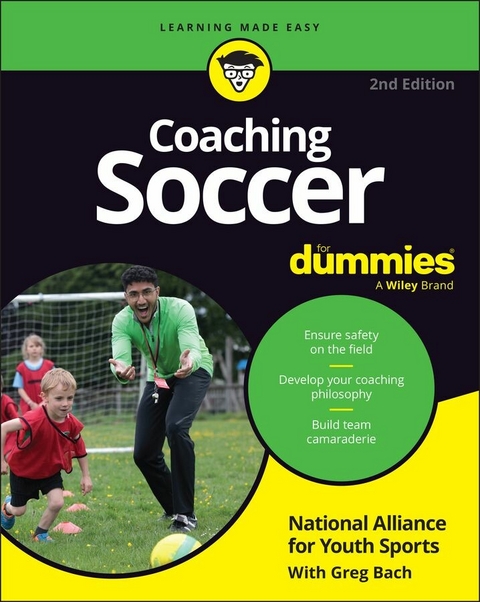
Coaching Soccer For Dummies (eBook)
555 Seiten
For Dummies (Verlag)
978-1-394-37026-9 (ISBN)
Become an unforgettable soccer coach for kids of any age, with this complete guide
Coaching Soccer For Dummies is a quick and easy reference guide for anyone who wants to start coaching youth soccer-or start coaching better. Help kids 5 and older to improve their skills, work together, and have fun, no matter their experience level. You'll get a refresher on the rules of soccer, with tips on how to teach them to different age groups. Plus, you'll find drills and dynamic exercises you can use to improve the outcomes of your practice sessions. The title 'Coach' comes with the responsibility to help players stay motivated and safe, all while building a respectful team culture and supporting kids' mental health. With Coaching Soccer For Dummies it's simple to do all that-and to develop a coaching philosophy that will help you give young players the support they need.
- Learn drills and techniques for teaching soccer skills to kids of all ages
- Get a complete rundown on safety, including proper form for injury prevention
- Establish a positive team culture, prevent bullying, and keep players motivated
- Communicate effectively with parents and other coaches
This book is the perfect choice for beginner or novice youth soccer coaches who are seeking guidance to help improve and develop their coaching skills.
The National Alliance for Youth Sports (NAYS) educates, equips, and empowers youth sports leaders, program administrators, volunteer coaches, and parents through a variety of trainings, programs, and resources so all children can enjoy the lifelong benefits of sports.
Greg Bach is the Senior Director of Communication & Content for NAYS.
Chapter 1
Teaching Soccer to Children
IN THIS CHAPTER
Preparing to coach
Planning for your practices and games
Coaching your own child
Congratulations on your decision to coach a youth soccer team this season. You’re embarking on a wonderful journey that can be filled with many special moments that both you and your players — regardless of their age or skill level — will savor and remember for the rest of your lives.
Before you step on the field, you need to be aware that you’re taking on a very important role: Ensure that the season is memorable for all the right reasons. How you manage the youngsters on your team and the way you interact with them during practices and games affect how they feel about the sport and even themselves for years to come. How you handle the lengthy list of responsibilities that comes with the job either helps them develop an unquenchable passion for the game or drains their interest in ever participating again.
All you need — besides a bunch of soccer balls and endless enthusiasm — is some good information to guide you through the season. In this chapter, you find useful, straightforward insight and tips to help you and your team have a safe, fun, and rewarding season.
It's All About the Kids — Always!
Coaching a youth soccer team is all about meeting the needs of all the players all season long, but that’s a lot trickier than it sounds. You may not have considered lots of factors that can wiggle their way into a season and be disruptive and even destructive. Being aware of the biggies is key so you can prep to prevent them from sabotaging your season.
For starters, you’ve got to ditch your ego (we all have them!). This season is not about you, how knowledgeable you may be about the sport, how great of a soccer player or all-round athlete you were, what a savvy soccer strategist you consider yourself to be, or how many wins you can lead your team to this season. While you naturally want to look good in front of the parents, it’s important to keep in mind that your team’s won–loss record is not a reflection of your coaching acumen.
The best barometer of your coaching skills and impact is whether the kids on your team learn and develop soccer skills and either want to play again next season or bail on the sport. (And when they are clamoring to play for you again, that’s the biggest win of all!)
But once the scoreboards are turned on, and there’s that game day buzz of excitement swirling in the air, remembering who the season is all about can get murky. (In Chapter 4, we share all-important information on crafting a kid-first coaching philosophy — and sticking to it.)
Doing Your Homework
Whether you volunteered to coach youth soccer this season because you want to spend more time with your child or because the league has a shortage of coaches and you’re willing to step forward, you’re accepting a massive responsibility that you can’t take lightly. Before you roll out the soccer balls at your first practice, you have plenty of work to do behind the scenes to ensure that the season gets off to a smooth start and stays on course.
Working with — and not against — parents
The overwhelming majority of parents with children involved in organized youth soccer programs are a supportive and caring group who want only the best for their children. Of course, parents in the minority can turn out to be a source of season-long aggravation that you may be forced to deal with. You can head off many potential problems by gathering the parents together before the season begins and laying the ground rules on your expectations for behavior during games, how they can best support their child and the entire team, and how some can even assist you in helping provide a fun-filled and productive season for everyone.
Coaches and parents finding ways to work together — the adult form of teamwork — is a formula that produces tremendous benefits for the youngsters. Coaches and parents who clash over everything from playing time to why Junior isn’t getting to be the goalkeeper spoil the experience for that child and quite possibly others as well. Kids sense tension and turmoil among adults, and when negativity seeps into the team’s practice sessions or envelops game day, fun is squashed and interest in continuing with the sport dwindles.
With parents, keep the following in mind:
- Be proactive with them. Outlining your expectations and coaching methods before the season paints a clear picture to parents about how you plan to handle the season. When parents hear firsthand that you’re a processed-based coach committed to skill development over winning (we go more in-depth on that in Chapter 4) and that you adhere to the league’s equal-playing-time rule, you leave no room for petty squabbles over how much playing time their children receive. Playing time is the No. 1 headache maker for youth coaches and if you don’t jump out in front of this before the season starts and clarify your approach for parents, you’re asking for a heap of trouble — and you’ll get it, too. In Chapter 2, we help you develop your coaching philosophy and become familiar with your league so that you can clearly communicate these points to the parents.
- Involve them. Parents invest a lot of time and money in their child’s soccer experience, and being included (instead of simply watching practice from the car or dropping their youngster off and then running errands) makes it far more worthwhile to them and their children. Parents can do more than bring treats after the game, too. Find ways to involve them at your practices and recruit the right ones to assist you on game day; doing so helps you turn the season into a rewarding one for everyone involved. Throughout the book, you can find tips on boosting parental involvement, from practice drills that have team parents sticking around (see Chapter 6) to working with parents at higher levels of play.
-
Communicate with them. Besides a preseason parents’ meeting (which you can read all about in Chapter 4), keep the communication lines open all season long. Talk to the parents about the kids’ progress; share your thoughts on where they really make improvements; offer suggestions for things they can do to help their youngsters develop in other areas; and check in from time to time to find out whether their children are having fun playing for you. You can even send a short weekly email with a rundown of what skills you will be focusing on in practice that week to help keep parents in the loop.
Sharing honest feedback is a two-way street: While you’re speaking openly and honestly about their child, be willing to listen to what parents have to say about your coaching and the impact you’re having on their child. Perhaps during your parental conversations you can pick up some valuable nuggets on areas you can focus on to have a greater impact with specific children. Including parents in all facets of the season is the right thing to do and the smart thing to ensure that their children have positive experiences. In fact, we suggest that you meet 1-on-1 with each parent as part of your midseason progress review (see Chapter 8).
Suggest to parents that they abide by a 24-hour rule. If something upsets them at practice or in a game, encourage them to wait until the following day to address the issue with you. This waiting period helps calm the emotions of the moment and usually leads to more productive conversations.
Despite your best efforts, problems may arise with parents. Our advice is to remain calm and in control of your emotions and never allow situations to escalate. Check out Chapter 19, where we help you troubleshoot this issue and other problems coaches are most likely to face throughout the season.
Deciphering rules and mastering terminology
You’ve taken the job of teaching kids the world’s most popular sport, but perhaps you never played organized soccer growing up. Therefore, to fulfill your responsibilities, you have to get a good handle on the basics of the game and be able to explain rules, introduce terminology, and teach strategies to your young players. Sound complicated? It isn’t; it just takes a little time and effort on your part to learn some of the quirky rules (like offside) and some of the terms (like corner kicks and indirect free kicks) that are at the heart of this great game. We open up the rulebook in Chapter 3 and cover all the terms that you need to know. And we concentrate on the skills, techniques, and strategies that you need to pass along to your kids throughout Parts 2 and 3 of this book. Whether you need to brush up on fundamental skills for a beginning team or work out a defensive formation when you play against that high-octane older squad, we have you covered.
One of the most important steps you can take is to find out what special rules your league operates under. Quite often, the rules that leagues utilize vary depending on the age and experience level of the players. Everything from the size of the field, to the number of players on it, to which rules are enforced changes from community to community. Knowing these rules — and sharing them with your players (and parents, too!) — makes a tremendous difference in...
| Erscheint lt. Verlag | 6.11.2025 |
|---|---|
| Sprache | englisch |
| Themenwelt | Sachbuch/Ratgeber ► Sport |
| Schlagworte | coaching girls soccer • coaching kids soccer • coaching soccer guide • Coaching youth soccer • kids soccer exercises • practice drills soccer • soccer coach book • Soccer Coaching • Soccer coaching books • Soccer Drills • soccer plays • Soccer Training |
| ISBN-10 | 1-394-37026-1 / 1394370261 |
| ISBN-13 | 978-1-394-37026-9 / 9781394370269 |
| Informationen gemäß Produktsicherheitsverordnung (GPSR) | |
| Haben Sie eine Frage zum Produkt? |
 EPUB (Adobe DRM)
Kopierschutz: Adobe-DRM
Adobe-DRM ist ein Kopierschutz, der das eBook vor Mißbrauch schützen soll. Dabei wird das eBook bereits beim Download auf Ihre persönliche Adobe-ID autorisiert. Lesen können Sie das eBook dann nur auf den Geräten, welche ebenfalls auf Ihre Adobe-ID registriert sind.
Details zum Adobe-DRM
Dateiformat: EPUB (Electronic Publication)
EPUB ist ein offener Standard für eBooks und eignet sich besonders zur Darstellung von Belletristik und Sachbüchern. Der Fließtext wird dynamisch an die Display- und Schriftgröße angepasst. Auch für mobile Lesegeräte ist EPUB daher gut geeignet.
Systemvoraussetzungen:
PC/Mac: Mit einem PC oder Mac können Sie dieses eBook lesen. Sie benötigen eine
eReader: Dieses eBook kann mit (fast) allen eBook-Readern gelesen werden. Mit dem amazon-Kindle ist es aber nicht kompatibel.
Smartphone/Tablet: Egal ob Apple oder Android, dieses eBook können Sie lesen. Sie benötigen eine
Geräteliste und zusätzliche Hinweise
Buying eBooks from abroad
For tax law reasons we can sell eBooks just within Germany and Switzerland. Regrettably we cannot fulfill eBook-orders from other countries.
aus dem Bereich