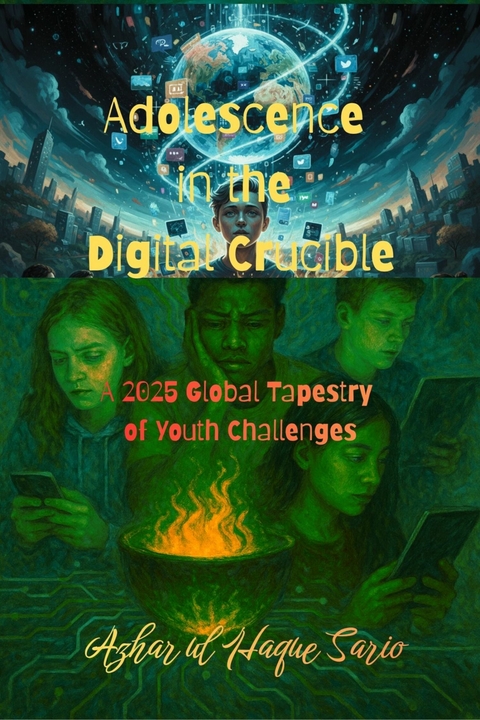
Adolescence in the Digital Crucible (eBook)
186 Seiten
Azhar Sario Hungary (Verlag)
978-3-384-74819-5 (ISBN)
Hey, ever wondered what it's really like to be a teen in 2025 across the globe?
This book dives into the wild world of adolescence today. It covers theoretical foundations first. Think Erikson's identity theories updated for social media in the US. Then Japan's peer pressures in a collectivist society. Nigeria's family role in financial smarts. It moves to real-life case studies. South Korea's intense education fever and mental health toll. UK's social media shifting friendships and cyberbullying. Brazil's casual dating culture clashing with inequality. Germany's vocational training versus disconnected youth. China's AI in schools and social credit myths. South Africa's youth activism amid unemployment. Australia's eco-anxiety and crypto trends. Egypt's jobless grads delaying marriage. Russia's patriotic education push. India's edtech boom bridging rural-urban gaps. Mexico's unseen rural kids facing violence. Indonesia's fintech adoption with cultural clashes. Each chapter spotlights a country. It uses data from 2025 reports. It includes stats on mental health, economy, relationships. There's a big comparative table at the end. It proposes new research agendas too.
What sets this book apart is its global tapestry approach. Other books stick to one region or theme, like just US teen mental health or European education. This one weaves 15 countries together, showing how digital trends hit differently in diverse cultures. It highlights under-researched spots, like Mexico's indigenous youth or Indonesia's dating norms versus apps. No fluff-it's packed with fresh 2025 insights from UNICEF, OECD, and more. While competitors recycle old data, this delivers a forward-looking edge with hybrid modernity frameworks and calls for youth-centered studies. It's your go-to for understanding interconnected challenges others overlook.
This author has no affiliation with any board and it is independently produced under nominative fair use.
Part II: Practical Applications and Manifestations
Education Under Pressure: Academic Stress and the AI Revolution (Case Study: South Korea)
4.1 The "Education Fever": Hyper-Competition from Preschool to University Entrance Exams
In South Korea, education is not merely a path to knowledge; it is the arena for the single most important battle of a young person's life. This phenomenon, known as gyoyukyeol (교육열), or "education fever," describes a society-wide obsession with academic achievement as the primary determinant of social status, career prospects, and even future marital eligibility. This fever is not a recent trend. It is deeply embedded in the national psyche, a legacy of Confucian values that prized scholarly merit, combined with a post-war development model that used a highly educated workforce to build a global economic powerhouse from ashes. The result is a system of hyper-competition that begins long before a child can even properly read.
The relentless pursuit of elite status begins in preschool, which has transformed from a place of play into the first preparatory stage for university. The competition is so fierce that trends like the "7-year-old exam" and even the "4-year-old exam" have emerged, particularly in affluent districts of Seoul like Gangnam. These are not school tests, but entrance exams for other private academies, such as exclusive English-language kindergartens, which are seen as the first stepping stone onto the elite track. Recent reports highlight an alarming trend of specialized prep classes marketed to parents of toddlers, including "elementary school pre-med tracks." Statistics from 2024 reveal that nearly half of all South Korean children under the age of six are already enrolled in some form of private "cram school," or hagwon.
This early-stage pressure cooker sets the tone for the next twelve years, which are all oriented around a single, eight-hour event: the College Scholastic Ability Test (CSAT), or Suneung. This national, standardized exam, held annually on the third Thursday of November, is the gatekeeper. A high score is the only reliable way to gain entry into one of the country's "SKY" universities: Seoul National University, Korea University, and Yonsei University. Graduating from a SKY institution is widely perceived as a golden ticket, a virtual guarantee of a prestigious job at a major conglomerate (chaebol), social respect, and a stable future.
The power of this single exam over an individual's destiny cannot be overstated. On the day of the Suneung, the entire country holds its breath. The stock market opens late. Police officers are dispatched to give students running late an emergency escort, sirens blaring. Flights are grounded or rerouted during the English listening portion of the test to ensure that no noise interferes. This national mobilization underscores the immense weight placed on students' shoulders. The pressure to perform, to not "waste" their family's massive financial and emotional investment, is unimaginable.
To prepare for this day, the life of a typical South Korean high school student is a grueling marathon of endurance. A student's day often begins before 8:00 AM for school. After school ends around 4:30 PM, there is rarely time for rest or play. Most students eat a quick dinner and are immediately shuttled to a series of hagwons for intensive, specialized tutoring in key subjects like math, English, and Korean. These sessions can last until 10:00 PM, a government-mandated curfew that is often unofficially bypassed. From there, many students proceed to a "self-study" room or library, or return home, to review and complete homework until 1:00 or 2:00 AM. They wake up a few hours later, and the cycle repeats.
This routine is not the exception; it is the norm. It is a life lived in a perpetual state of exhaustion, sacrificing sleep, hobbies, friendships, and mental well-being for a few extra points on an exam. Research on South Korean adolescents consistently links this intense academic pressure and late-night studying directly to chronic sleep deprivation. While students in many Western countries may lose sleep due to social activities or screen time, in SouthKorea, the primary culprit is the academic grind. This systemic burnout, starting from kindergarten, produces some of the world's top-performing students on international assessments like PISA, but it does so at a staggering human cost, leaving a generation of young people physically and emotionally depleted before they even reach adulthood.
4.2 The Double-Edged Sword of EdTech: Private "Hagwons" and the Deepening Inequality Gap
The hyper-competitive "education fever" has spawned a massive, multi-billion-dollar private industry: the hagwon. These for-profit, after-school academies are not just supplemental; they are a parallel, and many would argue more important, education system. With an estimated eight out of ten South Korean students attending at least one hagwon, they have become a non-negotiable component of schooling. This industry has become the primary vector for educational inequality, transforming the pursuit of knowledge into a high-stakes financial arms race that has cemented a new form of class stratification.
Hagwons thrive by offering what the public school system, with its standardized curriculum and larger class sizes, cannot: tailored, intensive, and advanced instruction. There are hagwons for every conceivable niche: Suneung "killer question" prep, university-specific essay writing, subject-specific advancement (often teaching curriculum months or even years ahead of the public school syllabus), and even "star" instructors who earn millions of dollars and are treated like celebrities. These star tutors have masterfully utilized EdTech, broadcasting their lectures online to thousands of paying students, creating a nationwide brand. This is the "double-edged sword" of educational technology. While it ostensibly "democratizes" access to a top instructor, it does so only for those who can pay the subscription fee, further commercializing education.
The financial burden of this parallel system is immense. According to 2024 reports, the average household with a student spent approximately 2 million KRW (about $1,500 USD) per month on private education. In the affluent Gangnam district of Seoul, home to the most elite hagwons, that figure can be multiples higher. This spending has cemented a system where academic success is no longer just about merit or hard work; it is inextricably linked to a family's income. This is often referred to as the "parental spine": the financial and social ability of parents to support their child's academic career.
The data unequivocally supports this. A 2016 study by the Hankyoreh newspaper revealed a stark gap: among high-achieving high school students, 90.8% from high-income families were admitted to a four-year university. For students from low-income families with similar high-achieving grades, the admission rate was only 75.6%. The 15-point gap shows that money directly purchases an advantage that merit alone cannot overcome. Families with wealth can afford the best hagwons, private tutors, and admissions consultants, creating a formidable barrier to entry for talented students from poorer backgrounds.
This system functions exactly as the text describes: a "quasi-financial market." Families are forced to become speculators, "investing" a significant portion of their income—and often taking on debt—in the "asset" of their child's education. This investment is speculative because the goal is a high-return payout: admission to a SKY university, which is believed to secure their child's economic future. This "marketization of childhood" creates a powerful and damaging feedback loop. The intense competition for university spots drives the demand for hagwons. The high cost of hagwons means wealthier families can "invest" more. Their children, in turn, secure the top university spots, reinforcing the elite status of these institutions. This reaffirms the belief that this high-cost path is the only path to success, which further fuels the competitive cycle.
EdTech, far from being a democratizing force, has largely been co-opted by this commercial system. Instead of leveling the playing field, it has created new, more sophisticated, and often more expensive products. Premium hagwons now offer AI-powered learning platforms, personalized data analytics, and 24/7 online access to tutors, creating an even wider gap between the tech-enhanced private education of the rich and the standard-issue public education available to all. In this context, educational inequality becomes a direct and potent driver of economic inequality, and vice versa, as a family's ability to "play the market" becomes the single greatest determinant of their child's future.
4.3 Student Mental Health: The High Cost of Academic Excellence
The relentless, single-minded pursuit of academic perfection has precipitated a silent and devastating public health crisis in South Korea. The nation that consistently ranks at the top of global education charts simultaneously ranks at the bottom for an even more important metric: the happiness and well-being of its children. The immense, unrelenting pressure to succeed is inflicting deep and lasting psychological harm on a generation of young people.
The statistics are a stark indictment of the system. According to a 2024 report from The Korea Times, the number of student suicides reached a record high of 214 in 2023, a...
| Erscheint lt. Verlag | 6.11.2025 |
|---|---|
| Sprache | englisch |
| Themenwelt | Sachbuch/Ratgeber ► Gesundheit / Leben / Psychologie ► Lebenshilfe / Lebensführung |
| Schlagworte | adolescent development 2025 • cross cultural teen studies • digital identity formation • education pressure • financial socialization • global youth challenges • Youth Mental Health |
| ISBN-10 | 3-384-74819-0 / 3384748190 |
| ISBN-13 | 978-3-384-74819-5 / 9783384748195 |
| Informationen gemäß Produktsicherheitsverordnung (GPSR) | |
| Haben Sie eine Frage zum Produkt? |
 EPUB (Ohne DRM)
Digital Rights Management: ohne DRM
Dieses eBook enthält kein DRM oder Kopierschutz. Eine Weitergabe an Dritte ist jedoch rechtlich nicht zulässig, weil Sie beim Kauf nur die Rechte an der persönlichen Nutzung erwerben.
Dateiformat: EPUB (Electronic Publication)
EPUB ist ein offener Standard für eBooks und eignet sich besonders zur Darstellung von Belletristik und Sachbüchern. Der Fließtext wird dynamisch an die Display- und Schriftgröße angepasst. Auch für mobile Lesegeräte ist EPUB daher gut geeignet.
Systemvoraussetzungen:
PC/Mac: Mit einem PC oder Mac können Sie dieses eBook lesen. Sie benötigen dafür die kostenlose Software Adobe Digital Editions.
eReader: Dieses eBook kann mit (fast) allen eBook-Readern gelesen werden. Mit dem amazon-Kindle ist es aber nicht kompatibel.
Smartphone/Tablet: Egal ob Apple oder Android, dieses eBook können Sie lesen. Sie benötigen dafür eine kostenlose App.
Geräteliste und zusätzliche Hinweise
Buying eBooks from abroad
For tax law reasons we can sell eBooks just within Germany and Switzerland. Regrettably we cannot fulfill eBook-orders from other countries.
aus dem Bereich