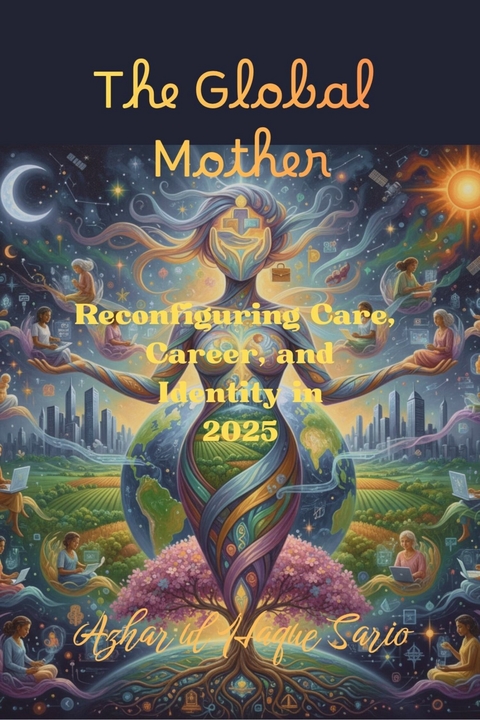
The Global Mother (eBook)
174 Seiten
Azhar Sario Hungary (Verlag)
978-3-384-74812-6 (ISBN)
Hey, ever wondered why motherhood feels like a global tightrope walk in 2025?
This book dives into the paradox of modern motherhood worldwide. It explores how women juggle intense cultural expectations with tough economic realities. The report is structured as a 15-chapter comparative analysis. It covers diverse countries like the US, Sweden, Japan, Germany, Italy, South Korea, Australia, India, China, South Africa, Brazil, Mexico, Saudi Arabia, Egypt, and Nigeria. Part I lays theoretical foundations using the US, Sweden, and Japan. It defines 'intensive mothering' as child-centered and emotionally demanding. It explains 'cognitive labor' as the invisible mental work of family planning. It discusses neoliberal policies in the US causing motherhood penalties. In Sweden, it shows limits of egalitarian policies amid persistent gender gaps. In Japan, it theorizes demographic crises clashing with traditional roles. Part II applies theories to lived experiences in Germany, Italy, South Korea, and Australia. It details Germany's part-time trap and 'Rabenmutter' stigma. In Italy, it covers the 'child penalty' and 'la mamma' ideal. South Korea's chapter focuses on 'education fever' turning mothers into managers. Australia's section examines expanding parental leave and 'lighthouse parenting.' Part III explores intersections like caste in India, state planning in China, and post-apartheid legacies in South Africa. It highlights India's maternal dropout rates. In China, it discusses urban-rural parenting divides. South Africa reveals family resilience amid vulnerability. Part IV innovates theories with Brazil, Mexico, and Saudi Arabia. It proposes 'Adaptive Maternal Labor' for Brazil's informal economy. For Mexico, it introduces 'Cultural-Economic Dissonance.' Saudi Arabia inspires 'State-Accelerated Change' via Vision 2030. Part V identifies research gaps using Egypt and Nigeria. It calls for studies on Egypt's empowerment policies' real impact. In Nigeria, it urges research on health-economy links and community supports. Tables compare policies, pay gaps, and penalties across nations. The introduction sets the 2025 paradox. The conclusion urges new paradigms.
What sets this book apart is its global, evidence-based depth that others skim over. Most motherhood books focus on Western experiences or single issues like work-life balance. This one weaves theories with real case studies from 15 countries, revealing unique cultural-economic clashes. It innovates frameworks like Adaptive Maternal Labor, filling gaps in non-Western contexts. Unlike vague advice books, it uses 2025 data for actionable insights on policies and stigmas. It highlights mental health tolls and demographic links often ignored. Its comparative tables provide quick, data-driven overviews missing elsewhere. By blending sociology, economics, and policy, it offers academics, policymakers, and moms a comprehensive tool for change, not just sympathy.
The rest of the book unpacks these ideas with sub-topics, data points, and policy details. You'll see how US moms face no federal leave, leading to burnout. Swedish dads take more leave but moms still manage mentally. Japanese women flee rural norms amid birth declines. German childcare shortages trap moms part-time. Italian familialism relies on grandmas. Korean education fever links to fertility drops. Australian super on leave eases finances. Indian caste affects early births. Chinese Gen Z parents shift styles. South African women build resilience post-apartheid. Brazilian moms adapt informally. Mexican ideals clash with precarity. Saudi reforms double workforce participation. Egyptian laws promise much but deliver little. Nigerian vulnerability demands health-economy research.
This book is independently produced and has no affiliation with any original authors or boards. It is created under nominative fair use for descriptive purposes only.
Part I: Theoretical Foundations of 21st-Century Motherhood
The United States – The Ideology of Intensive Mothering in a Neoliberal State
1.1 Defining "Intensive Motherhood" as a Cultural Mandate
The dominant cultural script for American mothers in 2025 is an ideology of "intensive mothering," a concept first theorized by sociologist Sharon Hays. This framework is not merely a parenting style; it is a pervasive and deeply embedded cultural mandate. Hays’ foundational work defines this ideology as a model of child-rearing that must be child-centered (where the child's needs, not the parents', dictate family schedules and decisions), expert-guided (requiring parents, primarily mothers, to research and apply the latest pediatric, psychological, and developmental science), emotionally absorbing (demanding constant, patient, and nurturing engagement), labor-intensive (involving a massive investment of physical and mental energy), and financially expensive (requiring endless expenditures on enrichment, education, and health).
This ideology has, in the contemporary United States, metastasized into what many researchers now call the "Perfect Mother Myth." It is a cultural yardstick against which all mothers are measured, and it is a standard that is, by its very design, impossible to meet. This impossibility is not a bug; it is a feature that serves a specific economic and social function. By setting an unattainable ideal, the culture of intensive mothering ensures that mothers are in a constant state of perceived failure, guilt, and striving. This, in turn, fuels a multi-billion dollar market of parenting advice, educational products, and "self-care" commodities, all promising to help mothers close the gap between their reality and the cultural ideal.
The psychological fallout of this mandate is severe and well-documented. Recent studies, including a 2024 report from The Ohio State University, identify this "culture of achievement" and the immense pressure to be a "perfect" parent as a primary driver of a public health crisis in parental burnout. In this national study, a staggering 57% of parents self-reported feelings of burnout, a state of profound emotional, mental, and physical exhaustion. This pressure is a direct antecedent to rising rates of maternal anxiety and depression. Mothers are, in effect, being crushed under the weight of an ideal that demands they be endlessly nurturing, emotionally available, and patient, all while managing careers, households, and the constant hum of domestic logistics.
A devastating consequence of this pressure-cooker environment is a profound sense of isolation. The performance of "perfect motherhood" is, by nature, a solitary one. It discourages vulnerability; to admit to struggling, to being overwhelmed, or to feeling deep ambivalence is to fail the test. This is borne out by stark data. Motherly's 2025 "State of Motherhood" report—the source of the statistic cited in our framework—found that 70% of mothers report that the experience is lonelier than they ever imagined. This is not a marginal finding; it demonstrates that isolation is now a defining feature of the modern American maternal experience. The cultural script demands a mother be the all-sufficient center of the child's universe, which paradoxically isolates her from the very communities of support she needs to survive.
Furthermore, this ideology is not a neutral, universal standard. It is a deeply classed and racialized construct, historically rooted in a white, middle-class model of domesticity. It presumes the mother has the choice to be a stay-at-home parent or, at minimum, the financial resources and career flexibility to center her child's needs above all else. This model actively marginalizes and pathologizes the experiences of mothers from diverse backgrounds.
For instance, sociological research on "integrated mothering" within Black communities reveals a starkly different, and historically necessary, ideological framework. This model often views paid work not as a distraction from mothering, but as an essential duty of mothering. It is a model that has long relied on extensive kin and community networks—the "othermothers"—for shared childcare, standing in direct contrast to the nuclear, mother-centric model of intensive parenting. Similarly, for working-class mothers or mothers in poverty, the demands of intensive, "expert-guided" parenting (such as purchasing organic foods, engaging in expensive enrichment activities, or spending hours on specialized homework) are simply unattainable. This deviation is not a sign of deficient parenting but a rational response to economic necessity. The intensive mothering mandate thus becomes a tool of social judgment, one that positions privileged mothers as the "gold standard" while casting less-privileged mothers as failing a test they were never meant to pass.
In the 2025 landscape, this pressure to perform has found its most potent and toxic vector: social media. Platforms like Instagram and TikTok have transformed motherhood from a private relationship into a public-facing aesthetic. The "perfect mother myth" is now curated and broadcast 24/7 through stylized feeds of immaculate homes, peaceful, well-dressed children, homemade organic meals, and smiling, serene mothers. As multiple scoping reviews on social media and maternal mental health have confirmed, this constant stream of "highly romanticized versions of motherhood" stimulates intense social comparison. It weaponizes the "expert-guided" tenet, as mothers are inundated with conflicting advice from influencers, creating a state of constant anxiety that they are "doing it wrong."
The result is a shift in focus from the relational act of mothering—the messy, imperfect, human connection with a child—to the performative act of motherhood. The trap is set: a mother's worth is no longer measured by her child's well-being, but by her ability to publicly project an image of successful, intensive mothering. This performance, combined with the real-world exhaustion and the systemic lack of support, creates the profound distress, guilt, and isolation that now characterize the American maternal experience. It is a cultural mandate that demands everything from mothers while offering them almost nothing in return.
1.2 Theorizing "Cognitive Labor" as the Invisible Engine of Family Life
If intensive mothering is the cultural mandate, cognitive labor is the invisible, unpaid, and profoundly gendered work required to execute it. This is the vast, hidden workload that keeps a family and household functioning. It is the "thinking work," the "mental load," or what many now refer to as the "mother load." While the physical tasks of domestic life—cooking, cleaning, driving—are visible and increasingly shared, cognitive labor remains the unseen and unacknowledged engine running in the background, and it is a workload that falls disproportionately on women.
Building on the pathbreaking work of sociologist Allison Daminger, this concept can be theorized as a distinct form of work encompassing four key stages. To understand this framework is to understand the primary source of the modern "second shift."
Anticipating: This is the constant environmental scanning for future needs. It is not the act of buying milk; it is the act of noticing the milk is low and that it must be purchased before breakfast tomorrow. It is seeing a child's pants are getting short and realizing new ones must be acquired before the growth spurt renders them unwearable. It is checking the calendar and seeing a birthday party in three weeks, triggering the need to RSVP, buy a gift, and arrange transportation.
Identifying/Researching: Once a need is anticipated, options must be identified. Which milk is healthiest? Which brand of pants is durable and affordable? What gift is appropriate for an 8-year-old? This stage involves researching summer camps, reading pediatrician reviews, and comparing insurance plans.
Deciding: This is the executive function of making a choice. We will buy this brand of milk, sign up for this camp, and see this doctor.
Monitoring: This is the follow-up. It is ensuring the task was actually completed. It is the mental checklist that asks, "Did the grocery order get placed? Did I remember to pack the gift? Is the new doctor's appointment on the shared calendar?" It is the persistent, low-grade hum of project management that is never truly "off."
A central tenet of this theory, as confirmed by Daminger's research and subsequent studies, is that cognitive labor is profoundly gendered. This is not a matter of personality—the "Type A" woman versus the "laid-back" man. In fact, many couples believe they are sharing the load equally because they often share the "Deciding" stage. They sit down together and decide on a vacation or a new school.
The gender inequality, however, lies buried in the other three stages. Our research, including in-depth interviews with dual-earning couples, confirms that women disproportionately perform the most mentally taxing and invisible components: Anticipation and Monitoring. The man may agree to do the grocery shopping, but it is the woman who is expected to have anticipated the need and created the list. The man may take the child to the doctor, but it is the woman who is expected to have monitored the child's symptoms, researched the doctor, and anticipated the need for an appointment.
This division of labor is the primary driver of...
| Erscheint lt. Verlag | 6.11.2025 |
|---|---|
| Sprache | englisch |
| Themenwelt | Sachbuch/Ratgeber ► Gesundheit / Leben / Psychologie ► Familie / Erziehung |
| Schlagworte | cognitive labor • cultural economic dissonance • global gender policy • Intensive Mothering • motherhood 2025 • Motherhood penalty • Work Family Balance |
| ISBN-10 | 3-384-74812-3 / 3384748123 |
| ISBN-13 | 978-3-384-74812-6 / 9783384748126 |
| Informationen gemäß Produktsicherheitsverordnung (GPSR) | |
| Haben Sie eine Frage zum Produkt? |
 EPUB (Ohne DRM)
Digital Rights Management: ohne DRM
Dieses eBook enthält kein DRM oder Kopierschutz. Eine Weitergabe an Dritte ist jedoch rechtlich nicht zulässig, weil Sie beim Kauf nur die Rechte an der persönlichen Nutzung erwerben.
Dateiformat: EPUB (Electronic Publication)
EPUB ist ein offener Standard für eBooks und eignet sich besonders zur Darstellung von Belletristik und Sachbüchern. Der Fließtext wird dynamisch an die Display- und Schriftgröße angepasst. Auch für mobile Lesegeräte ist EPUB daher gut geeignet.
Systemvoraussetzungen:
PC/Mac: Mit einem PC oder Mac können Sie dieses eBook lesen. Sie benötigen dafür die kostenlose Software Adobe Digital Editions.
eReader: Dieses eBook kann mit (fast) allen eBook-Readern gelesen werden. Mit dem amazon-Kindle ist es aber nicht kompatibel.
Smartphone/Tablet: Egal ob Apple oder Android, dieses eBook können Sie lesen. Sie benötigen dafür eine kostenlose App.
Geräteliste und zusätzliche Hinweise
Buying eBooks from abroad
For tax law reasons we can sell eBooks just within Germany and Switzerland. Regrettably we cannot fulfill eBook-orders from other countries.
aus dem Bereich