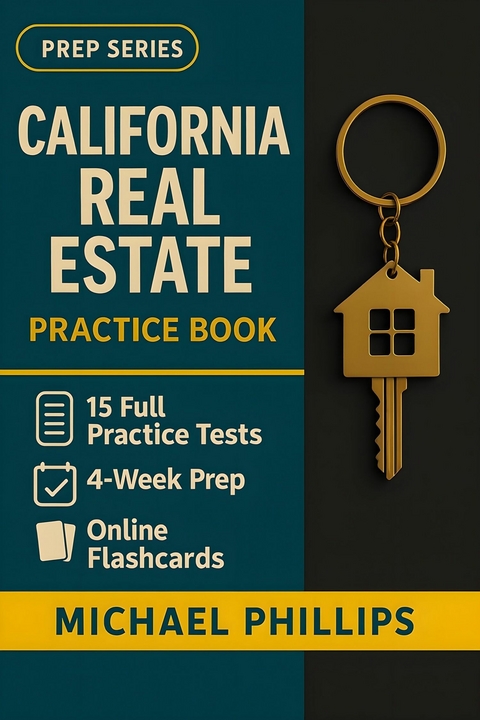
California Real Estate Exam Practice Book (eBook)
382 Seiten
Publishdrive (Verlag)
978-0-00-109820-6 (ISBN)
What if I told you that preparing for the California Real Estate License Exam with confidence-without stress, without confusion, and without feeling unready-can become your reality?
If you're worried you haven't practiced enough realistic real estate questions or you're unsure how well you'll perform under pressure, then training with full-length, exam-accurate practice tests can be your answer.
It can dramatically improve your understanding of property ownership, contracts, finance, valuation, laws, disclosures, and agency relationships-because nothing prepares you better than practicing with tests that mirror the exact structure and difficulty of the California Real Estate Exam.
This practice book was created with one goal: to simulate the real California Real Estate Salesperson Exam using 15 full-length practice tests aligned with the DRE content outline, each including clear answer explanations to strengthen your understanding instantly.
Each test reflects the real exam's seven major competency areas: Property Ownership, Land Use Controls, Valuation, Financing, Transfer of Property, Agency Law, Contracts, and Practice of Real Estate.
You'll work through realistic questions covering disclosures, escrow, fair housing, trust funds, ethics, listings, property management, and more-exactly like the official exam.
Whether you're a first-time test taker or retaking for a higher score, these full-length exams give you the repetition, pacing, and clarity you need to walk into the testing center with confidence.
And you don't need long daily sessions. Even with 30-40 minutes a day, this system helps you stay consistent and build mastery without burnout.
If you're unsure whether this will help, don't worry. Inside this book, you'll find complete practice exams that reveal strengths, expose weak points, and show exactly how ready you are for test day.
This is perfect if you want a cost-effective, structured way to practice without relying on expensive courses or scattered online questions. Whether you struggle with contract clauses, financing terms, disclosures, math questions, or legal definitions, these tests train you to think exactly the way the DRE exam expects.
Here is just a fraction of what you'll discover inside this book:
15 full-length California Real Estate practice tests matching real exam difficulty
• Answer explanations that clarify the reasoning behind every correct answer
• A complete 4-week testing schedule to structure your practice
• Accurate coverage of all DRE exam categories
• Hundreds of exam-style questions that build accuracy and speed
• Timed practice sessions to improve pacing under pressure
• Up-to-date content aligned with the latest California DRE guidelines
• A realistic exam simulation for candidates who improve fastest through repetition
Practice Test 1
Logical Reasoning 1 (Q1–Q25)
Q1. A real estate agent claims that homes near good schools always sell faster than homes in other areas. Which of the following, if true, would most weaken the agent’s claim?
A) Homes near good schools are often more expensive.
B) Some homes near top schools take longer to sell due to poor marketing.
C) Families prefer homes near schools to avoid long commutes.
D) Homes far from schools occasionally sell faster because of lower prices.
E) Real estate agents receive bonuses for selling homes near schools.
Correct: B
Why: It provides an example contradicting the claim that proximity to schools always speeds sales.
Q2. A homeowner says installing a swimming pool will increase the property value because it is a desirable feature. Which of the following assumptions is required?
A) Homebuyers do not like pools.
B) Pool installation costs are minimal.
C) Desirable features increase property value.
D) Pools reduce energy efficiency.
E) Neighborhoods have similar pool prevalence.
Correct: C
Why: The argument depends on desirable features actually increasing value.
Q3. A survey finds that homes with renovated kitchens sell faster than those without renovations. Which conclusion is most justified?
A) Kitchen renovations always increase property value.
B) Renovated kitchens can correlate with faster sales.
C) Homes with renovations are always more expensive.
D) Buyers prefer older kitchens.
E) Renovations make homes harder to sell.
Correct: B
Why: The survey indicates a correlation, not causation.
Q4. An agent claims that luxury homes sell slower because they are priced higher than average homes. Which observation would most strengthen this claim?
A) Luxury homes sometimes sell faster due to location.
B) High prices discourage many potential buyers.
C) Luxury homes have more bedrooms.
D) Average homes sell slower in some markets.
E) Mortgage rates affect all home sales equally.
Correct: B
Why: High prices directly support slower sales.
Q5. If a city imposes stricter zoning laws, property developers argue that home prices will rise. Which statement, if true, weakens this prediction?
A) Zoning limits construction.
B) Developers can build elsewhere.
C) Supply decreases while demand stays constant.
D) Buyers prefer densely built areas.
E) Prices generally increase with demand.
Correct: B
Why: If developers can build elsewhere, supply may not be restricted, weakening the argument.
Q6. A broker claims that staging a home significantly reduces its time on market. Which of the following, if true, would most weaken the claim?
A) Staged homes sell faster in high-demand neighborhoods.
B) Many staged homes take just as long as unstaged homes to sell.
C) Staging increases the aesthetic appeal.
D) Staged homes photograph better for listings.
E) Sellers often pay for staging.
Correct: B
Why: Evidence that staging doesn’t reduce time contradicts the claim.
Q7. A landlord argues that adding smart home devices will allow him to charge higher rent. Which assumption is most necessary?
A) Tenants are indifferent to technology.
B) Smart devices are expensive to install.
C) Renters value smart home technology.
D) All apartments already have devices.
E) Property taxes are unaffected.
Correct: C
Why: The argument relies on tenants valuing smart features.
Q8. A report states that homes near parks have higher resale value. Which of the following is a reasonable inference?
A) Parks always guarantee higher property value.
B) Nearby amenities can influence resale value.
C) Homes far from parks never appreciate.
D) Parks reduce nearby property value.
E) Buyers ignore outdoor spaces.
Correct: B
Why: The passage suggests proximity to parks can affect value.
Q9. A broker claims, “Homes listed on Fridays sell faster.” Which alternative explanation might weaken this claim?
A) Friday listings coincide with high-demand seasons.
B) Homes listed on Fridays have better photos.
C) Buyers shop more actively on weekends.
D) Homes listed on other days can sell just as fast.
E) Agents work harder on Fridays.
Correct: D
Why: If homes listed other days sell equally fast, the claim is weakened.
Q10. A seller argues that painting the front door increases buyer interest. Which evidence would best support this?
A) Homes with painted doors sell 10% faster than similar homes.
B) Painting the door increases maintenance costs.
C) Buyers ignore exterior paint colors.
D) Interior renovations matter more.
E) Homes without painted doors sell quickly.
Correct: A
Why: Quantitative evidence shows the effect on sales.
Q11. A realtor claims that open houses attract more serious buyers. Which of the following weakens this argument?
A) Open houses generate more foot traffic but not necessarily offers.
B) Sellers enjoy hosting events.
C) Buyers attend open houses to gather information.
D) Open houses are usually scheduled on weekends.
E) Agents advertise open houses widely.
Correct: A
Why: More visitors do not necessarily translate to serious buyers.
Q12. A developer claims that luxury condos in downtown areas will always appreciate faster than suburban homes. Which fact would most weaken this claim?
A) Urban condos often have higher maintenance fees.
B) Suburban homes occasionally appreciate faster due to local demand.
C) Luxury condos are desirable.
D) Downtown areas attract professionals.
E) Property taxes are higher downtown.
Correct: B
Why: If suburban homes sometimes appreciate faster, the absolute claim is weakened.
Q13. A study shows that energy-efficient homes sell for higher prices. Which assumption underlies this conclusion?
A) Buyers care about energy costs.
B) Energy-efficient homes are ugly.
C) Prices are unrelated to efficiency.
D) Tax incentives are irrelevant.
E) Homes vary in location.
Correct: A
Why: Higher value depends on buyers valuing energy efficiency.
Q14. An agent claims that houses with large backyards sell faster. Which would weaken this?
A) Many buyers prefer small, low-maintenance yards.
B) Backyards increase appeal.
C) Large yards cost more.
D) Homes with small yards are cheaper.
E) Yard size affects landscaping costs.
Correct: A
Why: Buyer preference for small yards contradicts the claim.
Q15. A city council argues that new commercial zoning will boost property values. Which supports the argument?
A) Commercial development attracts businesses and jobs.
B) Some properties may decline in value.
C) Traffic may increase.
D) Noise levels rise.
E) Zoning has no effect.
Correct: A
Why: Economic activity increases nearby property demand.
Q16. A realtor claims that homes with updated bathrooms sell faster. Which data would weaken the claim?
A) Many updated homes sell slower than expected.
B) Buyers prefer modern bathrooms.
C) Bathroom updates improve aesthetics.
D) Homes with older kitchens sell slowly.
E) Bathrooms vary in size.
Correct: A
Why: Evidence of slower sales contradicts the claim.
Q17. A broker argues that homes near shopping centers have higher resale value. Which assumption is required?
A) Buyers value proximity to shopping.
B) Shopping centers reduce traffic.
C) All neighborhoods have stores.
D) Resale value is unrelated to location.
E) Prices fluctuate randomly.
Correct: A
Why: The claim relies on buyer preference.
Q18. A survey finds that homes with professional photos sell faster. Which strengthens the claim?
A) Homes with amateur photos take longer to sell.
B) Buyers ignore listing images.
C) Photography costs are high.
D) Listing timing is more important.
E) Homes sell faster in spring.
Correct: A
Why: Comparing professional vs. amateur photos shows impact.
Q19. An agent claims that weekday showings are less effective than weekend showings. Which observation would weaken this?
A) Some weekday showings result in offers.
B) Weekends attract more visitors.
C) Agents schedule more weekend showings.
D) Traffic is lighter on weekdays.
E) Showings require preparation.
Correct: A
Why: Evidence of weekday success contradicts the claim.
Q20. A seller argues that curb appeal increases home sale speed. Which evidence best supports this?
A) Homes with landscaped yards sell faster.
B) Interior updates matter more.
C) Neighborhood reputation dominates.
D) Buyers ignore exteriors.
E) Some homes sell quickly despite poor appearance.
Correct: A
Why: Positive exterior presentation correlates with faster sales.
Q21. A broker claims that staging a vacant home boosts its sale price. Which weakens this?
A) Staging does not change offers in some cases.
B) Vacant homes are harder to visualize.
C) Staging improves perception.
D) Buyers often negotiate price.
E) Homes sell faster when staged.
Correct: A
Why: Evidence showing no price change contradicts the...
| Erscheint lt. Verlag | 5.11.2025 |
|---|---|
| Sprache | englisch |
| Themenwelt | Sachbuch/Ratgeber ► Beruf / Finanzen / Recht / Wirtschaft ► Bewerbung / Karriere |
| ISBN-10 | 0-00-109820-9 / 0001098209 |
| ISBN-13 | 978-0-00-109820-6 / 9780001098206 |
| Informationen gemäß Produktsicherheitsverordnung (GPSR) | |
| Haben Sie eine Frage zum Produkt? |
 EPUB (Adobe DRM)
Größe: 997 KB
Kopierschutz: Adobe-DRM
Adobe-DRM ist ein Kopierschutz, der das eBook vor Mißbrauch schützen soll. Dabei wird das eBook bereits beim Download auf Ihre persönliche Adobe-ID autorisiert. Lesen können Sie das eBook dann nur auf den Geräten, welche ebenfalls auf Ihre Adobe-ID registriert sind.
Details zum Adobe-DRM
Dateiformat: EPUB (Electronic Publication)
EPUB ist ein offener Standard für eBooks und eignet sich besonders zur Darstellung von Belletristik und Sachbüchern. Der Fließtext wird dynamisch an die Display- und Schriftgröße angepasst. Auch für mobile Lesegeräte ist EPUB daher gut geeignet.
Systemvoraussetzungen:
PC/Mac: Mit einem PC oder Mac können Sie dieses eBook lesen. Sie benötigen eine
eReader: Dieses eBook kann mit (fast) allen eBook-Readern gelesen werden. Mit dem amazon-Kindle ist es aber nicht kompatibel.
Smartphone/Tablet: Egal ob Apple oder Android, dieses eBook können Sie lesen. Sie benötigen eine
Geräteliste und zusätzliche Hinweise
Buying eBooks from abroad
For tax law reasons we can sell eBooks just within Germany and Switzerland. Regrettably we cannot fulfill eBook-orders from other countries.
aus dem Bereich