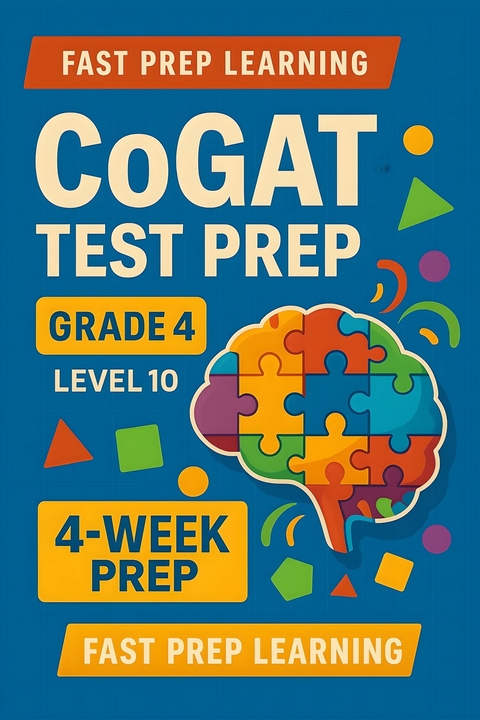
CoGAT Test Prep Grade 4 (eBook)
157 Seiten
Publishdrive (Verlag)
978-0-00-109785-8 (ISBN)
What if I told you that preparing for the COGAT Grade 4 Level 10 with confidence-without stress, without confusion, and without feeling overwhelmed-can become your reality?
If you're worried your child won't score high enough for gifted placement or certain question types feel too difficult, then following a structured, child-friendly study plan can be your answer.
It can significantly improve your child's reasoning skills across Verbal, Quantitative, and Nonverbal sections.
It's so effective because every chapter mirrors real COGAT logic-picture analogies, number puzzles, figure matrices, relationships, and patterns-explained in a way students understand quickly.
All lessons follow the Level 10 difficulty structure, making this guide ideal for 4th graders aiming for gifted programs, advanced placement, or higher academic confidence. So whether your child is preparing early or needs focused help, this guide supports every learning level.
Your student doesn't need advanced skills to benefit-but it becomes even more valuable if a higher score is your goal.
So you get one prep book... designed for beginners, strong learners, and anyone wanting a clear, supportive path to improvement.
And if you feel unsure whether this can truly help, don't worry. Inside this guide you'll find simple explanations, fun examples, and confidence-building questions that make learning engaging-not stressful.
Your child doesn't need long study sessions. With just 20-30 minutes a day, this system helps them build skills consistently without burnout.
This works best if you want an affordable, easy-to-use resource without expensive tutors or confusing worksheets. Whether your child struggles with analogies, number series, pattern recognition, or spatial puzzles, each chapter teaches the concepts in a clear, motivating way.
Here is just a fraction of what you'll discover inside this book:
A complete 4-week COGAT study plan with daily tasks
• Full coverage of Level 10 Verbal, Quantitative, and Nonverbal batteries
• Picture and verbal analogies explained in kid-friendly language
• Number sequences, equations, and quantitative patterns simplified
• Figure matrices, classifications, and paper-folding logic broken down step-by-step
• Strategies for identifying patterns quickly and accurately
• 90+ COGAT-style practice questions designed to match Level 10 difficulty
• Short, manageable lessons perfect for young learners
• Up-to-date content aligned with the current COGAT format
• Skill checklists, progress trackers, and quick-review pages included
CHAPTER 1 – Understanding the CoGAT: Format, Structure, and Mindset
Overview
The Cognitive Abilities Test (CoGAT) is designed to measure how you think, learn, and solve problems—not what you already know from school. For many fourth graders, this is their first time taking a reasoning-focused test rather than an achievement exam. That means the CoGAT looks at your ability to discover patterns, make connections, use logic, and apply reasoning to new situations.
This chapter introduces exactly how the CoGAT works, what Level 10 means for Grade 4 students, and what to expect on test day. You will learn about the different batteries (or major sections), the nine subtests, and the types of thinking each one measures. You will also start developing the growth mindset and calm, focused test-taking approach used by strong CoGAT performers. The goal is to help you enter the test with confidence, clarity, and the strategies you need to begin strong.
Learning Objectives
By the end of this chapter, you will be able to:
- Explain what the CoGAT measures and how it differs from schoolwork.
- Identify the three batteries and the nine subtests in Level 10.
- Understand how the test is administered in Grade 4.
- Describe what “Level 10” means and why it is used for fourth graders.
- Apply mindset and confidence strategies that support logical thinking.
- Practice early warm-up reasoning tasks that build foundational skills.
What the CoGAT Measures
The CoGAT does not test your knowledge of math facts, spelling rules, or school subjects. Instead, it measures your reasoning abilities. These are skills that help you solve new problems, identify relationships, and think in flexible ways. They are not tied to a particular curriculum or grade level.
The CoGAT focuses on three major reasoning areas:
- Verbal Reasoning – how you understand and work with language relationships
- Quantitative Reasoning – how you analyze numbers and use logical number patterns
- Nonverbal Reasoning – how you interpret visual information, shapes, and patterns
Every subtest fits into one of these three areas. Together, they provide a picture of how you solve problems using words, numbers, and visuals.
Why Reasoning Matters
Reasoning skills are essential because they help you learn new information faster. When you see a new type of math problem, a confusing metaphor in a story, or an unexpected science task, your reasoning ability helps you figure out what to do. This is why gifted and talented programs often use CoGAT scores; reasoning ability predicts how quickly and deeply students can learn.
Reasoning also helps in daily life. When you build a structure out of blocks, solve a puzzle, understand a story’s message, or figure out what comes next in a pattern, you are using the kinds of thinking the CoGAT measures.
How the CoGAT Thinks About “Ability”
The test does not try to label you or decide your future. Instead, it measures a moment of your thinking. Your reasoning ability grows with experience, practice, and challenge. A student who works confidently, stays flexible, and applies good strategies often performs better than expected. That is why preparing thoughtfully can make a real difference.
Overview of Batteries and Subtests
Level 10 of the CoGAT has three batteries, each with three subtests, for a total of nine subtests.
1. Verbal Battery
These measure relationships between words and ideas.
- Verbal Analogies
- Sentence Completion
- Verbal Classification
2. Quantitative Battery
These measure numeric reasoning and pattern discovery.
- Number Analogies
- Number Puzzles
- Number Series
3. Nonverbal Battery
These measure visual and spatial reasoning.
- Figure Matrices
- Paper Folding
- Figure Classification
Each subtest focuses on a specific type of reasoning challenge. Some rely more on language, others on math, and others entirely on pictures and shapes. This design helps the test measure different strengths and thinking styles.
How Subtests Are Timed
Most subtests are short—around 10 to 12 minutes. Each is given separately, and students work quietly until time is up. You will not complete all nine subtests at once; schools often split the test across two or three days.
The pacing is fast. There is not enough time to answer every question slowly, so learning to work steadily and avoid getting stuck is an important skill you will practice throughout this book.
How the Test Is Administered
The CoGAT is typically taken at school with your class or grade-level group. The format may vary depending on the district, but most fourth graders experience the test in one of two ways:
- Online testing using Chromebooks, iPads, or computers
- Paper-and-pencil testing (still used in some schools)
Both versions use the same types of questions, the same batteries, and the same scoring system.
What to Expect on Test Day
- You will listen to instructions for each subtest before starting.
- You cannot go back to a previous subtest once it ends.
- You can skip questions within a subtest, but you cannot return once time runs out.
- The test is not adaptive—everyone receives the same questions.
- There are no penalty points for wrong answers.
Your classroom will likely be quiet, calm, and structured during testing. Students often find the CoGAT more interesting than typical tests because many questions look like puzzles, patterns, or shape challenges.
Tools Allowed
Students generally use:
- A scratch sheet of paper (for quantitative tasks)
- A pencil (if using paper version)
- No calculators
- No notes, devices, or talking during testing
For the online version, a simple click-based interface is used. For the paper version, you fill in bubbles next to answer choices.
What Level 10 Means for Grade 4
The CoGAT uses levels rather than grade numbers to describe test versions. Level 10 is designed for students around ten years old, typically fourth graders. The reasoning tasks at this level assume that students have reached a certain stage of cognitive development—especially in reading comprehension, pattern recognition, and number sense.
While Level 10 is standardized for fourth grade, some students may find certain batteries easier than others. This variation is normal. The purpose of having three batteries is to capture different types of strengths.
How Level 10 Differs from Lower Levels
You will notice that Level 10:
- Includes multi-step reasoning questions
- Uses more complex vocabulary
- Displays more visually detailed shapes
- Introduces more advanced numerical relationships
- Requires efficient time management
These differences make preparation especially helpful at Grade 4.
Mindset and Confidence Building
Your mindset plays a big role in how well you perform on the CoGAT. Reasoning is not just about intelligence; it is also about staying calm, flexible, and ready to adjust when a pattern is confusing.
Adopt a Growth Mindset
A growth mindset means believing your abilities can improve with practice. When you hit a tricky pattern or confusing analogy, your reaction is important. Instead of thinking, “I can’t do this,” a growth mindset says:
- “This is new, so it’s OK that it feels challenging.”
- “If I look more closely, I can find the relationship.”
- “I can improve by practicing this kind of question.”
Students with a growth mindset perform better on reasoning tasks because they stay engaged instead of freezing or giving up.
Manage Your Thinking Energy
Reasoning uses mental energy. The CoGAT rewards students who can:
- Stay focused
- Switch quickly between tasks
- Avoid fixating on confusing problems
If a question feels too long or unfamiliar, it is better to skip it and come back only if time allows. This is not a sign of weakness—it is a strategic skill strong test takers use.
Build Pattern Awareness
Seeing patterns quickly is a major advantage. You will practice:
- Spotting relationships
- Recognizing transformations
- Comparing attributes
- Identifying rules without overthinking
Pattern awareness grows through repeated exposure. Every practice question in this book strengthens that skill.
Warm-Up Skill Checks
Before diving into specific batteries, try the following warm-up tasks. They loosen your mind and prepare your reasoning muscles.
Warm-Up 1: Visual Pattern Flash
Look at the following simple pattern rule:
- A triangle becomes a star.
- A square becomes a circle.
- A pentagon becomes what?
Think: Each shape turns into a shape with more points.
Triangle (3 points) → star (5 points)
Square (4 sides) → circle (infinite edge)
This suggests increasing the number of edges or complexity.
A pentagon (5 sides) might transform into a shape with more complexity, such as a hexagon.
Warm-Up 2: Verbal...
| Erscheint lt. Verlag | 5.11.2025 |
|---|---|
| Sprache | englisch |
| Themenwelt | Sachbuch/Ratgeber ► Beruf / Finanzen / Recht / Wirtschaft ► Bewerbung / Karriere |
| ISBN-10 | 0-00-109785-7 / 0001097857 |
| ISBN-13 | 978-0-00-109785-8 / 9780001097858 |
| Informationen gemäß Produktsicherheitsverordnung (GPSR) | |
| Haben Sie eine Frage zum Produkt? |
 EPUB (Adobe DRM)
Größe: 1,2 MB
Kopierschutz: Adobe-DRM
Adobe-DRM ist ein Kopierschutz, der das eBook vor Mißbrauch schützen soll. Dabei wird das eBook bereits beim Download auf Ihre persönliche Adobe-ID autorisiert. Lesen können Sie das eBook dann nur auf den Geräten, welche ebenfalls auf Ihre Adobe-ID registriert sind.
Details zum Adobe-DRM
Dateiformat: EPUB (Electronic Publication)
EPUB ist ein offener Standard für eBooks und eignet sich besonders zur Darstellung von Belletristik und Sachbüchern. Der Fließtext wird dynamisch an die Display- und Schriftgröße angepasst. Auch für mobile Lesegeräte ist EPUB daher gut geeignet.
Systemvoraussetzungen:
PC/Mac: Mit einem PC oder Mac können Sie dieses eBook lesen. Sie benötigen eine
eReader: Dieses eBook kann mit (fast) allen eBook-Readern gelesen werden. Mit dem amazon-Kindle ist es aber nicht kompatibel.
Smartphone/Tablet: Egal ob Apple oder Android, dieses eBook können Sie lesen. Sie benötigen eine
Geräteliste und zusätzliche Hinweise
Buying eBooks from abroad
For tax law reasons we can sell eBooks just within Germany and Switzerland. Regrettably we cannot fulfill eBook-orders from other countries.
aus dem Bereich