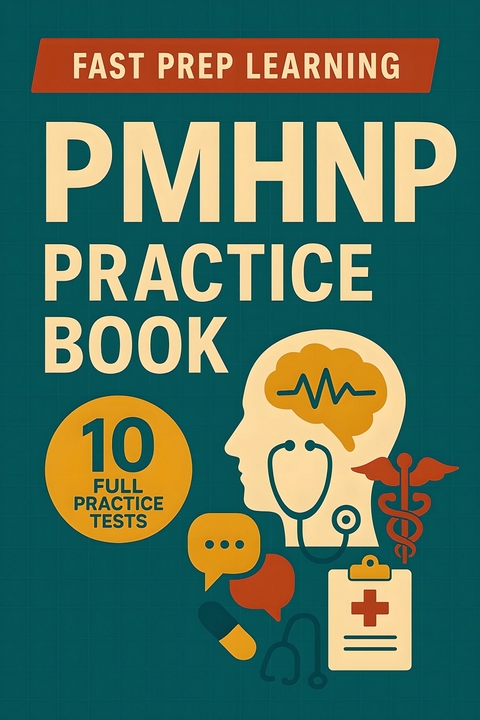
PMHNP Practice Book (eBook)
330 Seiten
Publishdrive (Verlag)
978-0-00-109779-7 (ISBN)
What if I told you that preparing for the PMHNP exam with confidence-without stress, without overwhelm, and without feeling unready-can become your reality?
If you're worried you haven't practiced enough realistic psychiatric-nursing questions or you're unsure how well you'll perform on complex scenario-based items, then training with full-length, exam-accurate practice tests can be your answer.
It can dramatically improve your psychiatric assessment skills, diagnostic reasoning, therapeutic interventions, and exam confidence-because nothing prepares you better than practicing with tests that mirror the exact structure and difficulty of the real PMHNP exam.
This practice book was created with one purpose: to simulate the PMHNP board exam using 15 full-length practice tests aligned with the ANCC blueprint, each including clear answer explanations so you can learn fast and strengthen weak areas immediately.
Every test reflects real PMHNP content: Psychotherapy, Psychopharmacology, Diagnostic Processes, Neurobiology, Ethical Practice, Developmental Disorders, Crisis Interventions, and Cultural Competence.
You'll work through realistic patient scenarios involving mood disorders, psychosis, trauma, substance use, personality disorders, anxiety, pediatric psychiatry, geriatric mental health, and emergency interventions.
Whether you're taking the exam for the first time or retaking to improve your score, these full-length tests give you the repetition, pacing, and clarity you need. And you don't need long study sessions. With just 30-40 minutes a day, this system keeps your preparation structured, manageable, and stress-free.
If you're unsure whether this will help, don't worry. Inside this book you'll find complete PMHNP-style exams that reveal your strengths, expose weak areas, and show exactly how close you are to being ready.
This is ideal if you want a cost-effective, organized way to practice without relying on expensive review courses or scattered online questions.
Whether you struggle with medication selection, therapeutic communication, DSM-5 criteria, safety priorities, or test pacing, these exams train you to think exactly the way the PMHNP exam expects.
Here is just a fraction of what you'll discover inside this book:
15 full-length PMHNP practice tests matching official exam difficulty
• Answer explanations that reinforce clinical reasoning
• A complete 4-week testing schedule to keep you structured and focused
• Accurate coverage of all ANCC domains: Assessment, Diagnosis, Treatment, Ethical Practice, Scientific Foundations
• Hundreds of scenario-based questions that strengthen clinical judgment
• Timed practice sessions to improve pacing for exam day
• Up-to-date content aligned with the newest PMHNP standards
• A realistic exam simulation for psychiatric-nurse practitioners who learn best through repetition
Practice Test 1
Logical Reasoning 1 (Q1–Q25)
Q1. A study shows that patients who receive regular psychotherapy report lower anxiety than those who do not. Which conclusion is best supported?
A) Psychotherapy eliminates all anxiety.
B) Psychotherapy may help reduce anxiety levels.
C) Anxiety is caused by avoiding psychotherapy.
D) All patients must receive psychotherapy.
E) Psychotherapy increases anxiety.
Correct: B
Why: The study suggests a reduction, not elimination, supporting B.
Q2. A nurse observes that patients who exercise report better sleep quality. Which is a reasonable inference?
A) Exercise guarantees good sleep.
B) Exercise may contribute to improved sleep.
C) Patients with poor sleep cannot exercise.
D) Sleep quality determines exercise frequency.
E) Exercise worsens sleep quality.
Correct: B
Why: Correlation suggests contribution, not certainty.
Q3. If all PMHNPs must follow evidence-based guidelines, and Dr. Lee is a PMHNP, which is true?
A) Dr. Lee may ignore guidelines at will.
B) Dr. Lee is required to follow evidence-based guidelines.
C) Dr. Lee does not follow any guidelines.
D) Some PMHNPs do not follow guidelines.
E) Guidelines are optional.
Correct: B
Why: Universal rule applies to Dr. Lee.
Q4. Research finds CBT improves mood in 70% of patients with mild depression. Which is best supported?
A) CBT is ineffective.
B) CBT helps most patients.
C) CBT worsens depression.
D) All patients respond equally.
E) CBT is harmful.
Correct: B
Why: 70% improvement indicates effectiveness for most patients.
Q5. Patients with chronic insomnia often consume caffeine late in the day. Which is a reasonable inference?
A) Caffeine causes insomnia.
B) Insomnia patients may consume more caffeine.
C) All caffeine users have insomnia.
D) Insomnia prevents caffeine use.
E) Caffeine cures insomnia.
Correct: B
Why: Observation suggests correlation, not causation.
Q6. A PMHNP notices that mindfulness reduces stress in most participants. Which is true?
A) Mindfulness eliminates stress.
B) Mindfulness may reduce stress.
C) Mindfulness causes stress.
D) Only some mindfulness practices reduce stress.
E) Stress levels are unaffected.
Correct: B
Why: Evidence shows reduction, not elimination.
Q7. A study reports teletherapy improves access for rural patients. Which conclusion is best?
A) Teletherapy cures mental illness.
B) Teletherapy increases access in rural areas.
C) Teletherapy is ineffective.
D) Teletherapy worsens outcomes.
E) Rural patients avoid teletherapy.
Correct: B
Why: Passage indicates improved access.
Q8. If all depressed patients should receive screening, and Maria is depressed, which is correct?
A) Maria may skip screening.
B) Maria should receive screening.
C) Screening is optional.
D) Some depressed patients are not screened.
E) Maria is excluded.
Correct: B
Why: Universal requirement applies.
Q9. A meta-analysis finds group therapy reduces relapse risk. Which is supported?
A) Group therapy guarantees no relapse.
B) Group therapy reduces relapse risk.
C) Relapse is unrelated to therapy.
D) Group therapy increases relapse.
E) Only medication prevents relapse.
Correct: B
Why: Analysis shows reduced risk.
Q10. Observing that morning exercise improves mood, the PMHNP infers:
A) Morning exercise guarantees happiness.
B) Morning exercise may boost mood.
C) Mood determines exercise time.
D) Exercise worsens mood.
E) Only morning exercise helps.
Correct: B
Why: Correlation suggests possible benefit.
Q11. If therapy is effective for adults, which applies to John, age 35?
A) John may ignore therapy.
B) Therapy may be effective for John.
C) John cannot benefit.
D) Therapy only works for children.
E) Effectiveness is random.
Correct: B
Why: Adults include age 35.
Q12. A study finds anxiety decreases after mindfulness practice for most participants. Which conclusion is supported?
A) Mindfulness eliminates all anxiety.
B) Mindfulness may reduce anxiety.
C) Mindfulness causes anxiety.
D) Anxiety is unchangeable.
E) Only group therapy works.
Correct: B
Why: Evidence supports reduction, not elimination.
Q13. Patients attending therapy weekly improve faster than those monthly. Which is reasonable?
A) Frequency may contribute to improvement.
B) Weekly therapy guarantees cure.
C) Monthly therapy is harmful.
D) Improvement is unrelated to therapy.
E) Only monthly therapy works.
Correct: A
Why: Correlation supports contribution.
Q14. PMHNPs are required to follow ethical codes. Which applies to Dr. Kim?
A) Dr. Kim may ignore ethics.
B) Dr. Kim must follow ethics.
C) Ethics are optional.
D) Some PMHNPs ignore ethics.
E) Dr. Kim is exempt.
Correct: B
Why: Requirement applies to all PMHNPs.
Q15. CBT reduces depressive symptoms in adolescents. Which is best supported?
A) CBT is harmful.
B) CBT may reduce symptoms.
C) CBT causes depression.
D) Adolescents never respond.
E) Only adults benefit.
Correct: B
Why: Evidence supports symptom reduction.
Q16. A patient reports less stress after yoga. Which conclusion is most reasonable?
A) Yoga eliminates all stress.
B) Yoga may reduce stress.
C) Yoga increases stress.
D) Stress levels are unaffected.
E) Yoga cures depression.
Correct: B
Why: Reduction suggests possible benefit.
Q17. Telehealth increases attendance among rural patients. Which is supported?
A) Telehealth reduces attendance.
B) Telehealth may increase attendance.
C) Telehealth has no effect.
D) Only urban patients benefit.
E) Attendance is irrelevant.
Correct: B
Why: Evidence shows improved participation.
Q18. If all patients should be screened for depression, what is true for Ana?
A) Ana may skip screening.
B) Ana should be screened.
C) Screening is optional.
D) Ana is excluded.
E) Only adults need screening.
Correct: B
Why: Universal requirement applies.
Q19. Mindfulness reduces cortisol in most adults. Which is correct?
A) Mindfulness has no effect.
B) Mindfulness may reduce cortisol.
C) Mindfulness increases cortisol.
D) Only children benefit.
E) Cortisol is unaffected.
Correct: B
Why: Evidence shows reduction.
Q20. Group therapy reduces relapse in 60% of cases. Which conclusion is reasonable?
A) Group therapy guarantees no relapse.
B) Group therapy may reduce relapse.
C) Group therapy causes relapse.
D) Therapy is ineffective.
E) Only medication works.
Correct: B
Why: Evidence supports reduced relapse risk.
Q21. Patients attending weekly therapy report improved mood. Which is supported?
A) Weekly therapy guarantees cure.
B) Weekly therapy may improve mood.
C) Therapy worsens mood.
D) Only daily therapy helps.
E) Therapy is irrelevant.
Correct: B
Why: Correlation suggests possible improvement.
Q22. CBT is effective for mild depression in most studies. Which is true?
A) CBT is harmful.
B) CBT may be effective.
C) CBT is ineffective.
D) Only adults benefit.
E) CBT guarantees cure.
Correct: B
Why: Evidence supports effectiveness.
Q23. If a PMHNP must follow safety protocols, which applies to Dr. Roy?
A) Protocols are optional.
B) Dr. Roy must follow protocols.
C) Dr. Roy may ignore protocols.
D) Only nurses follow protocols.
E) Protocols are irrelevant.
Correct: B
Why: Requirement applies universally.
Q24. Mindfulness reduces stress in adolescents. Which is supported?
A) Mindfulness is harmful.
B) Mindfulness may reduce stress.
C) Mindfulness worsens stress.
D) Stress is unaffected.
E) Only adults benefit.
Correct: B
Why: Evidence shows reduction.
Q25. Teletherapy expands access to therapy for rural patients. Which conclusion is reasonable?
A) Teletherapy is harmful.
B) Teletherapy may expand access.
C) Teletherapy reduces access.
D) Teletherapy is ineffective.
E) Only urban patients benefit.
Correct: B
Logical Reasoning 2 (Q1–Q25)
Q1. A study found that patients receiving therapy reported lower anxiety than those who did not. Which conclusion is best supported?
A) Therapy eliminates all anxiety.
B) Therapy may reduce anxiety.
C) Anxiety is caused by avoiding therapy.
D) All patients must receive therapy.
E) Therapy increases anxiety.
Correct: B
Why: Evidence shows reduction, not elimination.
Q2. Patients who exercised daily reported better sleep. Which is reasonable?
A) Daily exercise guarantees sleep improvement.
B) Daily exercise may contribute to better sleep.
C) Sleep quality determines exercise.
D) Exercise worsens sleep.
E) Only some sleep improves.
Correct: B
Why: Correlation suggests...
| Erscheint lt. Verlag | 5.11.2025 |
|---|---|
| Sprache | englisch |
| Themenwelt | Sachbuch/Ratgeber ► Beruf / Finanzen / Recht / Wirtschaft ► Bewerbung / Karriere |
| ISBN-10 | 0-00-109779-2 / 0001097792 |
| ISBN-13 | 978-0-00-109779-7 / 9780001097797 |
| Informationen gemäß Produktsicherheitsverordnung (GPSR) | |
| Haben Sie eine Frage zum Produkt? |
 EPUB (Adobe DRM)
Größe: 986 KB
Kopierschutz: Adobe-DRM
Adobe-DRM ist ein Kopierschutz, der das eBook vor Mißbrauch schützen soll. Dabei wird das eBook bereits beim Download auf Ihre persönliche Adobe-ID autorisiert. Lesen können Sie das eBook dann nur auf den Geräten, welche ebenfalls auf Ihre Adobe-ID registriert sind.
Details zum Adobe-DRM
Dateiformat: EPUB (Electronic Publication)
EPUB ist ein offener Standard für eBooks und eignet sich besonders zur Darstellung von Belletristik und Sachbüchern. Der Fließtext wird dynamisch an die Display- und Schriftgröße angepasst. Auch für mobile Lesegeräte ist EPUB daher gut geeignet.
Systemvoraussetzungen:
PC/Mac: Mit einem PC oder Mac können Sie dieses eBook lesen. Sie benötigen eine
eReader: Dieses eBook kann mit (fast) allen eBook-Readern gelesen werden. Mit dem amazon-Kindle ist es aber nicht kompatibel.
Smartphone/Tablet: Egal ob Apple oder Android, dieses eBook können Sie lesen. Sie benötigen eine
Geräteliste und zusätzliche Hinweise
Buying eBooks from abroad
For tax law reasons we can sell eBooks just within Germany and Switzerland. Regrettably we cannot fulfill eBook-orders from other countries.
aus dem Bereich