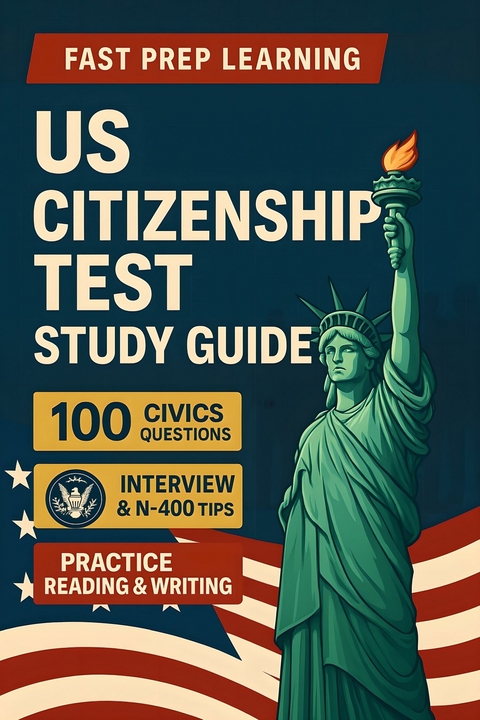
US Citizenship Test Study Guide (eBook)
20 Seiten
Publishdrive (Verlag)
978-0-00-109777-3 (ISBN)
What if I told you that preparing for the U.S. Citizenship Test with confidence-without stress, without confusion, and without feeling overwhelmed-can become your reality?
If you're worried you won't remember all the questions, struggle with English, or feel unsure about the interview process, then following a simple, citizenship-aligned study plan can be your answer. It can dramatically improve your understanding of U.S. history, government, civics, and interview expectations.
It's so effective because every chapter mirrors the real USCIS format, using clear explanations, simple language, and test-style questions that match the actual naturalization interview.
All lessons follow the official 100 Civics Questions, making this guide ideal for beginners, English learners, and long-term residents preparing for naturalization.
So whether you've lived in the U.S. for years or you're applying for the first time, this book supports every level. You don't need perfect English to benefit-but it becomes even more valuable if passing your interview is your next goal.
So you get one study guide... designed for adults, seniors, and busy applicants who want a clear, structured path to success.And if you feel unsure whether this can truly help you pass, don't worry. Inside this guide you'll find easy explanations, practice questions, and interview-style prompts that make learning fast and stress-free.
You don't need long study sessions. Even with 20-30 minutes a day, this system helps you learn quickly, remember key facts, and stay confident.
This works best if you want a cost-effective prep solution without complicated textbooks or confusing online information.
Whether you struggle with civics, English vocabulary, oral questions, or understanding the interview steps, every chapter teaches you what USCIS officers expect.
Here is just a fraction of what you'll discover inside this book:
A complete 4-week citizenship study plan with daily goals
• All 100 USCIS civics questions with clear, simple answers
• Easy explanations of U.S. history, Congress, the Constitution, and presidents
• Vocabulary and English phrases commonly used during the interview
• Realistic interview examples and officer-style questions
• Reading and writing practice for the English test
• Tips for remembering answers quickly and accurately
• 90+ practice questions modeled after real USCIS interviews
• Short, beginner-friendly lessons perfect for English learners
• Up-to-date content aligned with the current naturalization test
• Quick-reference charts, summaries, and pronunciation guides included
Chapter 1 — Understanding the Naturalization Process
Overview
Becoming a U.S. citizen is one of the most meaningful steps a person can take in their American journey. The naturalization process brings new rights, responsibilities, and opportunities—from voting in federal elections to serving on a jury or holding certain government jobs. This chapter explains the entire path to citizenship in a clear, structured, confidence-building way. Whether you have lived in the U.S. for three years or thirty, the steps below will help you understand what happens, why it matters, and how to prepare.
This chapter also sets the foundation for later chapters on interview success, civics knowledge, and communication skills. By the end, you will know every phase of the naturalization process and feel more confident about what to expect.
Learning Objectives
By the end of Chapter 1 (Parts A & B), you will be able to:
- Explain the purpose and meaning of naturalization.
- Identify each eligibility requirement for Form N-400.
- Understand the step-by-step USCIS application process.
- Prepare for the biometrics appointment.
- Recognize what happens during the interview and civics test.
- Understand the Oath of Allegiance ceremony and final responsibilities.
Core Concepts
What Is Naturalization?
Naturalization is the legal process by which a lawful permanent resident—also known as a “Green Card holder”—becomes a U.S. citizen. It is voluntary, but many residents choose it because citizenship unlocks full participation in American civic life. These include the right to vote, apply for certain federal jobs, and travel abroad with a U.S. passport.
Naturalization is overseen by USCIS (U.S. Citizenship and Immigration Services). USCIS officers evaluate eligibility, review applications, conduct interviews, and administer the Oath of Allegiance.
At its core, naturalization is both legal and symbolic:
- Legal: You gain permanent membership in the nation with all associated rights and responsibilities.
- Symbolic: You affirm devotion to the principles of the U.S. Constitution and the values of a democratic society.
Understanding this dual meaning can make the process feel less like paperwork and more like a personal milestone.
Eligibility Requirements
Before applying, you must meet USCIS eligibility standards. These rules ensure that applicants have demonstrated commitment, residency, character, and understanding of U.S. principles.
Here are the major requirements explained clearly:
1. Age Requirement
You must be 18 years or older to submit the N-400 application.
2. Permanent Residency Status
You must be a lawful permanent resident for:
- 5 years in most cases
- 3 years if married to and living with a U.S. citizen spouse
Some applicants, such as military service members, have modified requirements.
3. Continuous Residence
You must show that you have lived continuously in the United States for the required period.
This does not mean you cannot travel. Instead:
- You should avoid trips outside the U.S. longer than 6 months.
- Trips over 1 year usually break continuous residence.
4. Physical Presence
You must have been physically present in the U.S. for half of the required residency period:
- 30 months out of 5 years
- 18 months out of 3 years (marriage-based)
5. Good Moral Character
Good moral character is about following laws and fulfilling obligations. USCIS looks at the last five years (or three years), but serious issues at any time may affect eligibility.
Examples of good moral character:
- Filing taxes
- Supporting dependents
- Following community laws
- Being honest on all forms
6. English and Civics Requirements
Most applicants must:
- Speak, read, and write basic English
- Demonstrate knowledge of U.S. history and government (the civics test)
English exceptions and age-based waivers exist, and these will be discussed later in Chapter 13.
7. Selective Service Registration (If Required)
Men who lived in the U.S. between ages 18–26 must register for Selective Service. Failure to do so does not automatically disqualify you, but you may need to provide additional explanation.
8. Attachment to Constitutional Principles
You must demonstrate belief in and commitment to:
- Democracy
- Rule of law
- Equality under the Constitution
USCIS may ask questions during the interview to confirm your understanding.
The USCIS Application Process
Once you confirm eligibility, you follow a predictable path. These steps will be detailed in both parts of the chapter.
Step 1: Prepare and Submit Form N-400
Form N-400 can be submitted:
- Online
- By mail
You will need documents such as:
- Green Card
- Passports
- Marriage certificates (if applicable)
- Tax transcripts
- Proof of Selective Service registration (if required)
You also pay an application fee unless you qualify for a fee waiver.
Step 2: Receive a Receipt Notice
USCIS sends a receipt confirming they received your application. If you applied online, you can check status in your USCIS account.
Step 3: Biometrics Appointment
USCIS schedules an appointment to collect:
- Fingerprints
- Photograph
- Signature
These help verify your identity and screen your background.
Step 4: Interview and Tests
At a USCIS field office, you will:
- Review your N-400 with an officer
- Take the English tests
- Take the civics test
This is the step most applicants worry about. Later chapters will teach you communication strategies, study skills, and interview walkthroughs.
Step 5: Receive a Decision
You will receive:
- Approval,
- Continuation (meaning more information needed), or
- Denial.
Most applicants who prepare well and tell the truth are approved.
Step 6: Oath of Allegiance Ceremony
This is the final step. After taking the Oath, you become a U.S. citizen and receive a Certificate of Naturalization.
Examples
Example 1: Eligibility Evaluation
Scenario:
Amina has held a Green Card for 5 years and has lived in the U.S. continuously except for one 5-month trip abroad. She filed her taxes regularly and has no criminal history.
Result:
Amina meets eligibility requirements.
SHRM Competency Highlight:
Critical evaluation—Amina reviews her own history and documentation before applying.
Example 2: Continuous Residence Issue
Scenario:
Carlos traveled abroad for 11 months to care for a sick parent. He returned to the U.S. and wants to apply after his 5-year anniversary as a permanent resident.
Result:
The long trip likely broke continuous residence. Carlos may need to wait until he establishes a new 5-year continuous period.
Example 3: Selective Service Issue
Scenario:
Ahmed lived in the U.S. from age 20 to 30 as a permanent resident but did not know he needed to register.
Result:
He must submit a statement explaining the situation. Honesty and documentation are important.
SHRM Competency Highlight:
Ethical practice—being transparent and truthful in reporting.
Guided Practice
Pause and try these yourself. Answers follow after a separator.
1.
You have held a Green Card for 3 years and are married to a U.S. citizen. You took one 4-month trip abroad. Are you eligible to apply?
2.
You spent 7 months outside the U.S. during your residency period. What issue might you face?
3.
List at least three examples of “good moral character.”
Scroll down for answers.
Guided Practice Answers
- Yes, you may be eligible under the 3-year rule.
- You may have broken continuous residence, requiring additional proof.
- Filing taxes, obeying laws, supporting dependents, being honest with USCIS.
Quick Checks
- What form is used to apply for naturalization?
- What does USCIS collect at the biometrics appointment?
- How long must most applicants hold a Green Card before applying?
- What is continuous residence?
- What is the final step of the naturalization process?
(Answers will be reviewed in Part 1B.)
Pitfalls
Common mistakes to avoid include:
- Forgetting to update USCIS about a change of address
- Taking long trips that break continuous residence
- Submitting an incomplete N-400
- Providing unclear or inconsistent information
- Assuming the interview is only about the civics test
- Hiding information (which is worse than disclosing it)
Recap
In Part 1A, you learned:
- What naturalization means and why it matters
- Every major eligibility requirement
- The step-by-step USCIS application process
- How to evaluate your residency and moral...
| Erscheint lt. Verlag | 5.11.2025 |
|---|---|
| Sprache | englisch |
| Themenwelt | Sachbuch/Ratgeber ► Beruf / Finanzen / Recht / Wirtschaft ► Bewerbung / Karriere |
| ISBN-10 | 0-00-109777-6 / 0001097776 |
| ISBN-13 | 978-0-00-109777-3 / 9780001097773 |
| Informationen gemäß Produktsicherheitsverordnung (GPSR) | |
| Haben Sie eine Frage zum Produkt? |
 EPUB (Adobe DRM)
Größe: 1,1 MB
Kopierschutz: Adobe-DRM
Adobe-DRM ist ein Kopierschutz, der das eBook vor Mißbrauch schützen soll. Dabei wird das eBook bereits beim Download auf Ihre persönliche Adobe-ID autorisiert. Lesen können Sie das eBook dann nur auf den Geräten, welche ebenfalls auf Ihre Adobe-ID registriert sind.
Details zum Adobe-DRM
Dateiformat: EPUB (Electronic Publication)
EPUB ist ein offener Standard für eBooks und eignet sich besonders zur Darstellung von Belletristik und Sachbüchern. Der Fließtext wird dynamisch an die Display- und Schriftgröße angepasst. Auch für mobile Lesegeräte ist EPUB daher gut geeignet.
Systemvoraussetzungen:
PC/Mac: Mit einem PC oder Mac können Sie dieses eBook lesen. Sie benötigen eine
eReader: Dieses eBook kann mit (fast) allen eBook-Readern gelesen werden. Mit dem amazon-Kindle ist es aber nicht kompatibel.
Smartphone/Tablet: Egal ob Apple oder Android, dieses eBook können Sie lesen. Sie benötigen eine
Geräteliste und zusätzliche Hinweise
Buying eBooks from abroad
For tax law reasons we can sell eBooks just within Germany and Switzerland. Regrettably we cannot fulfill eBook-orders from other countries.
aus dem Bereich