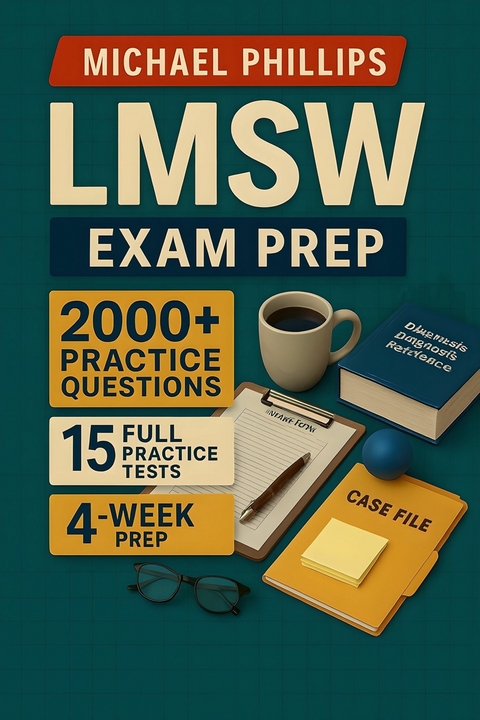
LMSW Exam Prep (eBook)
132 Seiten
Publishdrive (Verlag)
978-0-00-109775-9 (ISBN)
What if I told you that preparing for the LMSW exam with confidence-without stress, without confusion, and without feeling overwhelmed-can become your reality?
If you're worried you won't pass on the first attempt or certain social work domains still feel unclear, then following a structured, clinically aligned study plan can be your answer. It can significantly strengthen your understanding of human development, assessment, interventions, ethics, and professional practice.
It's so effective because every chapter mirrors ASWB exam logic, using simple explanations, real-case examples, and clear reasoning steps that match how licensed social workers think.
All lessons follow the official ASWB content outline, making this guide ideal for social work students, new graduates, and retakers who want a predictable, organized path to passing.
So whether you've been in the field for years or you're fresh out of your MSW program, this guide supports every starting level.
You don't need advanced clinical experience to benefit-but it becomes even more powerful if licensure is your next step. So you get one study guide... built for busy students, interns, and professionals who need a simple, dependable way to prepare.
And if you feel unsure whether this can truly help, don't worry.
Inside this guide you'll find clean explanations, practical examples, and exam-specific strategies designed to make complex topics easier to understand.
You don't need long study sessions. Even with just 30 minutes a day, this system helps you learn efficiently and build real confidence.
This works best if you want a cost-effective prep method without overwhelming textbooks or overpriced courses.
Whether you struggle with ethics, interventions, practice models, DSM terminology, or assessment questions, every chapter teaches you exactly how to think the way the LMSW exam expects.
Here is just a fraction of what you'll discover inside this book:
A complete 4-week LMSW study plan with daily goals
• Full ASWB content coverage: Human Development, Assessment, Intervention, Diversity, Ethics
• Counseling theories, practice models, and clinical frameworks explained simply
• DSM-based overviews of common disorders and symptoms
• Assessment tools, risk evaluation, and treatment planning
• Ethics, boundaries, confidentiality, and professional responsibilities
• Cultural competence and diversity considerations
• 90+ LMSW-style practice questions with step-by-step reasoning
• Short, focused lessons ideal for busy social workers
• Up-to-date content aligned with the modern ASWB exam
• Quick-reference charts, definitions, and decision-making guides included
CHAPTER 1 — Understanding the LMSW Exam Structure & Strategy
Overview
The LMSW exam is designed to assess whether new social workers possess the foundational knowledge, ethical reasoning, and decision-making skills required to enter the field safely and effectively. While it includes theoretical content, the exam is not about memorizing academic material—it is about applying social work principles in practical, real-world scenarios. Most questions revolve around client safety, ethics, assessment, best practices, and selecting the most appropriate first, next, or best action. Understanding how the exam is structured helps you approach each question with confidence and purpose.
This chapter breaks down the exam format, scoring, domains, question styles, and common traps. It also introduces the core reasoning strategies that will guide you throughout this book. By the end of this chapter, you will know not only what the exam covers but how to think like the test-makers expect an LMSW to think.
Learning Objectives
By the end of Chapter 1, you will be able to:
- Describe the layout and timing of the LMSW exam
- Understand question structure and how responses are evaluated
- Identify common distractors and traps
- Apply strategic reasoning for best and next type questions
- Understand how ethics and cultural competence shape nearly every item on the exam
Exam Format Overview
The LMSW exam typically contains 170 items, of which 150 are scored. The remaining 20 are unscored pretest items used to pilot new question types. Although unscored, these items are indistinguishable from scored ones, meaning you must give equal attention to all questions.
You are allotted four hours, which is more than enough time if you pace yourself correctly. Most first-time test-takers finish with some time remaining, but anxiety and overthinking can disrupt pacing. It’s important to recognize that the exam is designed so you don’t need to rush—you need to reason.
Key Format Components
- 170 total questions
- 150 scored
- 20 unscored pilot items
- Multiple-choice, single-best-answer format
- Scenario-heavy and ethics-heavy
- 4-hour time limit
- Scaled score range: 0–100, with pass around low- to mid-70s
The exam is not adaptive; you can mark, skip, and return to questions as needed. However, skipping too many questions can increase test-day anxiety, which is why a structured question-approach method is included later in this chapter.
Domain Breakdown & Weighting
The LMSW exam is divided into key domains. While the exact weighting may vary slightly by year, the general structure remains stable:
- Human Development, Diversity, and Behavior in the Environment
- Assessment and Intervention Planning
- Interventions with Clients and Client Systems
- Professional Relationships, Ethics, and Values
The last domain—ethics—is the backbone of the entire exam. A large portion of questions evaluate your judgment regarding confidentiality, boundaries, professional roles, client rights, cultural competence, and mandated reporting. If you master ethics, you significantly boost your chances of passing.
Why Domain Weight Matters
You should not study every topic equally. Weighting helps you strategize your prep:
- Ethics + Professional Values = High frequency
- Assessment planning = Strong presence
- Human development theories = Moderate presence
- Policy knowledge = Lower frequency, but still important
Exam questions often incorporate multiple domains at once. For example, a scenario may present a client from a culturally diverse background (Domain 1), requiring an assessment approach (Domain 2), and ending with an ethical dilemma (Domain 4). The exam rarely labels which domain a question is testing, so you must integrate knowledge across domains.
How LMSW Questions Are Structured
Most LMSW questions follow a predictable pattern:
- Short or medium-length scenario
- A presenting problem or client need
- A required action (FIRST, NEXT, BEST, MOST APPROPRIATE)
- Four answer choices—only one clearly correct
Common Question Types
- FIRST Action
Used when establishing rapport, gathering foundational information, or addressing immediate needs. - NEXT Action
Used after the social worker has already engaged. This requires sequencing and professional judgment. - BEST Action
Typically used in scenarios with multiple reasonable options. You must identify the ethically superior one. - MOST APPROPRIATE
Similar to “best,” but often focuses more on alignment with social work values.
Example: Understanding Question Stems
“A social worker meets with a client who appears anxious and overwhelmed. The client reports stress related to a recent divorce but denies safety risks. What should the social worker do FIRST?”
A less experienced test-taker may jump toward treatment or problem-solving. But the correct FIRST action often involves establishing rapport, clarifying concerns, or gathering baseline assessment information.
Common Exam Traps
The LMSW exam is not trying to trick you—but it is testing whether you can avoid common errors new social workers make.
Trap 1 — Doing Too Much, Too Soon
Beginners often jump to interventions before completing assessment.
Wrong example:
- Creating a treatment plan before gathering enough data
Correct approach:
- Assess → Clarify → Identify → THEN intervene
Trap 2 — Violating Boundaries Without Realizing It
Some answers sound “helpful” but break professional boundaries.
Wrong example:
- Giving a client your personal number
- Accepting gifts
- Sharing personal experiences to build rapport
Trap 3 — Ignoring Client Autonomy
The exam always prefers answers that support the client’s voice and self-determination unless safety is a concern.
Trap 4 — Cultural Assumptions
If an answer assumes something about the client’s culture, belief system, or identity without assessing, it is almost always incorrect.
Trap 5 — Ethical Shortcutting
If an answer breaks confidentiality—even subtly—it’s wrong unless:
- The client threatens harm to self or others
- A vulnerable person is in danger
- Reporting is legally required
- A court order specifically compels information
A Quick Example of a Trap
“A client asks for your personal opinion about their relationship. What should you do NEXT?”
Trap answers:
- Give them advice
- Disclose your personal relationship history
Correct answer:
- Explore why they are asking and redirect focus to their goals.
Strategy Framework for LMSW Success
The LMSW exam rewards structured, ethical reasoning rather than memorization. You will use the following strategy throughout the book:
STEP 1 — Ensure Safety
If safety is in question, intervene immediately.
Safety overrides rapport, assessment, and planning.
STEP 2 — Stay Ethical
Confidentiality, boundaries, cultural humility.
STEP 3 — Assess Before Acting
If you don’t have enough information, gather more.
STEP 4 — Empower the Client
Promote autonomy, self-determination, collaboration.
STEP 5 — Choose the Least Restrictive, Most Ethical Action
Intervene responsibly, ethically, and appropriately.
Examples
Example 1 — FIRST vs. NEXT
Scenario:
A 42-year-old client arrives for an intake session visibly distressed. She reports losing her job two weeks ago and feeling overwhelmed by financial pressures. She denies suicidal or homicidal ideation. She says, “I don’t even know where to start.”
Wrong choices might include:
- Creating a treatment plan
- Providing job leads
- Offering reassurance without assessment
- Referring her to career counseling immediately
These actions skip assessment or assume what she wants.
Correct FIRST action:
- Begin with empathetic engagement and explore her primary concerns further
Because this is the first meeting, the priority is establishing rapport, clarifying presenting issues, and understanding her emotional and practical needs before planning.
Example 2 — Boundaries and Ethics
Scenario:
A client expresses strong admiration for you and invites you to attend a family celebration, saying your support “deserves to be honored.”
Wrong choices include:
- Accepting the invitation to maintain rapport
- Declining but offering to meet outside for coffee
- Sharing a personal story to “balance the relationship”
Correct answer:
- Politely decline and redirect the focus back to the therapeutic relationship and the client’s goals.
The LMSW exam always prioritizes maintaining professional boundaries and modeling ethical...
| Erscheint lt. Verlag | 5.11.2025 |
|---|---|
| Sprache | englisch |
| Themenwelt | Sachbuch/Ratgeber ► Beruf / Finanzen / Recht / Wirtschaft ► Bewerbung / Karriere |
| ISBN-10 | 0-00-109775-X / 000109775X |
| ISBN-13 | 978-0-00-109775-9 / 9780001097759 |
| Informationen gemäß Produktsicherheitsverordnung (GPSR) | |
| Haben Sie eine Frage zum Produkt? |
 EPUB (Adobe DRM)
Größe: 1,1 MB
Kopierschutz: Adobe-DRM
Adobe-DRM ist ein Kopierschutz, der das eBook vor Mißbrauch schützen soll. Dabei wird das eBook bereits beim Download auf Ihre persönliche Adobe-ID autorisiert. Lesen können Sie das eBook dann nur auf den Geräten, welche ebenfalls auf Ihre Adobe-ID registriert sind.
Details zum Adobe-DRM
Dateiformat: EPUB (Electronic Publication)
EPUB ist ein offener Standard für eBooks und eignet sich besonders zur Darstellung von Belletristik und Sachbüchern. Der Fließtext wird dynamisch an die Display- und Schriftgröße angepasst. Auch für mobile Lesegeräte ist EPUB daher gut geeignet.
Systemvoraussetzungen:
PC/Mac: Mit einem PC oder Mac können Sie dieses eBook lesen. Sie benötigen eine
eReader: Dieses eBook kann mit (fast) allen eBook-Readern gelesen werden. Mit dem amazon-Kindle ist es aber nicht kompatibel.
Smartphone/Tablet: Egal ob Apple oder Android, dieses eBook können Sie lesen. Sie benötigen eine
Geräteliste und zusätzliche Hinweise
Buying eBooks from abroad
For tax law reasons we can sell eBooks just within Germany and Switzerland. Regrettably we cannot fulfill eBook-orders from other countries.
aus dem Bereich