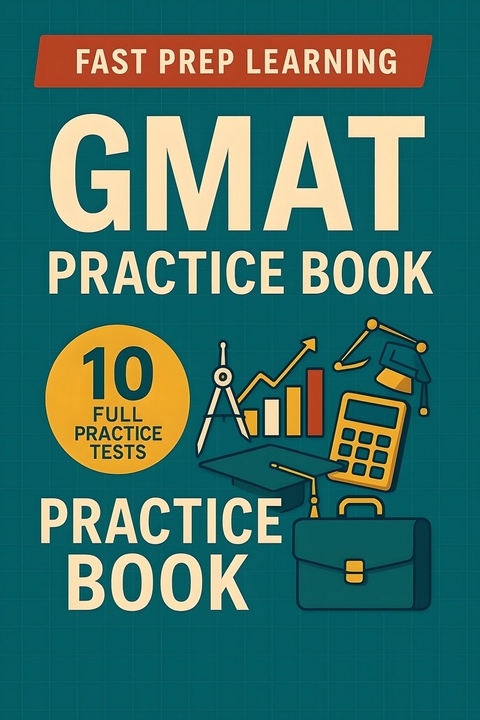
GMAT Practice Book (eBook)
20 Seiten
Publishdrive (Verlag)
978-0-00-109774-2 (ISBN)
What if I told you that preparing for the GMAT with confidence-without stress, without confusion, and without feeling unready-can become your reality?
If you're worried you haven't practiced enough full-length GMAT-style tests or you're unsure how well you'll perform under real timing pressure, then training with complete, exam-accurate practice tests can be your answer.
It can dramatically improve your Quantitative Reasoning, Verbal Reasoning, and Data Insights performance-because nothing prepares you better than practicing with tests that mirror the exact structure and difficulty of the modern GMAT.
This practice book was designed with one mission: to simulate the real GMAT using 15 full-length practice tests aligned with the current GMAT Focus Edition format, each including clear answer explanations so you can learn fast and correct weak areas immediately.
Each test reflects authentic GMAT logic: Data Sufficiency, Problem Solving, Critical Reasoning, Reading Comprehension, Data Interpretation, and multi-step analytical tasks. You'll face realistic business-style reasoning, charts, tables, logic sets, and quantitative challenges-just like the real exam.
Whether you're applying to MBA programs, business master's programs, or aiming to improve competitiveness, these full-length exams give you the repetition, pacing, and clarity you need to raise your score.
And you don't need long daily study sessions. With just 30-40 minutes a day, this system keeps you consistent, organized, and ready without burnout.
If you're unsure whether this will help, don't worry. Inside this book you'll find complete GMAT-level exams that reveal strengths, expose weak points, and show exactly how close you are to your target score.
This is perfect if you want a cost-effective practice solution without relying on expensive prep courses or scattered online questions.
Whether you struggle with timing, data sufficiency, reading passages, quantitative comparisons, or logic-heavy reasoning, these tests train you to think exactly the way the GMAT expects.
Here is just a fraction of what you'll discover inside this book:
15 full-length GMAT practice tests matching official exam difficulty
• Answer explanations for every question for fast improvement
• A structured 4-week testing plan to keep your practice consistent
• Accurate coverage of Quantitative Reasoning, Verbal Reasoning, and Data Insights
• Hundreds of exam-style questions that build accuracy and confidence
• Timed practice sessions to improve pacing and endurance
• Up-to-date content aligned with the current GMAT Focus Edition
• A realistic test simulation ideal for future MBA applicants who improve fastest through repetition
Chapter 1: Understanding the GMAT
Overview
The GMAT is a skills-based exam designed to measure how well you think, not how much math, grammar, or business knowledge you have memorized. For first-time test takers, understanding the structure and purpose of the GMAT is the first major step toward lowering anxiety and building confidence. Every section of the GMAT—Quantitative Reasoning, Verbal Reasoning, and Integrated Reasoning—assesses your ability to analyze information, identify patterns, apply logic, and make decisions under pressure. Unlike content-heavy exams, the GMAT rewards efficiency, not memorization.
The exam is also adaptive, which means your performance determines the difficulty of the questions you see next. This adaptiveness is central to the scoring system, and learning how to manage it is one of the most important skills for GMAT success. By understanding how the test is structured, how questions behave, and how the scoring algorithm rewards accuracy and consistency, you will approach your preparation with clarity and purpose.
In this opening chapter, you will learn what the GMAT measures, how the sections work, how timing and pacing shape your performance, and what to expect on test day. You will also gain insight into the differences between the classic GMAT and the newer GMAT Focus format, so you know which version best suits your strengths and goals.
Learning Objectives
By the end of this chapter, you will be able to:
- Understand the purpose, structure, and logic of the GMAT.
- Recognize the skills tested in Quant, Verbal, and Integrated Reasoning.
- Explain how timing and pacing affect performance.
- Interpret scoring mechanics and percentiles.
- Identify whether the Classic or Focus edition is the better fit for your goals.
What the GMAT Measures
The GMAT is not a test of memorized facts—it is a reasoning exam built to simulate real business decision-making. The test measures four core competencies:
1. Analytical Reasoning
This competency reflects your ability to understand relationships, apply logic, and evaluate claims. It appears in both Verbal Reasoning (especially Critical Reasoning) and Quantitative Reasoning (particularly Data Sufficiency).
2. Problem Solving Ability
The test rewards your capacity to analyze unfamiliar scenarios, identify essential information, and execute the correct strategy. This is why problem-solving skills matter far more than formulas.
3. Data Interpretation
Much of the GMAT involves understanding charts, tables, passages, or numerical data. Integrated Reasoning emphasizes this skill heavily.
4. Decision-Making Under Time Pressure
Time management is one of the strongest predictors of GMAT success. The exam is intentionally tight on time, forcing you to make strategic decisions—such as when to solve, when to skip, and when to guess.
Format and Sections Overview
The GMAT Classic format includes the following sections:
- Quantitative Reasoning (Quant)
Tests arithmetic, algebra, word problems, number properties, probability, and geometry—but through a reasoning approach rather than pure calculation. - Verbal Reasoning (Verbal)
Includes Sentence Correction, Critical Reasoning, and Reading Comprehension. The focus is on logic, clarity, structure, and inference, not memorizing grammar rules or reading slowly. - Integrated Reasoning (IR)
Tests your ability to work with multiple forms of data—charts, tables, and combined sources—to make strategic decisions. - Analytical Writing Assessment (AWA) – Classic Only
A one-essay response analyzing argument logic. Many schools now place less weight on this section.
GMAT Focus Edition
The Focus Edition removes AWA, shortens the exam, reduces geometry, removes Sentence Correction, and places greater weight on Data Insights. Many test-takers prefer it due to reduced content breadth and shorter testing time.
Timing and Pacing Expectations
The GMAT is tightly timed, and pacing mistakes are one of the major reasons scores fall below expectations.
- Quant: Approximately 2 minutes per question
- Verbal: Approximately 1.8 minutes per question
- Integrated Reasoning: Varies by format; typically 30 minutes total
Because the exam is adaptive, rushing early questions or spending too long on one item can significantly impact your score. You must learn to recognize when a problem is too time-consuming and apply an intentional guessing strategy.
Score Calculations and Percentiles
The GMAT uses scaled scores for each section and an overall composite score. The scoring system is designed to evaluate how well you respond to increasingly difficult questions.
Key scoring principles include:
- Accuracy early in the section has a strong influence on your score due to adaptiveness.
- Consistency is more important than perfection.
- A few incorrect answers are expected even among top scorers.
Percentiles tell you how you perform relative to other test takers. A 90th percentile score means you performed better than 90% of examinees.
Classic vs. Focus Edition: What You Need to Know
Both exams serve the same purpose—predicting success in business school—but each offers different advantages:
GMAT Classic Advantages
- Includes Sentence Correction for those strong in grammar
- Classic structure used by many existing prep materials
- Many test takers are familiar with this version
GMAT Focus Advantages
- Shorter exam
- Removes AWA
- Reduces geometry and grammar content
- Adds enhanced score reporting
- More modern question formats
Choosing between them depends on your skill set. If you prefer logic and data interpretation over grammar and geometry, the Focus Edition may suit you better.
Testing Strategies for Beginners
Before diving into advanced prep, every first-time taker should understand these foundational strategies:
- Do not aim for perfection; aim for consistency.
- Identify your strengths early. You will build your pacing and guessing strategy around them.
- Never spend more than 3 minutes on any question.
- Use educated elimination whenever possible.
- Understand that adaptiveness rewards early stability.
- Practice with official materials when possible.
Deep Dive: Skills Tested Across GMAT Sections
To prepare effectively as a first-time test taker, you need a clear understanding of the specific skills each section measures. While the GMAT appears to test a wide range of math and verbal topics, the exam actually emphasizes reasoning, pattern recognition, and structured thinking more than pure content knowledge.
Quantitative Reasoning Skills
Quant is not a traditional math test. What matters most is:
- recognizing patterns
- identifying what a problem is really asking
- eliminating impossible answer choices quickly
- applying logical shortcuts
The GMAT tests:
- Arithmetic reasoning
- Algebraic manipulation
- Number properties
- Rates, ratios, and proportional reasoning
- Geometry-based inference
- Statistics fundamentals
- Probability logic
Although formulas help, the exam rewards the ability to:
- simplify complex expressions
- test numbers efficiently
- see structural similarities between problems
Verbal Reasoning Skills
In Verbal, the GMAT evaluates:
- argument structure recognition
- flaw identification
- inference skills
- reading comprehension under time pressure
- clarity and logic in sentence interpretation
Even grammar-heavy Sentence Correction questions ultimately revolve around meaning first, and grammar second.
Integrated Reasoning Skills
IR questions require:
- synthesizing multiple data sources
- evaluating charts, tables, and two-part structures
- identifying relevant vs. irrelevant data
- interpreting quantitative information in real-world contexts
These tasks mirror MBA-level decision-making, making IR an important indicator of analytical strength.
How Computer Adaptive Testing (CAT) Works
The GMAT is a Computer Adaptive Test, meaning:
- The difficulty adjusts to your level.
- Early questions strongly influence your trajectory.
- The algorithm wants to find the point where questions become challenging for you.
What This Means for You
- Don't panic if questions feel hard.
Hard questions can be a good sign — they show the algorithm is pushing you upward. - Avoid long streaks of wrong answers.
One wrong answer won’t ruin your score, but multiple errors in a row can drop your difficulty band. - Educated guessing is a strategy, not a failure.
Strategic guessing prevents time traps and keeps you from slipping into “downward difficulty spirals.” - Time management must be intentional.
Because of adaptiveness, blowing too much time early creates both pacing pressure and increased accuracy...
| Erscheint lt. Verlag | 5.11.2025 |
|---|---|
| Sprache | englisch |
| Themenwelt | Sachbuch/Ratgeber ► Beruf / Finanzen / Recht / Wirtschaft ► Bewerbung / Karriere |
| ISBN-10 | 0-00-109774-1 / 0001097741 |
| ISBN-13 | 978-0-00-109774-2 / 9780001097742 |
| Informationen gemäß Produktsicherheitsverordnung (GPSR) | |
| Haben Sie eine Frage zum Produkt? |
 EPUB (Adobe DRM)
Größe: 945 KB
Kopierschutz: Adobe-DRM
Adobe-DRM ist ein Kopierschutz, der das eBook vor Mißbrauch schützen soll. Dabei wird das eBook bereits beim Download auf Ihre persönliche Adobe-ID autorisiert. Lesen können Sie das eBook dann nur auf den Geräten, welche ebenfalls auf Ihre Adobe-ID registriert sind.
Details zum Adobe-DRM
Dateiformat: EPUB (Electronic Publication)
EPUB ist ein offener Standard für eBooks und eignet sich besonders zur Darstellung von Belletristik und Sachbüchern. Der Fließtext wird dynamisch an die Display- und Schriftgröße angepasst. Auch für mobile Lesegeräte ist EPUB daher gut geeignet.
Systemvoraussetzungen:
PC/Mac: Mit einem PC oder Mac können Sie dieses eBook lesen. Sie benötigen eine
eReader: Dieses eBook kann mit (fast) allen eBook-Readern gelesen werden. Mit dem amazon-Kindle ist es aber nicht kompatibel.
Smartphone/Tablet: Egal ob Apple oder Android, dieses eBook können Sie lesen. Sie benötigen eine
Geräteliste und zusätzliche Hinweise
Buying eBooks from abroad
For tax law reasons we can sell eBooks just within Germany and Switzerland. Regrettably we cannot fulfill eBook-orders from other countries.
aus dem Bereich