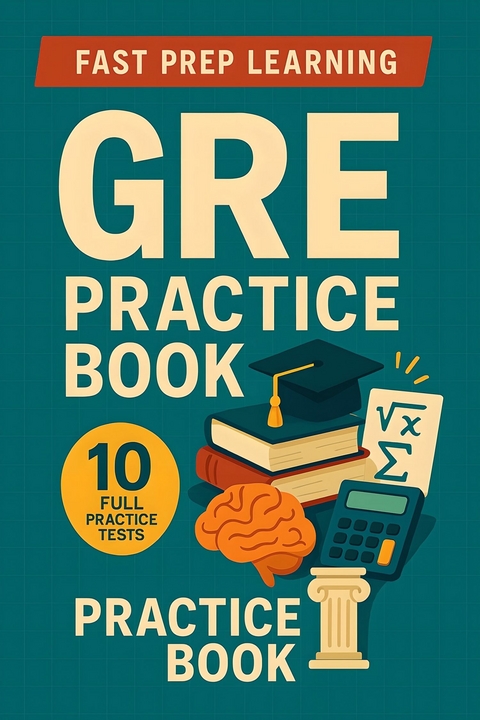
GRE Practice Book (eBook)
335 Seiten
Publishdrive (Verlag)
978-0-00-109772-8 (ISBN)
What if I told you that preparing for the GRE with real confidence-without stress, without confusion, and without feeling unready-can become your reality?
If you're worried you haven't practiced enough full-length GRE-style tests or you're unsure how well you'll perform under real timing pressure, then training with complete, exam-accurate practice tests can be your answer.
It can dramatically improve your Quantitative, Verbal, and Analytical Writing performance-because nothing prepares you better than practicing with tests that match the exact structure and difficulty of the modern GRE.
This practice book was designed with one clear mission: to simulate the real GRE using 15 full-length practice tests aligned with ETS' official test format, each including clear answer explanations to help you improve fast and strengthen weak areas.
Every test reflects real GRE logic: Complex Reading passages, Text Completion, Sentence Equivalence, Algebra, Geometry, Data Analysis, and multi-step Quantitative Reasoning.
You'll face realistic question patterns, academic vocabulary, and true GRE-style reasoning challenges.
Whether you're applying for graduate school, business school, STEM programs, or simply aiming to raise your score, these full-length exams give you the repetition, pacing, and clarity you need. And you don't need long study sessions.
With just 30-40 minutes a day, this system keeps your prep structured, focused, and manageable.
If you're unsure whether this will help, don't worry. Inside this book you'll find complete GRE-level tests that reveal strengths, expose weak points, and show exactly how close you are to your target score.
This is perfect if you want a cost-effective, organized way to practice without relying on expensive prep courses or scattered online questions. Whether you struggle with dense passages, vocabulary logic, quantitative comparisons, word problems, or time management, these tests train you to think exactly the way the GRE expects.
Here is just a fraction of what you'll discover inside this book:
15 full-length GRE practice tests mirroring real exam difficulty
• Answer explanations for every question to reinforce understanding
• A structured 4-week testing schedule for consistent practice
• Accurate coverage of all sections: Verbal, Quantitative, and Analytical Writing
• Hundreds of exam-style questions that build accuracy and confidence
• Timed practice sessions to help you master pacing under pressure
• Up-to-date content aligned with the latest GRE structure
• A realistic graduate-level test simulation ideal for students who improve fastest through repetition
Practice Test 1
Logical Reasoning 1 (Q1–Q25)
Q1. Studies show that students who study in groups tend to perform better than those who study alone. Therefore, forming study groups is the best way to improve academic performance.
A) The argument assumes that all students learn best in groups.
B) The argument shows that studying alone is ineffective.
C) Group study is better than tutoring.
D) Academic performance depends entirely on study methods.
E) Students prefer group study to studying alone.
Correct: A
Why: It assumes that group study is universally effective, which is not proven.
Q2. A new company claims that its energy drink increases alertness by 50%. However, the study was conducted on only ten volunteers over a single day.
A) The sample size is too small to generalize.
B) Energy drinks are generally safe.
C) Alertness cannot be measured.
D) Ten volunteers is enough for a valid study.
E) The company sells other drinks.
Correct: A
Why: The small sample size undermines the claim’s reliability.
Q3. If a plant species is genetically modified to grow faster, it will produce more fruit. However, these plants often require more water than normal.
A) Faster growth always reduces water needs.
B) Increased fruit production is guaranteed in all conditions.
C) Modifying plants may increase water requirements.
D) Fruit production is unrelated to growth.
E) Water needs remain constant.
Correct: C
Why: The modification may have unintended consequences like higher water demand.
Q4. A survey finds that people who exercise in the morning report higher energy levels throughout the day.
A) Morning exercise causes higher energy.
B) People who exercise at night are less healthy.
C) Evening exercise is ineffective.
D) All people feel energetic after any exercise.
E) The survey proves causation.
Correct: A
Why: The argument assumes morning exercise causes higher energy but does not prove it.
Q5. A city bans plastic bags to reduce pollution. Critics argue that paper bags also cause environmental harm.
A) Plastic bags are harmless.
B) Paper bags may not eliminate pollution.
C) Banning plastic solves all pollution problems.
D) Recycling is unnecessary.
E) Consumers prefer paper bags.
Correct: B
Why: The argument points out that paper bags have environmental costs too.
Q6. Some people believe that reading fiction improves empathy, but recent studies show mixed results.
A) Fiction always improves empathy.
B) Reading fiction is useless.
C) Empathy is influenced by multiple factors.
D) Non-fiction reduces empathy.
E) Studies conclusively prove fiction’s effect.
Correct: C
Why: Mixed results indicate other factors influence empathy besides reading fiction.
Q7. A company advertises that its product is “eco-friendly,” but an independent audit finds it still emits greenhouse gases.
A) The advertisement is fully accurate.
B) Eco-friendliness is irrelevant.
C) The company’s claim may be misleading.
D) All products are eco-friendly.
E) Greenhouse gases have no effect.
Correct: C
Why: The audit suggests the claim may overstate environmental benefits.
Q8. A study shows that children who sleep at least 9 hours score higher on tests, suggesting more sleep improves learning.
A) More sleep always increases intelligence.
B) Test scores depend on many factors besides sleep.
C) Less sleep is better for children.
D) Sleeping longer guarantees success.
E) Study time is irrelevant.
Correct: B
Why: Correlation does not confirm causation; other factors may affect test scores.
Q9. A politician claims that lowering taxes will increase business investment. Economic data, however, shows inconsistent effects.
A) Tax policy alone determines investment.
B) Lower taxes always increase investment.
C) Investment depends on multiple economic factors.
D) Businesses ignore taxes.
E) Investment is random.
Correct: C
Why: Economic outcomes depend on more than just tax rates.
Q10. A new fitness app claims users will lose weight in 30 days. Clinical evidence shows average weight loss is minimal.
A) All users will lose weight.
B) App claims may be exaggerated.
C) Weight loss is impossible.
D) Fitness apps always fail.
E) Diet has no effect.
Correct: B
Why: The evidence suggests the company’s claims overstate likely results.
Q11. People who take multivitamins report feeling healthier, but there is no clinical evidence of measurable benefit.
A) Multivitamins guarantee health.
B) Feeling healthier proves vitamins work.
C) Subjective reports do not confirm effectiveness.
D) Clinical evidence is unnecessary.
E) Vitamins are harmful.
Correct: C
Why: Self-reports cannot replace objective clinical proof.
Q12. Sales increased after a new ad campaign, so the company concludes the campaign caused the rise.
A) Correlation confirms causation.
B) Other factors could explain the sales increase.
C) Advertising has no effect.
D) Sales data is irrelevant.
E) Campaigns always fail.
Correct: B
Why: The conclusion assumes causation without ruling out other variables.
Q13. A study shows people who meditate are less stressed, but participants were volunteers already interested in meditation.
A) Meditation always reduces stress.
B) Volunteer bias may affect results.
C) Stress levels are unimportant.
D) Meditation is harmful.
E) All studies are unreliable.
Correct: B
Why: The sample may not represent the general population.
Q14. A company states its phones have the fastest processor, but independent tests show similar speeds to competitors.
A) The claim is fully accurate.
B) Marketing may exaggerate speed advantages.
C) Speed is irrelevant to consumers.
D) Competitors are slower.
E) Testing is unnecessary.
Correct: B
Why: Independent tests challenge the company’s claim.
Q15. Students who study late at night report higher alertness in exams, so late-night study is recommended.
A) Late-night studying always improves performance.
B) Self-reports may not reflect actual results.
C) Studying in the morning is ineffective.
D) Exam scores depend only on alertness.
E) Sleep is irrelevant.
Correct: B
Why: Self-reported alertness may not translate into better performance.
Q16. A new diet pill claims to reduce appetite, but only a minority of users see results.
A) The pill is effective for all users.
B) Marketing claims may overstate effectiveness.
C) Appetite is unaffected by diet.
D) All pills are harmful.
E) Results are guaranteed.
Correct: B
Why: Limited effectiveness means the claim is exaggerated.
Q17. Students who use flashcards score higher on vocabulary tests, leading to a claim that flashcards improve learning.
A) Flashcards are irrelevant.
B) The study proves causation.
C) Other study methods may contribute to higher scores.
D) Only visual learning works.
E) Vocabulary tests are invalid.
Correct: C
Why: Multiple factors could explain improved scores, not just flashcards.
Q18. A city installs new bike lanes and observes fewer traffic accidents, concluding the lanes improved safety.
A) Bike lanes are dangerous.
B) Accident reduction may be due to other factors.
C) Traffic safety is unrelated to infrastructure.
D) All cities need bike lanes.
E) Accidents are random.
Correct: B
Why: Correlation does not confirm causation; other factors may reduce accidents.
Q19. A pharmaceutical company claims its drug cures headaches, but trials show only marginal improvement over a placebo.
A) The drug is highly effective.
B) Placebo effects are irrelevant.
C) The claim overstates the drug’s effectiveness.
D) Headaches cannot be treated.
E) Trials are unnecessary.
Correct: C
Why: Marginal improvement does not support the strong claim.
Q20. People who read news in print report feeling more informed, but online readers have similar factual knowledge.
A) Feeling informed equals being informed.
B) Print reading guarantees knowledge.
C) Perception of being informed may not match actual knowledge.
D) Online reading is ineffective.
E) News consumption is unnecessary.
Correct: C
Why: Subjective perception does not equal objective knowledge.
Q21. Students who participate in arts programs have higher creativity scores, but they also have more parental support.
A) Arts programs guarantee creativity.
B) Parental support may contribute to creativity.
C) Creativity is innate only.
D) Participation in arts programs is irrelevant.
E) Scores are random.
Correct: B
Why: Other factors like parental support may explain higher creativity.
Q22. A survey shows people who walk 10,000 steps daily report better health, though they also tend to eat healthier diets.
A) Walking alone ensures good health.
B) Diet may contribute to perceived health benefits.
C) Steps are irrelevant.
D) Walking is harmful.
E) Surveys prove...
| Erscheint lt. Verlag | 5.11.2025 |
|---|---|
| Sprache | englisch |
| Themenwelt | Sachbuch/Ratgeber ► Beruf / Finanzen / Recht / Wirtschaft ► Bewerbung / Karriere |
| ISBN-10 | 0-00-109772-5 / 0001097725 |
| ISBN-13 | 978-0-00-109772-8 / 9780001097728 |
| Informationen gemäß Produktsicherheitsverordnung (GPSR) | |
| Haben Sie eine Frage zum Produkt? |
 EPUB (Adobe DRM)
Größe: 1,1 MB
Kopierschutz: Adobe-DRM
Adobe-DRM ist ein Kopierschutz, der das eBook vor Mißbrauch schützen soll. Dabei wird das eBook bereits beim Download auf Ihre persönliche Adobe-ID autorisiert. Lesen können Sie das eBook dann nur auf den Geräten, welche ebenfalls auf Ihre Adobe-ID registriert sind.
Details zum Adobe-DRM
Dateiformat: EPUB (Electronic Publication)
EPUB ist ein offener Standard für eBooks und eignet sich besonders zur Darstellung von Belletristik und Sachbüchern. Der Fließtext wird dynamisch an die Display- und Schriftgröße angepasst. Auch für mobile Lesegeräte ist EPUB daher gut geeignet.
Systemvoraussetzungen:
PC/Mac: Mit einem PC oder Mac können Sie dieses eBook lesen. Sie benötigen eine
eReader: Dieses eBook kann mit (fast) allen eBook-Readern gelesen werden. Mit dem amazon-Kindle ist es aber nicht kompatibel.
Smartphone/Tablet: Egal ob Apple oder Android, dieses eBook können Sie lesen. Sie benötigen eine
Geräteliste und zusätzliche Hinweise
Buying eBooks from abroad
For tax law reasons we can sell eBooks just within Germany and Switzerland. Regrettably we cannot fulfill eBook-orders from other countries.
aus dem Bereich