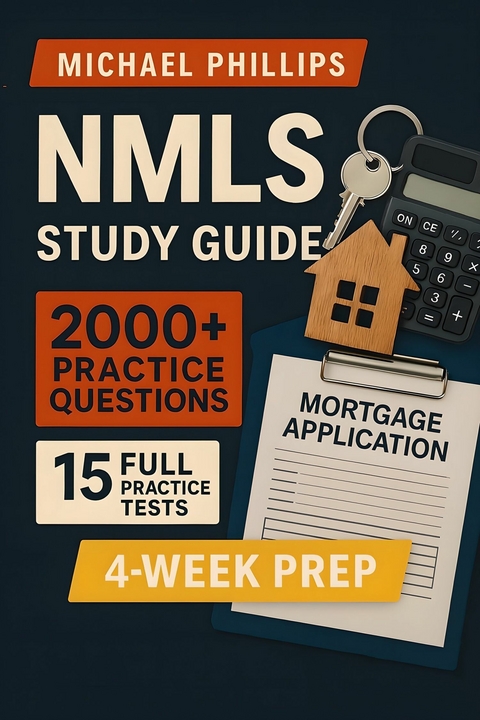
NMLS Study Guide (eBook)
161 Seiten
Publishdrive (Verlag)
978-0-00-109771-1 (ISBN)
What if I told you that preparing for the NMLS SAFE MLO exam with confidence-without stress, without confusion, and without feeling overwhelmed-can become your reality?
If you're worried you won't pass on the first attempt or certain mortgage concepts still feel unclear, then following a structured, exam-aligned study plan can be your answer.
It can significantly improve your understanding of federal laws, ethics, mortgage products, compliance, and loan-origination fundamentals.
It's so effective because every chapter mirrors real NMLS testing logic, using clear explanations, simple examples, and exam-style reasoning that match the SAFE exam exactly.
All lessons follow the official NMLS content outline, making this guide ideal for future mortgage loan officers, career changers, and anyone seeking a strong, organized prep method.
So whether you're brand new to lending or refreshing after coursework, this book supports every starting level.
You don't need mortgage experience to benefit-but it becomes even more valuable if earning your MLO license is your next career step. So you get one study guide... built for first-time test takers, retakers, and busy adults who want a reliable, easy-to-follow path to passing.
And if you feel unsure whether this can truly help, don't worry.
Inside this guide you'll find simple breakdowns, compliance-focused explanations, and test strategies designed to make complex regulations easier to understand.
You don't need long study sessions.Even with 30 minutes a day, this system helps you learn quickly, retain key laws, and stay confident.
This works best if you want a cost-effective prep solution without confusing textbooks or expensive prep courses. Whether you struggle with TILA, RESPA, ECOA, compliance timelines, ethics, or loan products, each chapter teaches you how to answer questions the way the exam expects.
Here is just a fraction of what you'll discover inside this book:
A complete 4-week NMLS study plan with daily goals
• Full SAFE exam coverage: Federal Law, General Mortgage Knowledge, Ethics, and UST
• Clear explanations of TILA, RESPA, HMDA, ECOA, MAP, FACTA, and other key regulations
• Mortgage products, loan types, underwriting basics, and qualification rules
• Ethics, consumer protection, advertising rules, and prohibited practices
• Loan calculations and examples explained step-by-step
• 90+ NMLS-style practice questions with detailed reasoning
• Short, focused lessons ideal for busy schedules
• Up-to-date content aligned with the modern SAFE exam
• Quick-reference charts, compliance timelines, and vocabulary lists included
CHAPTER 1 — THE MORTGAGE INDUSTRY OVERVIEW
Overview
The mortgage industry sits at the center of one of the most important economic engines in the United States: residential real estate. For first-time NMLS test takers, this chapter builds the foundation you must understand before moving into federal regulations, disclosure rules, ethics, and loan calculations. At its core, the mortgage industry exists to connect borrowers who want to buy homes with lenders and investors who provide the funds. But behind every loan is a web of rules, risk decisions, loan products, compliance standards, and market behavior.
This chapter gives you the “big picture”—the industry structure, key participants, the differences between conventional, government, and nontraditional loans, and the market forces that shape demand for mortgage credit. Understanding this context will make the regulatory chapters that follow far easier and will help you recognize why the SAFE Act, RESPA, TILA, ECOA, and TRID exist.
Learning Objectives
By the end of Chapter 1, you will be able to:
- Explain the purpose and role of the U.S. mortgage industry
- Identify major participants including lenders, investors, regulators, and MLOs
- Differentiate conventional, government-backed, and nontraditional loan products
- Understand how market cycles influence lending activity
1.1 What the Mortgage Industry Does
The mortgage industry fulfills three essential functions:
1. It Provides Access to Homeownership
Most Americans do not have the cash to purchase a property outright. Mortgage lenders bridge that gap by offering long-term financing—typically 15 to 30 years—allowing borrowers to buy now and pay over time. Without mortgage credit, homeownership rates would collapse.
2. It Manages and Prices Risk
Every mortgage loan is a risk decision.
Lenders must evaluate:
- The borrower’s likelihood of repayment
- The property’s stability as collateral
- Broader economic conditions
This risk is priced through interest rates, discount points, risk-based adjustments, and underwriting standards.
3. It Supports the Broader Financial System
Mortgages are not just loans—they are financial assets that can be bundled, sold, securitized, or held in investment portfolios.
This creates liquidity: lenders can free up capital and continue originating new loans.
This flow of money—borrowers, lenders, investors—keeps the housing market and the broader economy functioning.
1.2 Key Market Participants
The NMLS exam expects you to know not only what these entities do, but how they interact.
Borrowers
Consumers seeking financing for a home purchase, refinance, or equity loan.
Mortgage Loan Originators (MLOs)
MLOs (you) serve as the connection point between borrowers and lending institutions.
Your responsibilities include:
- Evaluating borrower needs
- Collecting applications and disclosures
- Educating borrowers
- Complying with TRID timing
- Preventing steering, discrimination, and misrepresentation
Under the SAFE Act, MLOs must be properly licensed or registered.
Lenders
Lenders come in several categories:
- Depository Institutions: Banks, credit unions (regulated federally)
- Non-Depository Lenders: Mortgage companies (state-licensed)
- Correspondent Lenders: Originate loans and sell them quickly
- Direct Lenders: Fund loans directly with their own capital
Secondary Market Investors
Once a loan closes, lenders often sell it to:
- Fannie Mae
- Freddie Mac
- Ginnie Mae–backed issuers
- Private investors
The secondary market sets underwriting expectations, loan size limits, and risk standards.
Regulators
You will study these in depth later, but here are the essentials now:
- CFPB → Oversees most consumer protection rules (TILA, RESPA, HMDA).
- HUD → Oversees FHA.
- VA → Guarantees VA loans.
- USDA → Guarantees rural housing loans.
- CSBS + State Regulators → Oversee MLO licensing and SAFE Act enforcement.
1.3 Conventional vs. Government Loan Structures
Every loan fits into one of three broad categories tested on the NMLS exam:
A. Conventional Loans
These loans are not insured or guaranteed by the government.
They split into:
- Conforming (meet Fannie/Freddie standards)
- Non-conforming (jumbo, portfolio loans, etc.)
Conforming loans follow rules on:
• maximum loan size
• DTI
• LTV
• credit score
• documentation requirements
Risk is entirely on the lender or investor—no government backing.
B. Government Loans
These loans are insured or guaranteed by U.S. federal agencies.
FHA Loans
- Insured by HUD
- Low down payment
- More forgiving credit standards
- Require MIP (Mortgage Insurance Premium)
VA Loans
- Guaranteed by the U.S. Department of Veterans Affairs
- Only for eligible veterans
- No down payment required
- No monthly mortgage insurance
USDA Loans
- Guarantee structure for rural properties
- Income and geographic restrictions
- 0% down payment for eligible borrowers
Government loans expand homeownership access for borrowers who may not qualify under conventional standards.
C. Nontraditional Loans
Nontraditional loans are anything outside fixed-rate or standard ARM structures.
Examples include:
- Interest-only loans
- Negative amortization
- Option ARMs
- Non-QM (non-qualified mortgage) structures
- Bank-statement loans
- Hard-money loans
While not illegal, they carry higher risk and require stronger ability-to-repay documentation.
The NMLS exam frequently tests your ability to identify risky loan features and recognize where non-QM mortgages differ from Qualified Mortgage (QM) standards.
1.4 Nontraditional & Subprime Loans
Before the 2008 housing collapse, nontraditional and subprime loans dominated the industry.
Today they still exist—but under strict scrutiny.
Nontraditional Loans
These loans break standard amortization patterns.
Red flags include:
- Payment shock after interest-only periods
- Negative amortization
- Teaser rates that reset dramatically
Subprime Loans
Subprime refers to borrower credit risk, not loan type.
Borrowers may be subprime due to:
- Low credit scores
- High DTI
- Limited reserves
- Prior delinquencies
The NMLS exam expects you to distinguish loan structure risk (nontraditional) from borrower credit risk (subprime).
1.5 Market Cycles and Loan Demand
Mortgage lending rises and falls based on economic cycles.
When rates fall:
- Refinances surge
- Demand for homes increases
- Lenders relax some credit overlays
- Loan officers see higher volume
When rates rise:
- Purchase volume slows
- Refinances collapse
- Borrowers struggle to qualify
- Lenders tighten underwriting rules
Economic factors affecting demand include:
- Inflation
- Unemployment
- Federal Reserve policy
- Housing supply
- Consumer confidence
Understanding these cycles helps explain why certain regulations—such as ATR, QM, and TRID—were created to stabilize lending standards regardless of market volatility.
Quick Checks (Mini-Questions)
- Who guarantees VA loans—HUD, VA, or USDA?
- What is the key difference between conventional and government loans?
- Which loan type involves teaser rates and payment shock?
- Who oversees TRID timing rules?
- What entity buys conforming loans on the secondary market?
1.6 How Mortgage Loans Are Funded
To understand the mortgage industry fully, you must recognize where the money actually comes from. The NMLS exam expects you to differentiate two core funding models: portfolio lending and secondary-market lending.
A. Portfolio Lending
A portfolio lender funds the loan and keeps it on its own books, holding it as an asset.
Characteristics:
- The lender sets its own underwriting overlays
- The loan does not need to meet Fannie/Freddie standards
- Often used for niche or “make sense” approvals
- Common among credit unions, small banks, and private lenders
Advantages:
Flexibility and ability to serve unique borrowers.
Disadvantages:
Lender carries all repayment risk → often results in higher rates.
B. Secondary Market Lending
Most loans today are originated with the intent to be sold.
Step-by-Step Flow:
- Lender funds the loan at closing
- Loan is sold to an investor (Fannie Mae, Freddie Mac, Ginnie Mae–backed issuer, or private entity)
- Servicer collects payments
- Investor receives returns through interest...
| Erscheint lt. Verlag | 5.11.2025 |
|---|---|
| Sprache | englisch |
| Themenwelt | Sachbuch/Ratgeber ► Beruf / Finanzen / Recht / Wirtschaft ► Bewerbung / Karriere |
| ISBN-10 | 0-00-109771-7 / 0001097717 |
| ISBN-13 | 978-0-00-109771-1 / 9780001097711 |
| Informationen gemäß Produktsicherheitsverordnung (GPSR) | |
| Haben Sie eine Frage zum Produkt? |
 EPUB (Adobe DRM)
Größe: 1,1 MB
Kopierschutz: Adobe-DRM
Adobe-DRM ist ein Kopierschutz, der das eBook vor Mißbrauch schützen soll. Dabei wird das eBook bereits beim Download auf Ihre persönliche Adobe-ID autorisiert. Lesen können Sie das eBook dann nur auf den Geräten, welche ebenfalls auf Ihre Adobe-ID registriert sind.
Details zum Adobe-DRM
Dateiformat: EPUB (Electronic Publication)
EPUB ist ein offener Standard für eBooks und eignet sich besonders zur Darstellung von Belletristik und Sachbüchern. Der Fließtext wird dynamisch an die Display- und Schriftgröße angepasst. Auch für mobile Lesegeräte ist EPUB daher gut geeignet.
Systemvoraussetzungen:
PC/Mac: Mit einem PC oder Mac können Sie dieses eBook lesen. Sie benötigen eine
eReader: Dieses eBook kann mit (fast) allen eBook-Readern gelesen werden. Mit dem amazon-Kindle ist es aber nicht kompatibel.
Smartphone/Tablet: Egal ob Apple oder Android, dieses eBook können Sie lesen. Sie benötigen eine
Geräteliste und zusätzliche Hinweise
Buying eBooks from abroad
For tax law reasons we can sell eBooks just within Germany and Switzerland. Regrettably we cannot fulfill eBook-orders from other countries.
aus dem Bereich