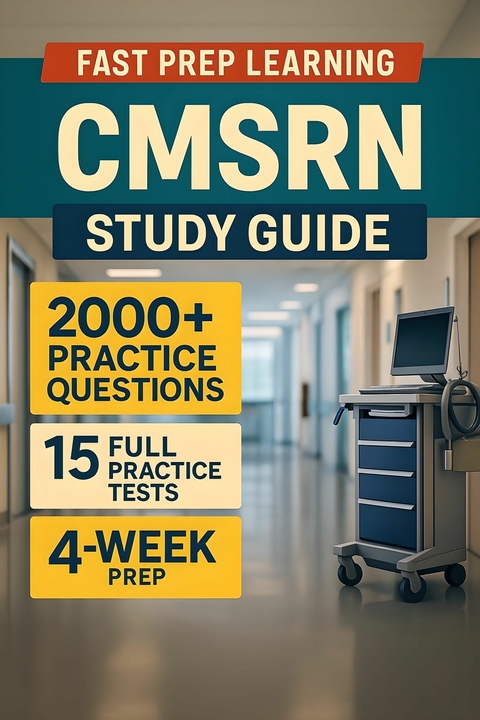
CMSRN Study Guide (eBook)
20 Seiten
Publishdrive (Verlag)
978-0-00-109766-7 (ISBN)
What if I told you that preparing for the CMSRN exam with confidence-without overwhelm, without confusion, and without doubting your clinical knowledge-can become your reality?
If you're worried you won't pass on the first attempt or certain med-surg topics still feel unclear, then following a clinically aligned study plan can be your answer.
It can significantly strengthen your nursing judgment, patient-care reasoning, and understanding of the conditions most frequently tested on the CMSRN.
It's so effective because every chapter mirrors the real CMSRN exam blueprint, using clear explanations, clinical examples, and test-style questions that match the way med-surg nurses think.
All lessons follow the MSNCB standards, making this guide ideal for new med-surg nurses, experienced staff, travel nurses, and retakers who want a structured path to passing. So whether you're reviewing after years of practice or studying fresh out of school, this book supports every level.
You don't need advanced certifications to benefit-but it becomes even more powerful if earning your CMSRN is your next professional goal. So you get one study guide... built for busy nurses who want clarity, efficiency, and fast mastery of key concepts.
And if you feel unsure whether this can really help, don't worry.
Inside this guide you'll find simple explanations, real patient scenarios, and focused strategies that make complex med-surg topics easier to understand.
You don't need long study sessions. Even with 30 minutes a day, this system helps you learn quickly, build confidence, and stay consistent. This works best if you want a cost-effective prep solution without overwhelming textbooks or pricey review courses.
Whether you struggle with cardiac conditions, respiratory care, endocrine disorders, renal issues, or GI and GU problems, each chapter teaches you how to answer questions the way the CMSRN exam expects.
Here is just a fraction of what you'll discover inside this book:
A complete 4-week CMSRN study plan with daily goals
• All MSNCB domains covered: Patient Care, Education, Safety, Collaboration, and Professional Practice
• Cardiac, respiratory, GI, GU, endocrine, neuro, and musculoskeletal essentials
• Chronic illness management explained with clear, clinical logic
• Fluid/electrolyte balance, labs, wound care, and infection control
• Pharmacology fundamentals with key nursing considerations
• Special-population care: older adults, bariatric, and high-risk patients
• 90+ CMSRN-style practice questions with step-by-step reasoning
• Short, focused lessons ideal for busy shifts
• Up-to-date content aligned with the current exam
• Quick-reference tables, assessment guides, and cheat sheets
To get your copy right now, just scroll up and click 'Add to Cart.'
CHAPTER 1 — UNDERSTANDING THE CMSRN EXAM
Overview
The Certified Medical-Surgical Registered Nurse (CMSRN) exam evaluates whether a med-surg nurse can deliver safe, effective, evidence-based care under real clinical pressure. This is not a memorization exam. It is a reasoning exam. Every question is built around prioritization, safe nursing judgment, and the ability to translate assessment findings into timely actions.
For first-time test takers, the challenge isn’t the content — you already practice this daily. The challenge is the format: transforming real-world nursing intuition into exam-friendly logic. This chapter explains how the CMSRN exam works, how it is scored, and what strategies give first-time candidates the strongest advantage.
Learning Objectives
By the end of this chapter, you should be able to:
- Explain the purpose and structure of the CMSRN exam.
- Identify the exam domains and how they appear in question scenarios.
- Understand the scoring model and how passing decisions are made.
- Navigate test-day procedures smoothly with no surprises.
- Build a realistic, effective study plan tailored to first-time test takers.
What the CMSRN Certification Represents
The CMSRN credential is one of the most respected med-surg certifications in the field. It validates that a nurse:
- Demonstrates safe nursing judgment.
- Applies evidence-based decisions consistently.
- Understands acute vs chronic patterns across all major body systems.
- Prioritizes effectively using frameworks like ABCDE, SBAR, and triage principles.
- Recognizes safety risks early and acts to prevent harm.
While the exam covers wide content, it consistently tests how nurses think, not how much they remember.
Why Hospitals Value CMSRN Certification
Hospitals rely on CMSRN-certified nurses for units with high complexity—telemetry, med-surg, step-down, post-op recovery, and progressive care. Certified nurses are statistically more accurate in:
- Early detection of deterioration
- Managing lab trends
- Delegation and prioritization
- Reducing preventable complications
This is why the CMSRN exam focuses on clinical reasoning above all else.
Exam Blueprint & Domains
The exam is organized into major domains. These domains determine how many questions you’ll see in each area.
Below is a simplified, exam-focused version of the blueprint:
1. Assessment and Diagnosis
Focuses on:
- Identifying abnormal findings
- Interpreting lab values
- Early red-flag recognition
2. Planning and Implementation
Covers:
- Priority interventions
- Medication safety
- Care coordination
- Delegation
3. Evaluation
Involves:
- Measuring response to treatment
- Recognizing improvement vs deterioration
- Adjusting care plans
4. Professional Role
Includes:
- Ethics
- Legal responsibilities
- Scope of practice
- Communication (SBAR, patient education)
5. Physiologic Adaptation
The largest domain. Focused on:
- Cardiovascular
- Respiratory
- GI
- Renal
- Endocrine
- Neuro
- Hematologic
This domain typically generates the most complex, scenario-based questions.
Scoring System & Passing Standards
The CMSRN exam uses a scaled scoring system, not a raw percentage. This gives you protection against a “hard version” of the exam.
Key points every test taker must know:
- You are not penalized for wrong answers.
- All questions are weighted by difficulty.
- Most exams contain multiple “experimental” questions that do NOT count toward your score.
- The passing score is based on the difficulty-adjusted performance, not the number of correct answers.
What this means for you
- Never leave a question blank.
- If two answers both seem correct, choose the one that reflects safety, stability, or early detection.
- Even strong test takers often can't tell which questions are experimental. Treat every question seriously.
Test-Day Process and Logistics
Walking into the exam knowing exactly what to expect lowers anxiety and improves performance.
Before the Exam
- Arrive 30 minutes early.
- Bring valid photo ID.
- Lockers are provided for personal items.
- No notes, watches, or phones allowed.
During Check-In
- Palm vein scan or photo (depending on center).
- The proctor explains rules.
- You receive a whiteboard or laminated sheet with a marker.
During the Exam
- Total time: 3 hours.
- You can take an unscheduled break, but the clock keeps running.
- Questions must be answered in order; you can mark for review but cannot skip ahead.
After the Exam
- You receive a preliminary result immediately.
- Official results arrive later from the certifying body.
Strategic Study Planning for First-Time Test Takers
First-time passers almost always follow a predictable pattern of study success:
1. They study by domain—not by random topics.
Your outline is built to reflect the exam blueprint. Each chapter reinforces a domain.
2. They prioritize high-yield systems (Cardio, Respiratory, Endocrine, GI).
These four systems often represent nearly half of the exam.
3. They practice answering with reasoning, not memory.
For example:
Example:
A postoperative patient reports new shortness of breath and tachycardia.
What is your priority?
This is not asking for a definition — it’s asking for a priority action based on recognizing early clinical deterioration.
4. They review common distractor patterns.
Exam writers frequently include:
- Outdated practices
- Interventions outside RN scope
- Reassurance instead of action
- Assessment after action
- Interventions that treat symptoms but ignore airway/breathing
5. They use short, frequent sessions—not marathon studying.
Most first-time passers study:
- 60–90 minutes at a time
- 5–6 days per week
- For 6–8 weeks
Quick Checks (Self-Assessment)
Try these now:
- What does scaling mean in the CMSRN scoring system, and how does it protect you?
- Which exam domain is the largest and most scenario-heavy?
- Why is the CMSRN exam more about reasoning than memorization?
(Answers will be reinforced at the end of the chapter.)
Deep Dive: How CMSRN Questions Are Built
Understanding how questions are designed is one of the strongest advantages you can have as a first-time test taker. Each CMSRN question follows a predictable structure:
- Clinical scenario
- Key assessment finding or change
- A decision point requiring nursing judgment
- Four answer choices with one clear priority
Hallmark Features of CMSRN Questions
1. They’re short but loaded with critical clues.
CMSRN questions avoid fluff. Every word is intentional.
2. They often contain a “pivot point”—the single sentence that reveals the priority.
Example pivot points include:
- New confusion
- Sudden vital sign changes
- Rapid glucose shifts
- One-sided weakness
- Bleeding that increases
3. They expect exam-level prioritization, not bedside intuition.
At the bedside, you may act instinctively.
On the exam, you must show why a decision is correct.
High-Yield Frameworks for the CMSRN Exam
These frameworks appear constantly in correct answer choices.
ABCDE
Airway → Breathing → Circulation → Disability → Exposure
Used for all acute scenarios.
Example:
A patient has sudden stridor and is visibly anxious.
- Priority: Airway
- Not priority: repositioning, teaching, or “monitor”
SBAR
Communication framework used in many nurse-to-provider questions.
Nursing Judgment
All correct answers must:
- Protect the patient
- Reflect scope of practice
- Prevent or reduce harm
- Show timely recognition of changes
Maslow
Physiologic needs always outrank psychosocial ones.
Common Traps in CMSRN Answer Choices
CMSRN exam writers use highly predictable distractors.
Avoiding these traps raises your score immediately.
Trap 1: “Monitor” When Action Is Required
If the patient is unstable or showing signs of deterioration, “monitor” is almost always wrong.
Bad answer pattern:
- “Continue to observe the patient.”
Reason: CMSRN expects identification of early red flags.
Trap 2: Doing Something Outside RN Scope
Examples of unsafe scope violations:
- Changing the pain medication dose
- Adjusting insulin without provider orders
- Interpreting imaging...
| Erscheint lt. Verlag | 5.11.2025 |
|---|---|
| Sprache | englisch |
| Themenwelt | Sachbuch/Ratgeber ► Beruf / Finanzen / Recht / Wirtschaft ► Bewerbung / Karriere |
| ISBN-10 | 0-00-109766-0 / 0001097660 |
| ISBN-13 | 978-0-00-109766-7 / 9780001097667 |
| Informationen gemäß Produktsicherheitsverordnung (GPSR) | |
| Haben Sie eine Frage zum Produkt? |
 EPUB (Adobe DRM)
Größe: 1,3 MB
Kopierschutz: Adobe-DRM
Adobe-DRM ist ein Kopierschutz, der das eBook vor Mißbrauch schützen soll. Dabei wird das eBook bereits beim Download auf Ihre persönliche Adobe-ID autorisiert. Lesen können Sie das eBook dann nur auf den Geräten, welche ebenfalls auf Ihre Adobe-ID registriert sind.
Details zum Adobe-DRM
Dateiformat: EPUB (Electronic Publication)
EPUB ist ein offener Standard für eBooks und eignet sich besonders zur Darstellung von Belletristik und Sachbüchern. Der Fließtext wird dynamisch an die Display- und Schriftgröße angepasst. Auch für mobile Lesegeräte ist EPUB daher gut geeignet.
Systemvoraussetzungen:
PC/Mac: Mit einem PC oder Mac können Sie dieses eBook lesen. Sie benötigen eine
eReader: Dieses eBook kann mit (fast) allen eBook-Readern gelesen werden. Mit dem amazon-Kindle ist es aber nicht kompatibel.
Smartphone/Tablet: Egal ob Apple oder Android, dieses eBook können Sie lesen. Sie benötigen eine
Geräteliste und zusätzliche Hinweise
Buying eBooks from abroad
For tax law reasons we can sell eBooks just within Germany and Switzerland. Regrettably we cannot fulfill eBook-orders from other countries.
aus dem Bereich