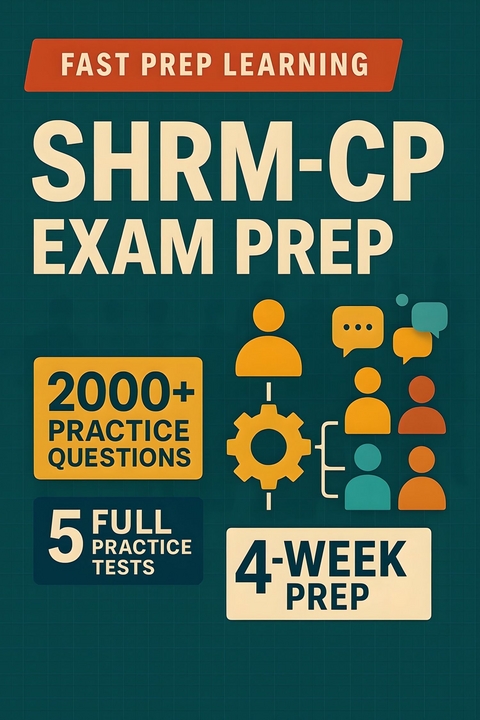
SHRM CP Exam Prep (eBook)
159 Seiten
Publishdrive (Verlag)
978-0-00-109763-6 (ISBN)
What if I told you that preparing for the SHSAT with confidence-without stress, without confusion, and without feeling overwhelmed-can become your reality?
If you're worried your child won't score high enough for a specialized high school or certain sections feel too hard, then following a focused, student-friendly study plan can be your answer.
It can significantly improve performance in both English Language Arts and Math.
It's so effective because every chapter mirrors real SHSAT logic-reading passages, revising/editing skills, grid-in math, and multi-step word problems-explained in a simple, supportive way students actually understand.
All lessons follow the current SHSAT format, making this guide perfect for 8th-grade students, motivated 7th graders, and families preparing for top NYC specialized high schools. So whether your child is aiming for Stuyvesant, Bronx Science, Brooklyn Tech, or any SHSAT school, this guide supports every starting level.
Your student doesn't need advanced skills to benefit-but it becomes even more powerful if admission to a competitive school is the goal.
So you get one prep book... built for beginners, strong students, and anyone who wants a clear, structured path to higher scores.
And if you feel unsure whether this can truly help, don't worry.
Inside this guide you'll find clean explanations, student-friendly examples, and score-boosting strategies designed to build confidence quickly.
Your child doesn't need long study sessions. Even 20-30 minutes a day can create major improvement without stress.
This works best if you want an affordable, easy-to-use resource without expensive tutors or confusing worksheets.
Whether your child struggles with reading comprehension, grammar, algebra, geometry, or tricky word problems, each chapter teaches concepts in a simple, motivating way.
Here is just a fraction of what you'll discover inside this book:
A complete 4-week SHSAT study plan with daily targets
• Full coverage of ELA and Math sections
• Reading strategies to understand passages quickly and accurately
• Revising/editing rules explained in simple steps
• Math foundations: equations, ratios, functions, geometry, and word problems
• High-yield grammar and writing patterns used on the exam
• Grid-in practice with clear, step-by-step explanations
• 90+ SHSAT-style practice sets modeled after the real exam
• Short, manageable lessons ideal for middle school students
• Up-to-date content aligned with the current SHSAT format
• Skill checklists, quick reviews, and progress trackers included
CHAPTER 1 — Understanding the SHRM-CP Exam Structure
Overview
The SHRM-CP exam measures a candidate’s ability to think and act like an HR professional in real workplace scenarios. It is not a memorization test. Instead, it evaluates how well you apply HR principles, ethical judgment, and behavioral competencies when navigating real-world employee challenges. This chapter prepares you to fully understand the exam format, the competency framework behind the questions, and what SHRM expects from a first-time test taker.
The SHRM-CP evaluates both behavioral competencies and technical HR expertise, blending theory with practice in a way that mirrors the role of an early- to mid-career HR professional. This chapter gives you the foundation needed to interpret questions correctly, manage time efficiently, and approach the exam with confidence.
Learning Objectives
By the end of this chapter, you will be able to:
- Explain the purpose and structure of the SHRM-CP exam
- Differentiate behavioral competencies from technical knowledge
- Understand the exam format, question types, and scoring system
- Recognize what SHRM expects from a first-time HR professional
- Prepare yourself mentally for exam-day execution
SHRM Competency Model Overview
To perform well on the SHRM-CP, you must understand the SHRM Behavioral and Technical Competency Model. These competencies define what “successful HR practice” looks like and remain the backbone of all exam questions.
Behavioral Competencies
These measure how HR professionals behave in real scenarios—not just what they know. They include:
- Leadership & Navigation
- Ethical Practice
- Relationship Management
- Communication
- Global & Cultural Effectiveness
- Critical Evaluation
- Business Acumen
- Consultation
Behavioral competencies are the lens through which SHRM expects you to evaluate each scenario. Even a technical question may test your ability to interpret data ethically, communicate clearly, or navigate conflict.
Technical Competencies
Technical areas measure core HR knowledge:
- People (Talent Acquisition, L&D, Performance)
- Organization (Employee Relations, Diversity, Risk, Compliance)
- Workplace (HR Strategy, Analytics)
Technical knowledge tells you what actions are possible.
Behavioral competencies tell you which action is right in the scenario.
On the exam, these two combine to form a realistic HR-decision matrix.
Exam Format & Question Types
The SHRM-CP exam contains:
- 134 questions total
- 110 scored questions
- 24 unscored pilot questions
- 4 hours to complete the exam
All questions fall into two categories:
1. Knowledge Items (Multiple Choice)
Straightforward questions that test definitions, concepts, and HR principles.
Example formats include:
- “Which of the following is the best definition of…?”
- “What is the primary purpose of…?”
These are usually more direct and fact-based.
2. Situational Judgment Items (SJI)
These are multi-layered scenario questions requiring you to choose the best and worst responses from a list.
SJIs reflect real HR decision-making and carry more weight because they measure:
- Judgment
- Ethics
- Communication
- Conflict resolution
- Organization-wide impact
In many cases, a technically correct action may be poorly timed, too harsh, or missing empathy—and SHRM expects you to identify this.
Scoring and Competency Weighting
SHRM uses a scaled score from 120 to 200, with 200 required to pass.
However, your raw number of correct answers does not directly translate to the final score.
Behavioral Competencies carry significant influence.
A scenario question where you demonstrate professional judgment often weighs more than a basic knowledge question. The exam is designed to show whether you can:
- Interpret information logically
- Select responses that align with SHRM’s ethical expectations
- Prioritize strategic, people-focused thinking
High scorers consistently choose responses that reflect clear communication, fairness, legal compliance, and organizational alignment.
SHRM-CP vs SHRM-SCP: Key Differences
Understanding the difference between the two certifications helps you target the right mindset.
SHRM-CP focuses on:
- Early/mid-level HR execution
- Day-to-day administration
- Supporting policies and programs
- Tactical decision-making
- Applying existing processes
SHRM-SCP focuses on:
- Executive-level HR leadership
- Strategic alignment
- Organization-wide planning
- Long-term impact
- Policy creation and oversight
For SHRM-CP, always think:
“What action shows solid HR judgment, empathy, compliance, and professionalism at my career level?”
Not:
“What would an HR executive with years of strategic influence do?”
This distinction prevents overthinking and avoids selecting answers outside the scope of the exam.
Test-Day Strategy & Time Management
Time pressure can affect performance as much as content knowledge. You have 4 hours to answer 134 questions, averaging:
- 1 minute 47 seconds per question
Most candidates struggle not with difficulty but with fatigue. Use these principles:
1. Answer every question
There is no penalty for guessing.
2. Mark and move
For tricky items, choose your best option, flag it, and return later.
3. Avoid spending time “perfecting” scenario answers
Your first instinct is usually closer to SHRM’s competency model than your over-analysis.
4. Use the tutorial
Before the exam starts, SHRM includes a brief tutorial. Take it. It helps calm nerves.
Behavioral vs Technical Competencies: How They Work Together
The SHRM-CP exam blends these two competency types in nearly every question. The key to performing well is understanding how to balance them within a scenario.
- Technical knowledge tells you what is correct.
- Behavioral competency tells you how to execute that correct action in a professional, ethical, and effective way.
Often, the best answer on a scenario is not the one that demonstrates the highest technical knowledge. Instead, it’s the one that:
- Communicates clearly
- Avoids assumptions
- Preserves employee dignity
- Ensures compliance
- Escalates appropriately
- Balances organizational and employee needs
Example (conceptual)
An employee complains that their supervisor favors another employee for project assignments.
- A purely technical answer might focus only on policy.
- A high-scoring behavioral response also shows curiosity, fairness, and open communication.
The exam rewards the response that approaches the situation professionally, respectfully, and systematically, not reactively.
Understanding this balance now will help you avoid over-prioritizing technical details—and maximize your score.
How SHRM Designs Questions
SHRM follows a specific structure in building exam items. While you do not need to memorize this, recognizing the pattern helps you decode scenarios quickly.
Most scenarios include:
- Context
Sets the workplace situation (department, conflict, employee behavior, business need). - Trigger
What event forces HR to act (complaint, turnover spike, safety issue, performance pattern). - Complication
A detail added to make the situation realistic and test your judgment (timing pressure, legal risk, communication breakdown). - Decision point
What the question is actually asking:
“What should the HR professional do FIRST?”
“Which action BEST supports the organization?” - Answer options
A mix of:
- One best response
- One worst response
- Two plausible-but-flawed responses
When you know this structure, you read with purpose and avoid distractions.
Common Wrong-Answer Patterns
SHRM intentionally uses predictable patterns for incorrect choices. Knowing them helps you eliminate bad answers instantly.
1. Overly aggressive or punitive options
Example: starting with discipline before investigation.
2. Acting without enough information
Jumping to conclusions without fact-finding is almost always wrong.
3. Ignoring key stakeholders
Good HR actions include others when appropriate—legal, management, employees.
4. Being too passive
Avoiding action or delaying a decision is rarely correct.
5. Violating confidentiality
Even indirectly sharing information is usually a red flag.
6. Skipping compliance
The exam heavily penalizes choices that disregard legal requirements.
If an answer looks bold...
| Erscheint lt. Verlag | 5.11.2025 |
|---|---|
| Sprache | englisch |
| Themenwelt | Sachbuch/Ratgeber ► Beruf / Finanzen / Recht / Wirtschaft ► Bewerbung / Karriere |
| ISBN-10 | 0-00-109763-6 / 0001097636 |
| ISBN-13 | 978-0-00-109763-6 / 9780001097636 |
| Informationen gemäß Produktsicherheitsverordnung (GPSR) | |
| Haben Sie eine Frage zum Produkt? |
 EPUB (Adobe DRM)
Größe: 1,0 MB
Kopierschutz: Adobe-DRM
Adobe-DRM ist ein Kopierschutz, der das eBook vor Mißbrauch schützen soll. Dabei wird das eBook bereits beim Download auf Ihre persönliche Adobe-ID autorisiert. Lesen können Sie das eBook dann nur auf den Geräten, welche ebenfalls auf Ihre Adobe-ID registriert sind.
Details zum Adobe-DRM
Dateiformat: EPUB (Electronic Publication)
EPUB ist ein offener Standard für eBooks und eignet sich besonders zur Darstellung von Belletristik und Sachbüchern. Der Fließtext wird dynamisch an die Display- und Schriftgröße angepasst. Auch für mobile Lesegeräte ist EPUB daher gut geeignet.
Systemvoraussetzungen:
PC/Mac: Mit einem PC oder Mac können Sie dieses eBook lesen. Sie benötigen eine
eReader: Dieses eBook kann mit (fast) allen eBook-Readern gelesen werden. Mit dem amazon-Kindle ist es aber nicht kompatibel.
Smartphone/Tablet: Egal ob Apple oder Android, dieses eBook können Sie lesen. Sie benötigen eine
Geräteliste und zusätzliche Hinweise
Buying eBooks from abroad
For tax law reasons we can sell eBooks just within Germany and Switzerland. Regrettably we cannot fulfill eBook-orders from other countries.
aus dem Bereich