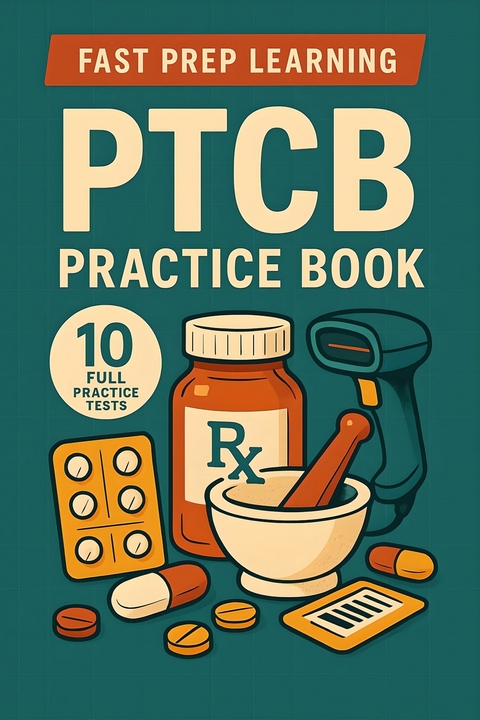
PTCB Practice book (eBook)
216 Seiten
Publishdrive (Verlag)
978-0-00-109686-8 (ISBN)
What if I told you that preparing for the PTCB exam with confidence-without stress, without confusion, and without feeling unsure about your readiness-can become your reality?
If you're worried you haven't practiced enough real PTCB-style questions or you're unsure how you'll perform under pressure, then training with full-length, exam-accurate practice tests can be your answer.
It can dramatically improve your speed, accuracy, and confidence-because nothing prepares you better than practicing with tests built to mirror the exact structure of the official Pharmacy Technician Certification Exam.
This practice book was designed with one goal: to simulate the real PTCB exam with 15 full-length practice tests that follow the official blueprint, each including clear answer explanations to help you learn quickly and strengthen weak areas.
Each test reflects the real domains: Medications, Federal Law, Patient Safety, and Order Processing. You'll work through realistic pharmacy math, drug classifications, safety rules, prescription processing, and scenario-based questions that look and feel just like the actual exam.
Whether you're testing for the first time or retaking to increase your score, these full-length exams help you measure your progress, master timing, and build confidence.
And you don't need long study sessions. Even with just 30-40 minutes a day, this system keeps your practice structured, consistent, and effective.
If you're unsure whether this will help, don't worry. Inside this book you'll find complete practice exams that show your strengths, reveal weak spots, and help you understand exactly how close you are to passing.
This is ideal if you want a cost-effective, organized way to practice without relying on expensive prep programs or random online quizzes.
Whether you struggle with pharmacy calculations, federal law, safety procedures, or medication classifications, these tests train you to think and perform exactly the way the PTCB expects.
Here is just a fraction of what you'll discover inside this book:
15 full-length PTCB practice tests that match the real exam
• Answer explanations that help you learn immediately from mistakes
• A 4-week testing schedule to structure your study routine
• Accurate coverage of all PTCB domains: Medications, Law, Safety, Order Processing
• Hundreds of exam-style questions that build accuracy and confidence
• Timed practice sessions to master real-test pacing
• Current, up-to-date content aligned with modern PTCB standards
• A realistic simulation designed for students who improve fastest through repetition
To get your copy right now, just scroll up and click 'Add to Cart.'
PRACTICE TEST 1
SECTION 1 — MEDICATIONS (18 Questions)
Q1. Which of the following is a beta-blocker commonly used to treat hypertension?
A) Lisinopril
B) Metoprolol
C) Amlodipine
D) Losartan
E) Furosemide
Correct: B
Why: Metoprolol is a selective beta-1 blocker used for blood pressure and heart rate control.
Q2. Which medication requires INR monitoring?
A) Apixaban
B) Dabigatran
C) Warfarin
D) Enoxaparin
E) Clopidogrel
Correct: C
Why: Warfarin requires regular INR monitoring to ensure safe anticoagulation levels.
Q3. A patient taking simvastatin should avoid:
A) Milk
B) Grapefruit juice
C) Green leafy vegetables
D) Caffeine
E) Dairy products
Correct: B
Why: Grapefruit inhibits CYP3A4 and increases simvastatin concentrations.
Q4. Which drug is classified as a Schedule II controlled substance?
A) Alprazolam
B) Tramadol
C) Hydrocodone
D) Gabapentin
E) Zolpidem
Correct: C
Why: Hydrocodone combination products are Schedule II.
Q5. Which antibiotic is associated with tendon rupture risk?
A) Azithromycin
B) Amoxicillin
C) Ciprofloxacin
D) Cefdinir
E) Doxycycline
Correct: C
Why: Fluoroquinolones like ciprofloxacin have FDA warnings for tendon rupture.
Q6. Levothyroxine should be taken:
A) With a fatty meal
B) With milk
C) On an empty stomach
D) With antacids
E) At bedtime with food
Correct: C
Why: Levothyroxine requires an empty stomach for consistent absorption.
Q7. Which medication is a proton pump inhibitor (PPI)?
A) Ranitidine
B) Famotidine
C) Omeprazole
D) Sucralfate
E) Metoclopramide
Correct: C
Why: Omeprazole inhibits gastric acid secretion via proton pump blockade.
Q8. Which drug treats Type 2 diabetes by increasing insulin sensitivity?
A) Metformin
B) Glipizide
C) Insulin lispro
D) Liraglutide
E) Acarbose
Correct: A
Why: Metformin improves peripheral insulin sensitivity and reduces hepatic glucose output.
Q9. Which medication is a benzodiazepine?
A) Zolpidem
B) Pregabalin
C) Clonazepam
D) Trazodone
E) Duloxetine
Correct: C
Why: Clonazepam enhances GABA activity and belongs to the benzodiazepine class.
Q10. Which medication is used as an emergency opioid reversal agent?
A) Naloxone
B) Flumazenil
C) Epinephrine
D) Diphenhydramine
E) Fentanyl
Correct: A
Why: Naloxone rapidly reverses opioid overdose by blocking opioid receptors.
Q11. What is the brand name for clopidogrel?
A) Plavix
B) Crestor
C) Lipitor
D) Effient
E) Brilinta
Correct: A
Why: Plavix is the brand name for clopidogrel.
Q12. Which medication requires refrigeration before dispensing?
A) Amoxicillin suspension
B) Insulin glargine
C) Nitroglycerin tablets
D) Metoprolol
E) Oxybutynin
Correct: B
Why: Most insulin types require refrigeration before use.
Q13. A common side effect of ACE inhibitors includes:
A) Bradycardia
B) Dry cough
C) Constipation
D) Urinary retention
E) Sedation
Correct: B
Why: ACE inhibitors may cause a persistent dry cough due to bradykinin buildup.
Q14. Which medication treats hypothyroidism?
A) Liothyronine
B) Methimazole
C) Propylthiouracil
D) Atenolol
E) Atorvastatin
Correct: A
Why: Liothyronine (T3) treats hypothyroidism; B and C treat hyperthyroidism.
Q15. Which drug is a calcium channel blocker?
A) Lisinopril
B) Amlodipine
C) Metoprolol
D) Carvedilol
E) Pravastatin
Correct: B
Why: Amlodipine dilates blood vessels through calcium channel inhibition.
Q16. Which medication increases potassium levels (risk of hyperkalemia)?
A) Hydrochlorothiazide
B) Furosemide
C) Lisinopril
D) Acetazolamide
E) Metoprolol
Correct: C
Why: ACE inhibitors can increase serum potassium.
Q17. What is the generic for Zithromax?
A) Amoxicillin
B) Azithromycin
C) Ciprofloxacin
D) Clarithromycin
E) Cephalexin
Correct: B
Why: Zithromax is the brand name for azithromycin.
Q18. Which drug is used for smoking cessation?
A) Buspirone
B) Varenicline
C) Isosorbide
D) Baclofen
E) Sertraline
Correct: B
Why: Varenicline (Chantix) is indicated for smoking cessation.
SECTION 2 — FEDERAL REQUIREMENTS (6 Questions)
Q19. Controlled substance inventory must be completed:
A) Every 6 months
B) Every year
C) Every 2 years
D) Every 5 years
E) Monthly
Correct: C
Why: DEA requires a biennial inventory.
Q20. DEA Form 222 is used to order:
A) Schedule III drugs
B) Schedule IV drugs
C) Schedule V drugs
D) Schedule II drugs
E) OTC pseudoephedrine
Correct: D
Why: Form 222 is required for Schedule II ordering, transferring, or returning.
Q21. Which item must appear on all controlled substance prescriptions?
A) Patient weight
B) Pharmacy NPI
C) Prescriber DEA number
D) Insurance formulary code
E) Refill limit wording
Correct: C
Why: DEA number is mandatory on all controlled prescriptions.
Q22. Pseudoephedrine sales are regulated under which act?
A) HIPAA
B) FDCA
C) Combat Methamphetamine Epidemic Act
D) Durham-Humphrey Act
E) Medicare Modernization Act
Correct: C
Why: CMEA controls pseudoephedrine purchase limits.
Q23. Maximum daily pseudoephedrine purchase allowed is:
A) 1.2 g
B) 3.6 g
C) 5 g
D) 7.5 g
E) 9 g
Correct: B
Why: Federal limits allow 3.6 grams per day.
Q24. How long must controlled substance records be kept?
A) 6 months
B) 1 year
C) 2 years
D) 3 years
E) 5 years
Correct: C
Why: DEA requires a minimum of 2 years for CS record retention.
SECTION 3 — PATIENT SAFETY & QUALITY ASSURANCE (12 Questions)
Q25. A “tall man lettering” example is:
A) simvastatin–atorvastatin
B) hydrOXYzine–hydrALAZINE
C) lisinopril–losartan
D) metformin–metoprolol
E) prednisone–prednisolone
Correct: B
Why: Tall man lettering helps differentiate look-alike drug names.
Q26. Which is a high-alert medication?
A) Acetaminophen
B) Loratadine
C) Insulin
D) Naproxen
E) Omeprazole
Correct: C
Why: Insulin carries high risk for dosing errors.
Q27. A bar-code medication administration system reduces errors by:
A) Identifying allergies
B) Matching drug to patient
C) Preventing drug interactions
D) Storing extra inventory
E) Preventing theft
Correct: B
Why: It confirms correct patient, drug, dose, route, and time.
Q28. What should be reported to ISMP?
A) Drug shortages
B) Medication errors or near misses
C) Insurance denials
D) Narcotic waste
E) Temperature logs
Correct: B
Why: ISMP collects medication safety data.
Q29. An example of a sound-alike drug pair is:
A) metformin–metoprolol
B) omeprazole–esomeprazole
C) hydralazine–hydroxyzine
D) lisinopril–atorvastatin
E) amlodipine–furosemide
Correct: C
Why: These names are often confused.
Q30. A patient receives the wrong strength due to similar packaging. Root cause?
A) System error
B) Mislabeling
C) Color blindness
D) Pharmacist bias
E) Inventory shortage
Correct: A
Why: Packaging similarity is a systemic issue, not individual fault.
Q31. Which action reduces dispensing errors?
A) Multitasking during fills
B) Independent double check
C) Rushing high-volume prescriptions
D) Avoiding final verification
E) Omitting patient counseling
Correct: B
Why: A second independent review decreases error occurrence.
Q32. What is a REMS program used for?
A) Insurance approval
B) Pricing transparency
C) Risk mitigation for high-risk drugs
D) Barcode scanning
E) Label formatting
Correct: C
Why: REMS ensures safe use of certain medications.
Q33. Which drug requires a REMS?
A) Metformin
B) Isotretinoin
C) Amlodipine
D) Lisinopril
E) Fluoxetine
Correct: B
Why: Isotretinoin requires iPLEDGE REMS due to teratogenicity.
Q34. Which error type involves giving the correct drug but incorrect dosage form?
A) Wrong patient
B) Wrong drug
C) Wrong dosage form
D) Wrong prescriber
E) Wrong billing code
Correct: C
Why: Dose-form errors occur when tablets, suspensions, etc. are mis-dispensed.
Q35. Which is an example of a near miss?
A) Wrong medication dispensed to patient
B) Expired drug given
C) Wrong drug caught before reaching patient
D) Drug recalled after dispensing
E) Counseling skipped
Correct: C
Why: A near miss is intercepted before reaching the patient.
Q36. The purpose of a medication error report is...
| Erscheint lt. Verlag | 5.11.2025 |
|---|---|
| Sprache | englisch |
| Themenwelt | Sachbuch/Ratgeber ► Beruf / Finanzen / Recht / Wirtschaft ► Bewerbung / Karriere |
| ISBN-10 | 0-00-109686-9 / 0001096869 |
| ISBN-13 | 978-0-00-109686-8 / 9780001096868 |
| Informationen gemäß Produktsicherheitsverordnung (GPSR) | |
| Haben Sie eine Frage zum Produkt? |
 EPUB (Adobe DRM)
Größe: 999 KB
Kopierschutz: Adobe-DRM
Adobe-DRM ist ein Kopierschutz, der das eBook vor Mißbrauch schützen soll. Dabei wird das eBook bereits beim Download auf Ihre persönliche Adobe-ID autorisiert. Lesen können Sie das eBook dann nur auf den Geräten, welche ebenfalls auf Ihre Adobe-ID registriert sind.
Details zum Adobe-DRM
Dateiformat: EPUB (Electronic Publication)
EPUB ist ein offener Standard für eBooks und eignet sich besonders zur Darstellung von Belletristik und Sachbüchern. Der Fließtext wird dynamisch an die Display- und Schriftgröße angepasst. Auch für mobile Lesegeräte ist EPUB daher gut geeignet.
Systemvoraussetzungen:
PC/Mac: Mit einem PC oder Mac können Sie dieses eBook lesen. Sie benötigen eine
eReader: Dieses eBook kann mit (fast) allen eBook-Readern gelesen werden. Mit dem amazon-Kindle ist es aber nicht kompatibel.
Smartphone/Tablet: Egal ob Apple oder Android, dieses eBook können Sie lesen. Sie benötigen eine
Geräteliste und zusätzliche Hinweise
Buying eBooks from abroad
For tax law reasons we can sell eBooks just within Germany and Switzerland. Regrettably we cannot fulfill eBook-orders from other countries.
aus dem Bereich