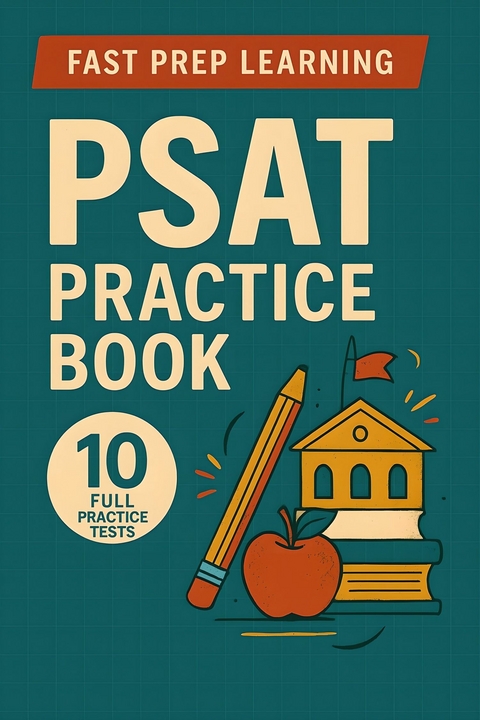
PSAT Practice Book (eBook)
203 Seiten
Publishdrive (Verlag)
978-0-00-109685-1 (ISBN)
What if I told you that preparing for the PSAT with confidence-without stress, without guessing, and without feeling unready-can become your reality?
If you're worried you haven't practiced enough real test questions or you're unsure how well you'll handle the timing, then working through full-length, exam-accurate practice tests can be your answer.
It can dramatically improve your Reading, Writing, and Math performance-because nothing strengthens your score faster than practicing with tests that mirror the real PSAT in structure, pacing, and difficulty.
This practice book was designed with a single purpose: to recreate the PSAT experience with 15 full-length practice tests that follow the official digital PSAT style, each including clear answer explanations so students learn from every mistake.
Every test matches real PSAT content: reading passages, grammar questions, algebra, geometry, data analysis, and word-in-context reasoning.
So whether you're aiming for competitive scores, National Merit potential, or simply a strong SAT foundation, these tests give you the realistic practice you need.
And your student doesn't need long daily sessions. With just 20-30 minutes a day, this system builds skill, confidence, and endurance step by step.
If you're unsure whether this will help, don't worry. Inside this book you'll find complete, exam-level practice that reveals strengths, exposes weak areas, and shows exactly how close your student is to their target score.
This is perfect if you want a cost-effective, structured way to practice without relying on expensive tutoring or scattered online questions. Whether your student struggles with reading accuracy, grammar rules, algebra, functions, or timing, these tests train them to think exactly the way the PSAT expects.
Here is just a fraction of what you'll discover inside this book:
15 full-length PSAT practice tests matching official digital exam style
• Answer explanations for every question to reinforce understanding
• A structured 4-week testing plan for consistent, organized practice
• True-to-exam Reading & Writing passages and Math sections
• Hundreds of exam-style questions that strengthen speed and accuracy
• Timed practice sessions to build real test endurance
• Up-to-date content aligned with the modern PSAT format
• A realistic simulation that builds confidence through repetition
PRACTICE TEST 1
Logical Reasoning 1 (Q1–Q15)
Q1. A paramedic argues that because a patient is alert and oriented, they must also have stable vital signs. Which flaw is present?
A) Mistakes correlation for causation
B) Assumes a condition ensures all related conditions
C) Uses circular reasoning
D) Relies on an unrepresentative sample
E) Ignores an alternative explanation
Correct: B
Why: Alertness does not guarantee stable vitals.
Q2. A dispatcher claims that because call volume increased this month, staffing must be inadequate.
A) Overgeneralization
B) Mistaken cause
C) Weak analogy
D) Straw man
E) Equivocation
Correct: B
Why: Rising calls may have multiple causes.
Q3. An EMT argues that because no one complained about a protocol, it must be effective.
A) Burden shifting
B) Appeal to popularity
C) Absence of evidence fallacy
D) Ad hominem
E) False dilemma
Correct: C
Why: Lack of complaints isn’t evidence of success.
Q4. A patient insists their dizziness is from dehydration because it happened on a hot day.
A) Post hoc
B) Circular reasoning
C) False cause
D) Biased sample
E) Appeal to authority
Correct: C
Why: Other causes may explain dizziness.
Q5. A trainee argues all rapid heart rates indicate shock.
A) Overgeneralization
B) False dilemma
C) Circular logic
D) Weak comparison
E) Faulty analogy
Correct: A
Why: Tachycardia has many causes.
Q6. A supervisor claims that since one shift performed poorly, the department’s training is failing.
A) Hasty generalization
B) Slippery slope
C) Red herring
D) Appeal to ignorance
E) Composition fallacy
Correct: A
Why: One example can’t represent overall performance.
Q7. A paramedic says, “Either we transport now or the patient will deteriorate.”
A) Composition fallacy
B) False dilemma
C) Ad hominem
D) Weak analogy
E) Oversimplification
Correct: B
Why: More options may exist.
Q8. An EMT states that because a medication usually works, it must work for this patient.
A) Appeal to tradition
B) Ecological fallacy
C) False cause
D) Overgeneralization
E) Equivocation
Correct: D
Why: What works generally may not fit all patients.
Q9. A responder assumes a calm patient cannot be in severe pain.
A) Appeal to emotion
B) Faulty inference
C) Personal incredulity
D) Ignoring counterevidence
E) Stereotyping
Correct: E
Why: Calm behavior doesn’t dictate pain level.
Q10. A trainee claims that if airway repositioning helped once, it always should.
A) Overgeneralization
B) Straw man
C) Circular reasoning
D) Ad hoc rescue
E) Appeal to authority
Correct: A
Why: One success doesn’t guarantee all outcomes.
Q11. A claim that “If oxygen doesn’t fix shortness of breath immediately, it’s the wrong treatment” commits:
A) False analogy
B) Hasty generalization
C) False cause
D) Faulty expectation
E) Composition fallacy
Correct: D
Why: Treatments can take time.
Q12. A supervisor argues that because one protocol improved outcomes, all protocols should be rewritten.
A) Overreach
B) Slippery slope
C) False equivalence
D) Unwarranted inference
E) Overconclusion
Correct: E
Why: One success doesn’t justify global changes.
Q13. “If CPR is good for cardiac arrest, doing it earlier must always be better.”
A) Appeal to extremes
B) Unsupported presumption
C) Misleading correlation
D) Faulty absolute
E) False distinction
Correct: D
Why: Procedure timing varies by context.
Q14. A responder claims that if no equipment malfunction was seen, none occurred.
A) Circular reasoning
B) Incomplete evidence
C) False dilemma
D) Appeal to authority
E) Hasty inference
Correct: B
Why: Lack of visible failure isn’t proof.
Q15. A patient says, “If the pain is mild now, it will stay mild.”
A) Overprojection
B) False guarantee
C) Weak induction
D) Overconfidence fallacy
E) Appeal to emotion
Correct: C
Why: Present pain doesn’t predict future severity.
Logical Reasoning 2 (Q1–Q15)
Q1. A crew chief argues that because a patient looks stable, they must not be bleeding internally.
A) Non sequitur
B) Overgeneralization
C) Weak inference
D) Circular reasoning
E) False dichotomy
Correct: A
Why: Visual appearance doesn’t rule out hidden bleeding.
Q2. A trainee states, “If the monitor shows no arrhythmia, the heart is structurally normal.”
A) False correlation
B) Category error
C) Hasty inference
D) Appeal to authority
E) Incomplete comparison
Correct: C
Why: Electrical rhythm doesn’t reveal structural issues.
Q3. Claiming a patient is exaggerating because their vitals look normal is:
A) Personal attack
B) Stereotyping
C) Bias-driven inference
D) False assumption
E) Overgeneralization
Correct: D
Why: Pain is subjective and not always vital-sign based.
Q4. A medic concludes that because one airway device failed, all similar devices are unreliable.
A) Overgeneralization
B) Misuse of evidence
C) Slippery slope
D) Circular inference
E) Oversimplification
Correct: A
Why: One malfunction doesn’t condemn all.
Q5. A responder infers that because a patient is elderly, transport decisions must be conservative.
A) Age bias
B) Weak deduction
C) False analogy
D) Overinference
E) Forced assumption
Correct: A
Why: Age alone can’t dictate treatment.
Q6. “If a symptom doesn’t worsen quickly, it isn’t serious.”
A) False cause
B) False reassurance
C) Rapid-generalization fallacy
D) Unsupported premise
E) Unwarranted inference
Correct: E
Why: Some conditions worsen slowly.
Q7. Concluding improper ventilation because CO2 is high is:
A) Circular evidence
B) Single-cause assumption
C) Faulty comparison
D) Hasty conclusion
E) Oversimplified causation
Correct: B
Why: Many conditions raise CO2.
Q8. Assuming a patient with anxiety cannot also have chest pain is:
A) False exclusivity
B) Invalid inference
C) Category error
D) Weak analogy
E) Biased sampling
Correct: A
Why: Two conditions can coexist.
Q9. A trainee claims, “If we can’t identify a cause, the symptoms must be exaggerated.”
A) Appeal to ignorance
B) False dichotomy
C) Straw inference
D) Misplaced certainty
E) Overprojection
Correct: A
Why: Lack of explanation doesn’t disprove symptoms.
Q10. If one medication is effective, assuming another similar one is too is:
A) Faulty analogy
B) Unwarranted expectation
C) Overgeneralization
D) Incomplete logic
E) Equivocation
Correct: A
Why: Similar drugs may act differently.
Q11. “Vitals are normal, so the condition must be mild.”
A) Non sequitur
B) False guarantee
C) Incomplete conclusion
D) Weak deduction
E) Oversimplification
Correct: A
Why: Normal vitals don’t confirm mild severity.
Q12. A responder claims CPR quality was perfect because no errors were seen.
A) False inference
B) Confirmation bias
C) Lack-of-evidence fallacy
D) Circular logic
E) Oversimplification
Correct: C
Why: Unseen errors may still occur.
Q13. “If the patient refuses treatment once, they always will.”
A) Hasty generalization
B) Composition fallacy
C) Oversimplification
D) Faulty expectation
E) Slippery slope
Correct: A
Why: One refusal doesn’t dictate future behavior.
Q14. Concluding trauma because a patient is anxious is:
A) False cause
B) Red herring
C) Misclassification
D) Weak correlation
E) False dichotomy
Correct: D
Why: Anxiety doesn’t imply trauma.
Q15. “If the scene looks safe, it is safe.”
A) Faulty belief
B) Partial-assumption error
C) Incomplete assessment
D) Wishful reasoning
E) Overreliance fallacy
Correct: C
Why: Safety requires verification.
Analytical Reasoning (Logic Games) — 10 Questions
Game 1 Setup (5 Q)
A 3-patient triage sequence (A, B, C) is assigned to one of three priority levels: Immediate (I), Delayed (D), Minimal (M).
Rules:
- B cannot be Immediate.
- If A is Immediate, C must be Minimal.
- At least one patient is Delayed.
Q1. If A = I, which must be true?
A) B = D
B) C = M
C) B = M
D) C = D
E) A = D
Correct: B
Why: Rule 2 enforces C = M.
Q2. If B = D, which is possible?
A) A=I, C=M
B) A=M, C=I
C) A=D, C=I
D) A=I, C=D
E) C=I, A=I
Correct: A
Why: Fits all rules.
Q3. If no one is Immediate, which must be true?
A) A=D
B) B=M
C) C=D
D)...
| Erscheint lt. Verlag | 4.11.2025 |
|---|---|
| Sprache | englisch |
| Themenwelt | Sachbuch/Ratgeber ► Beruf / Finanzen / Recht / Wirtschaft ► Bewerbung / Karriere |
| ISBN-10 | 0-00-109685-0 / 0001096850 |
| ISBN-13 | 978-0-00-109685-1 / 9780001096851 |
| Informationen gemäß Produktsicherheitsverordnung (GPSR) | |
| Haben Sie eine Frage zum Produkt? |
 EPUB (Adobe DRM)
Größe: 952 KB
Kopierschutz: Adobe-DRM
Adobe-DRM ist ein Kopierschutz, der das eBook vor Mißbrauch schützen soll. Dabei wird das eBook bereits beim Download auf Ihre persönliche Adobe-ID autorisiert. Lesen können Sie das eBook dann nur auf den Geräten, welche ebenfalls auf Ihre Adobe-ID registriert sind.
Details zum Adobe-DRM
Dateiformat: EPUB (Electronic Publication)
EPUB ist ein offener Standard für eBooks und eignet sich besonders zur Darstellung von Belletristik und Sachbüchern. Der Fließtext wird dynamisch an die Display- und Schriftgröße angepasst. Auch für mobile Lesegeräte ist EPUB daher gut geeignet.
Systemvoraussetzungen:
PC/Mac: Mit einem PC oder Mac können Sie dieses eBook lesen. Sie benötigen eine
eReader: Dieses eBook kann mit (fast) allen eBook-Readern gelesen werden. Mit dem amazon-Kindle ist es aber nicht kompatibel.
Smartphone/Tablet: Egal ob Apple oder Android, dieses eBook können Sie lesen. Sie benötigen eine
Geräteliste und zusätzliche Hinweise
Buying eBooks from abroad
For tax law reasons we can sell eBooks just within Germany and Switzerland. Regrettably we cannot fulfill eBook-orders from other countries.
aus dem Bereich