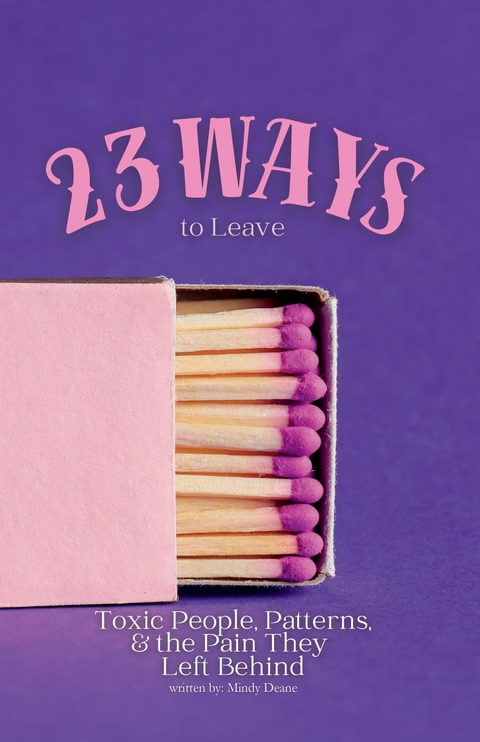
23 Ways to Leave (eBook)
196 Seiten
Bookbaby (Verlag)
979-8-3178-2208-8 (ISBN)
Mindy Deane is a life coach, writer, and truth teller who believes in the healing power of honest conversation. She spent over two decades as a hairstylist, where the salon chair became her first classroom in listening, holding space, and helping people see themselves more clearly. Her own experiences with loss, grief, and toxic relationships shaped her into the guide she is today. Mindy writes and teaches from the heart, showing others how to reclaim their power, walk away from what breaks them, and create lives filled with meaning and connection. She lives in West Texas with her two children and a circle of chosen family and friends. When she is not writing or coaching, she can be found dancing in her kitchen, dreaming up new ways to bring people together, or turning the volume up on empowerment anthems. 23 Ways to Leave is her first book.
Leaving isn't always as simple as it sounds. People talk about toxic relationships like you should just walk away, but when you are in the middle of it, leaving can feel like trying to breathe underwater. 23 Ways to Leave is for the woman who feels stuck, unsure, and exhausted, yet knows deep down she was made for more. Mindy Deane weaves together her own story of loss, grief, and survival with twenty-three practical and soulful ways to step out of cycles that keep you small. This is not a book about getting over it or pretending you are fine. It is about slowing down, telling yourself the truth, and choosing yourself again and again, until freedom becomes real. Inside you will discover:Tools to recognize the patterns that keep you trappedWays to rebuild your self-trust after betrayal and self-doubtGentle practices to soothe your body and regulate your emotionsEncouragement to set boundaries without apologyStories that remind you that you are not alone in your struggle or your healingEach chapter is both a spark of inspiration and an invitation to take action. With compassion and honesty, Mindy reminds readers that leaving is not just about walking away from someone or something. It is about leaving behind the pain, shame, and fear that no longer belong to you. This book is for the woman who has whispered, "e;I can't keep doing this"e; but doesn't know what comes next. It is for the one who secretly wonders if she is too much or not enough. It is for anyone who wants to stop surviving and start living. With warmth, vulnerability, and fierce encouragement, 23 Ways to Leave offers you a matchbook of small sparks. One choice at a time, you can burn down what is destroying you and light your way forward.
INTRODUCTION
The Wake-up Call I Didn’t Ask For
“Why do you let him lie to you like that?”
There was zero judgment or harshness in my new friend’s voice, only curiosity. Her words hung in the air like cigarette smoke, burning their way into my lungs. My eyes were wide, waiting for her to explain what she meant.
She apologized for being blunt and explained that she truly did not understand how I could stand by someone who wasn't honest, someone who twisted the truth to suit his own needs. “You’re so much the opposite of that, I just don’t understand how you’re okay with his lies,” she added softly.
Now I could have very easily defended my husband or demanded it was time for us to leave. I could have made the choice to never see her again and not allow her words to drive a wedge between me and my husband.
Only, I didn’t want to.
This was during Christmas break 2020. My husband’s friend had recently introduced us to his new girlfriend and her daughter. She and I hit it off at once. Our kids all got along, our partners were already best buds, and we had a lot in common. We spent the whole break together, with game nights, sleepovers and even a few double dates.
That night we had split a babysitter and gone out to dinner. Afterward, we went back to their house. We drank a little wine and whiskey, danced around the living room, and later my new friend joined me for a smoke in the garage, just the two of us. That was when she asked me the question.
It felt like her words cracked something open in me.
I had been letting him lie to me for years, quietly going along with embellishments, half-truths, and outright lies. I dreamed of calling him out and standing up to him, but instead I stayed silent. It was easier to protect the peace and his fragile ego, to make everything appear normal even when I knew deep down, it wasn’t.
And even though I had heard variations of it before- "Why do you stay? Why do you put up with it?” -this time, I couldn’t ignore it. This time, the truth hit me like a slap, and I knew she was right.
This person could have been anyone, but that’s not what’s important about this part of the story. Who she was, how long she’d known us, or how she had the audacity to ask such brutally honest questions to someone she barely knew, those things do not matter here.
In that moment, her words became a catalyst for me. This curious whisper from a new friend shined a light on a part of my life I’d been unwilling to face before.
I began thinking about all the times I had made excuses for him, the ways I’d rationalized his behavior, and ignored my own pain. Until then, I had just accepted that this was just part of our relationship and who we were. But her question forced me to see the damage that going along with his lies had done.
She wanted to know why, and for the first time, so did I.
The List That Saved My Life
I remember three specific moments over the years that chipped away at my denial and shook me into seeing there was nothing left to hold onto anymore:
Narcissists, Sociopaths, and Psychopaths Use to Silence You.”
Reading that list was like reading my own life in bullet points. Every single line on that list was something I had lived. Every single one confirmed what I had spent years trying to deny. Reading it, I felt so sick, and yet so seen. I knew I needed to get out. Only I didn’t have the strength or the tools.
I didn’t know how to leave.
So, like many of us do, I went into fix-it mode. I spent the next few days, months, and years trying to repair and patch up everything that was in my control. I lost weight. I fixed my mindset. I became a life coach. We even went to marriage counseling together. I did everything I could think of to make it work and to make us last. I told myself things were getting better, but really, I was just getting better at pretending.
Now my friend’s words echoed in my head: “Why do you let him lie to you like that?” This time, I couldn’t ignore it. I’d spent years accepting the lies because the fear of confronting him and the risk of losing the life we had built felt scarier than avoiding the truth. Plus, he was so horrible to me as my husband, I could only imagine how he’d treat me as my ex-husband.
Now the list from 2016 was front and center in my mind like a fire alarm blaring too loud to ignore. I knew I had to get out to save myself and my kids, and to stop trying to save him from himself.
I wanted to do the right thing and bravely leave with honesty & boundaries, with a clear voice and a clean break. I wanted to sign on that dotted line and walk away.
But that’s not how it ended.
Instead, the relationship I had been so desperate to escape ended in the most final and irreversible way imaginable- when he made his final exit by suicide.
I was all the sudden a widow, a single woman, and free from that troubled connection that I’d been trying to break away from for so many years.
And yet, I wasn’t free. Not at all.
Because here’s the thing nobody tells you: leaving doesn’t fix you. Just because you’re not in the relationship anymore, doesn’t mean the pain is gone. No matter how it ends, whether divorce, death or some other disaster splits you apart, you still take all of that pain and trouble with you. It stays lodged in your body, your brain, your reflexes. The real work begins when you walk away from the cycles, the conditioning, and the lies you’ve believed about yourself for too damn long.
It took years of heartache, moments of clarity, and a therapy bill a mile long before I finally understood what freedom truly looks like. Somewhere along that journey, I came across a song I had never paid much attention to before: Paul Simon’s 50 Ways to Leave Your Lover.
“The problem’s all inside your head, she said to me.”
Now I wasn’t Jack, and I sure as hell wasn’t Stan, and leaving hadn’t been as simple as hopping on a damn bus. But something about that upbeat rhyming chorus reminded me of my friend’s wise words that night.
It felt poetic, just a little tambourine backup and some good lyrics detailing how easy it was to walk away. I remembered all the times I googled things like ‘how to leave,’ ‘when is it over?’, ‘narcissism and codependency,’ ‘attachment,’ etc. Could it be as easy as this song made it sound, with a little brass backup and tune you could whistle to?
Of course not. But it got me thinking.
What if I made a list, not of cute, rhyming exit strategies, but of the actual tools that helped me climb out of the relationship I’d been in? And even the things I learned since he’s been gone?
I don’t want you to have to take the long and winding road it took me. So here I am, almost ten years later, making another list. It feels like some kind of divine retribution, sitting here writing not just a list, but a whole-ass book of twenty-three ways to leave.
Because that first list was about how I had been torn to pieces. But this one is about how I put myself back together.
This book isn’t just about leaving a toxic lover. It’s my road map to leave anything that keeps you trapped in patterns, stories, or roles you’ve outgrown. It’s about reclaiming yourself, one step at a time. This is me, standing on the other side, reaching back to say:
“Here. Let me help you in your struggle to be free.”
Author’s Note: Leaving is an Act of Self-Love
When I first imagined this book, I thought about all the ways I have had to leave in my life. That meant leaving not only relationships, but also versions of myself. I’ve had to walk away from the patterns that held me back, cycles that kept me stuck, and stories that kept me small.
So, while the title 23 Ways to Leave was inspired by a Paul Simon song, this book is about leaving much more than just a toxic partner. It is about walking away from the cycle of self-doubt that tells you you are not good enough, the patterns of people pleasing that keep you trapped, the guilt that whispers, “You can’t leave, you’ll regret it,” and the fear that convinces you to stay in places you have already outgrown.
Yes, this book will help you walk away from an unhealthy relationship if that is what brought you here. But it is also about breaking free from anything that holds you back, so you can choose yourself and walk toward the life you deserve.
And this book is just the beginning. I created a private Book Club with extra tools, stories, and practices that bring these pages to life. It is like your hidden bonus chapter library, made just for readers who are...
| Erscheint lt. Verlag | 5.11.2025 |
|---|---|
| Sprache | englisch |
| Themenwelt | Sachbuch/Ratgeber ► Gesundheit / Leben / Psychologie ► Partnerschaft / Sexualität |
| ISBN-13 | 979-8-3178-2208-8 / 9798317822088 |
| Informationen gemäß Produktsicherheitsverordnung (GPSR) | |
| Haben Sie eine Frage zum Produkt? |
 EPUB (Ohne DRM)
Größe: 618 KB
Digital Rights Management: ohne DRM
Dieses eBook enthält kein DRM oder Kopierschutz. Eine Weitergabe an Dritte ist jedoch rechtlich nicht zulässig, weil Sie beim Kauf nur die Rechte an der persönlichen Nutzung erwerben.
Dateiformat: EPUB (Electronic Publication)
EPUB ist ein offener Standard für eBooks und eignet sich besonders zur Darstellung von Belletristik und Sachbüchern. Der Fließtext wird dynamisch an die Display- und Schriftgröße angepasst. Auch für mobile Lesegeräte ist EPUB daher gut geeignet.
Systemvoraussetzungen:
PC/Mac: Mit einem PC oder Mac können Sie dieses eBook lesen. Sie benötigen dafür die kostenlose Software Adobe Digital Editions.
eReader: Dieses eBook kann mit (fast) allen eBook-Readern gelesen werden. Mit dem amazon-Kindle ist es aber nicht kompatibel.
Smartphone/Tablet: Egal ob Apple oder Android, dieses eBook können Sie lesen. Sie benötigen dafür eine kostenlose App.
Geräteliste und zusätzliche Hinweise
Buying eBooks from abroad
For tax law reasons we can sell eBooks just within Germany and Switzerland. Regrettably we cannot fulfill eBook-orders from other countries.
aus dem Bereich