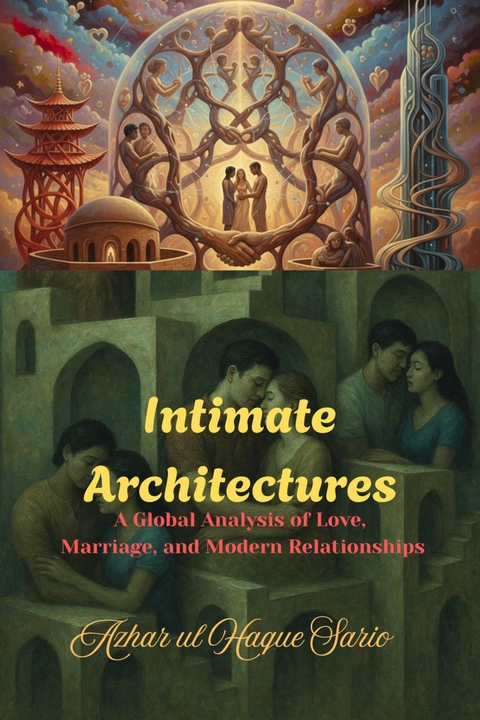
Intimate Architectures (eBook)
196 Seiten
Azhar Sario Hungary (Verlag)
978-3-384-74635-1 (ISBN)

Dive into the World of Global Romance!
This book explores love and marriage across 15 countries. It starts with traditions in Japan, India, and Saudi Arabia. Japan focuses on harmony and kokuhaku confessions. India covers caste endogamy and arranged-love marriages. Saudi Arabia discusses family matchmaking and gender segregation. Then, it moves to cultural practices in Brazil, France, South Africa, and Nigeria. Brazil highlights Carnival passion and ficar-to-namorar stages. France delves into la séduction and PACS unions. South Africa examines lobola bridewealth and post-apartheid cohabitation. Nigeria looks at communal weddings and Nollywood influences. Next, it analyzes modern pressures in South Korea, China, and Russia. South Korea discusses the Sampo generation opting out of dating. China covers sheng nu narratives and one-child policy effects. Russia explores gender imbalances and double burdens for women. The book proposes new theories using Sweden, Israel, and the US as models. Sweden represents statist individualism with sambo cohabitation. Israel shows collectivist ties through military service and religious laws. The US embodies market individualism with digital dating and capstone marriages. Finally, it identifies research gaps in Iran and Indonesia. Iran needs studies on white marriages and youth attitudes. Indonesia requires nuanced views on ethnic diversity and urbanization.
What sets this book apart is its fresh theoretical framework, blending deep case studies with new models like statist and market individualism-something many books overlook by sticking to surface customs or single regions. Unlike others that recycle Western views or ignore economic forces, it generates original insights on how state policies and tech reshape intimacy globally, offering a comparative matrix and future research directions for a truly innovative edge.
This author has no affiliation with any board and this is independently produced under nominative fair use.
Hey, if you're curious about why love looks so different around the world, this book's got you covered. We dive beyond the fairy tales into real forces like religion, economy, and tech shaping relationships. From subtle Japanese confessions to bold Brazilian flings, it's a fun, eye-opening ride. Plus, it wraps up with smart theories and calls for more research-perfect for anyone pondering modern romance.
Part I: Theoretical Foundations: Tradition, Ideology, and the Social Contract
Japan – The Interplay of Harmony, Hierarchy, and Modernity
1.1 The Legacy of the Ie System: From Household Duty to Individual Choice
In seeking to understand the deep currents of Japanese intimacy and family life, one must first look to the ie (家), or household system. This concept is perhaps the single most important key to unlocking the nation’s socio-centric worldview. For centuries, the ie—not the individual—was the fundamental, enduring unit of society. It was a collective entity, a corporate body that stretched from the ancestors into the future, and the lives of its members were secondary to its preservation and prosperity.
This was not a "family" in the modern Western sense of a small, emotionally-bonded nuclear unit. The ie was an institution. Its primary function was not personal happiness but continuity. Marriage, therefore, was not a romantic union but a crucial institutional transaction. Its sole, driving purpose was the procurement of an heir to perpetuate the family line and, by extension, the family's social standing and ancestral duties.
Within this framework, remaining single was not simply a personal choice; it was seen as a profound dereliction of duty, a failure to fulfill one's most basic obligation to the collective. The idea that one would marry for "love" was, for most of history, considered secondary, if not outright improper and selfish. The decision-making power rested exclusively with the koshu, or head of the household, typically the patriarch. His was the responsibility to arrange a match that would benefit the ie strategically, considering factors like social class, wealth, and the health of the prospective bride.
We can see this institutional reality embedded in the very language of Japan. The traditional kanji for "wife" is 嫁 (yome), and the word for "marriage" is 嫁入り (yomeiri). This literally translates to "wife entering." The term does not imply a partnership or a merging of two families; it describes a one-way transfer. A woman was, in effect, removed from her own family's registry (koseki) and "entered" into her husband's. She was absorbed by his ie, and her primary duty shifted from her own parents to her husband's parents, particularly her mother-in-law. Her value was measured by her ability to produce a male heir and adapt to the customs of her new household.
The historical roots of this system are deep and varied. During the aristocratic Heian period (794-1185), the political landscape was dominated by courtly intrigue. Marriage was a primary tool for political maneuvering, specifically for a father to gain influence by having his daughter produce a child with a high-ranking man, ideally the emperor. Courtship was a highly stylized ritual of exchanged poetry (waka), and intimacy was clandestine. A man's nocturnal visit to a woman, if repeated for three consecutive nights, was often all that was required to consider the union official, though it was frequently neither permanent nor exclusive.
This system was formalized and legally enshrined during the Meiji period (1868-1912). As Japan rapidly modernized to compete with Western powers, its leaders looked for a way to unify the nation. They found it by elevating the samurai-class ie system into a national legal doctrine. The Meiji Civil Code of 1898 established the ie as the foundational building block of the Japanese state. The household was a microcosm of the nation, with the father as its absolute ruler, just as the Emperor was the absolute ruler of Japan. This legal framework gave the household head immense power, including the right to determine where members lived, whom they married, and even to control their property. Marriage was a contract between households, not individuals.
This entire legal structure was forcibly dismantled by the Allied Occupation after World War II. The new 1947 Constitution, heavily influenced by American ideals, introduced radical concepts of individualism and gender equality. Article 24 explicitly states that marriage shall be based only on the mutual consent of both sexes and shall be maintained through "mutual cooperation with the equal rights of husband and wife as a basis." Legally, the ie system was abolished overnight. The koshu lost all his legal power, and marriage became, for the first time in Japanese law, a union of two individuals.
However, culture is far more resilient than law. While the ie was gone from the statute books, its ghost lingered powerfully in the social consciousness. For decades, the post-war generation continued to live by its unwritten rules. Family approval remained a critical prerequisite for marriage. The eldest son (chōnan), though no longer the sole legal heir, was still raised with the implicit understanding that he bore a special responsibility for his parents in their old age. This often meant his wife was still expected to be the primary caregiver for her in-laws, a major source of domestic friction that continues to this day.
In contemporary Japan, this legacy exists as a kind of background radiation, an echo that shapes decisions in subtle ways. While young people are free to choose their own partners based on love (ren'ai), the weight of family expectation can be immense. For example, a man who is the chōnan of a prominent rural family that has owned the same land for generations may feel an intense, unspoken pressure to marry a woman who is willing to move back to his hometown and take over the household—a choice that can be in direct conflict with his own or his partner's career aspirations in a major city like Tokyo. This tension, the psychic pull between one's modern, individual desires and the ancient, collective duties of the ie, remains a central, defining struggle in the landscape of Japanese intimacy.
1.2 Confucian Ethics and Gender Roles: A Historical and Contemporary Analysis
The rigid, hierarchical structure of the ie system was not born in a vacuum. It was built upon a philosophical and ethical foundation that had been imported from China centuries earlier: Confucianism. Arriving in Japan around the fifth century, Confucian thought provided the perfect moral framework for a stable, ordered, and productive society. Its core tenets were not about theology or an afterlife, but about the proper management of human relationships in the here andnow.
This philosophy is based on a set of five hierarchical relationships: ruler and subject, father and son, husband and wife, elder brother and younger brother, and friend and friend. Each relationship comes with a specific set of duties and obligations. Loyalty, filial piety (kō), and social propriety were paramount. This system was readily adapted to the Japanese social structure, providing a powerful justification for the feudal order. The daimyō (lord) demanded absolute loyalty from his samurai (subject), just as the father demanded absolute obedience from his son.
It was this same logic that was applied directly to the husband-wife dynamic. The relationship was explicitly defined as unequal, mirroring the feudal ideal of lord and subject. The wife's duty was one of subservience and obedience to her husband, who in turn was expected to be benevolent but firm. This hierarchy was further reinforced by a fundamental spatial and spiritual concept: uchi (内, inside) and soto (外, outside).
Man’s domain was soto, the outside world of politics, work, and public life. Woman’s domain was uchi, the inside world of the home, the children, and the kitchen. This was seen not just as a practical division of labor, but as a natural, cosmic order. A woman who ventured into the soto sphere was seen as neglecting her fundamental duty and upsetting social harmony.
This ideology became cemented as state policy during the Meiji era. As the government sought to mobilize the entire population for its modernization goals, it needed a clear and simple doctrine for women. The answer was ryōsai kenbo (良妻賢母), or "Good Wife, Wise Mother." This four-character slogan, promoted through the newly established national education system, became the undisputed ideal for Japanese womanhood.
A "good wife" was one who managed the household with thrift and diligence, who was obedient to her husband and his parents, and who created a harmonious domestic sanctuary. A "wise mother" was one who was educated (in domestic, moral, and basic academic subjects) specifically so she could raise loyal, patriotic, and productive sons for the new Japanese Empire. It was a brilliant piece of social engineering. It gave women a critical, state-sanctioned role, but one that was entirely confined to the uchi sphere. It elevated domesticity to a patriotic duty.
This division of labor became the default model for post-war Japan. As the nation rebuilt itself and entered its "economic miracle" phase, the ryōsai kenbo ideal was updated for the new corporate age. The man became the sararīman (salaryman), the corporate warrior who pledged his loyalty not to a feudal lord, but to his company. His life was the soto world, defined by long hours, grueling commutes, and after-work drinking sessions with colleagues, all in service to the corporate collective.
His wife, in turn, became the sengyō shufu (professional housewife). Her role was the uchi world. She was given total control of the family finances (managing her husband's salary) and, most importantly, the children's education. This gave rise to the kyōiku mama (education mom), a...
| Erscheint lt. Verlag | 3.11.2025 |
|---|---|
| Sprache | englisch |
| Themenwelt | Sachbuch/Ratgeber ► Gesundheit / Leben / Psychologie ► Familie / Erziehung |
| Sachbuch/Ratgeber ► Gesundheit / Leben / Psychologie ► Partnerschaft / Sexualität | |
| Schlagworte | Comparative Sociology • cultural intimacy • gender roles • global romance • marriage customs • Modern Love • relationship theories |
| ISBN-10 | 3-384-74635-X / 338474635X |
| ISBN-13 | 978-3-384-74635-1 / 9783384746351 |
| Informationen gemäß Produktsicherheitsverordnung (GPSR) | |
| Haben Sie eine Frage zum Produkt? |
 EPUB (Ohne DRM)
Digital Rights Management: ohne DRM
Dieses eBook enthält kein DRM oder Kopierschutz. Eine Weitergabe an Dritte ist jedoch rechtlich nicht zulässig, weil Sie beim Kauf nur die Rechte an der persönlichen Nutzung erwerben.
Dateiformat: EPUB (Electronic Publication)
EPUB ist ein offener Standard für eBooks und eignet sich besonders zur Darstellung von Belletristik und Sachbüchern. Der Fließtext wird dynamisch an die Display- und Schriftgröße angepasst. Auch für mobile Lesegeräte ist EPUB daher gut geeignet.
Systemvoraussetzungen:
PC/Mac: Mit einem PC oder Mac können Sie dieses eBook lesen. Sie benötigen dafür die kostenlose Software Adobe Digital Editions.
eReader: Dieses eBook kann mit (fast) allen eBook-Readern gelesen werden. Mit dem amazon-Kindle ist es aber nicht kompatibel.
Smartphone/Tablet: Egal ob Apple oder Android, dieses eBook können Sie lesen. Sie benötigen dafür eine kostenlose App.
Geräteliste und zusätzliche Hinweise
Buying eBooks from abroad
For tax law reasons we can sell eBooks just within Germany and Switzerland. Regrettably we cannot fulfill eBook-orders from other countries.
aus dem Bereich