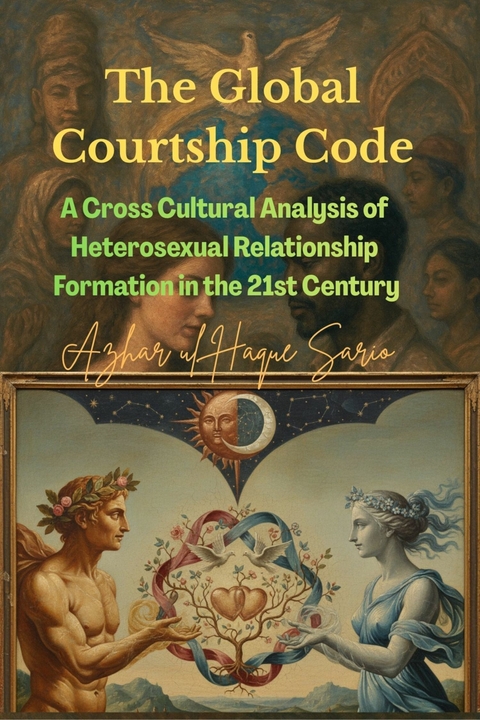
The Global Courtship Code (eBook)
200 Seiten
Azhar Sario Hungary (Verlag)
978-3-384-74614-6 (ISBN)
Hey, let's talk about 'The Global Courtship Code' - your ultimate guide to how love works around the world today.
This book dives into romantic relationships across cultures. It starts with theories on love and attraction. It covers Sternberg's Triangular Theory of intimacy, passion, and commitment. It explains Reiss's Wheel Theory on how relationships progress. It discusses love styles like limerence, storge, and pragma. It explores evolutionary psychology and mate preferences. It examines attachment theory and how early bonds shape adult romance. It analyzes investment models and motivations for dating. It views courtship as cultural rituals and symbols. It looks at community roles in dating, from chaperones to social networks. It discusses the political economy of love and social structures. It includes case studies from 15 countries, grouped by themes. It covers the U.S. with its choice paradox and hookup culture. It describes Australia's casual mateship and app reliance. It highlights Sweden's egalitarian fika dates. It details France's seductive, unspoken rules. It notes Germany's pragmatic structure. It explores Japan's kokuhaku confessions and marriage hunting. It covers South Korea's couple culture and anniversaries. It discusses China's pragmatic, family-driven approach. It examines India's caste endogamy and arranged marriages. It looks at Nigeria's bride price and talking stages. It analyzes Saudi Arabia's conservative traditions amid reforms. It covers Egypt's family-vetted arranged unions. It describes Brazil's passionate paquera and family ties. It details Mexico's chivalrous courtship. It explores Russia's grand gestures and gender roles. It discusses dating apps' global impact. It covers post-COVID shifts like slow dating. It examines AI in romance. It proposes new models like the commitment spectrum. It introduces the Socioeconomic Contract theory. It offers a Cultural Compatibility Index for intercultural dating. It identifies research gaps and future directions.
What sets this book apart is its fresh, global lens that blends timeless theories with 2025 trends like AI companions and situationships - something most dating books miss by focusing only on Western norms or outdated advice. Unlike narrow psychology texts or superficial travelogues, it provides evidence-based comparisons across 15 nations, revealing how tech and culture rewrite love rules, giving you practical tools like the Compatibility Index that no other guide offers for real-world navigation.
This author has no affiliation with the brand and it is independently produced under nominative fair use. All for your eyes only!
Part I: Theoretical Foundations of Modern Courtship
The Sociology of Love: From Limerence to Lasting Bonds
1.1 The Architecture of Love: Sternberg's Triangular Theory
The quest to define "love" is an ancient one. Philosophers, poets, and now, sociologists have all attempted to build a container for this complex, overwhelming, and fundamental human experience. While poetry captures its feeling, sociology seeks to understand its structure, its function, and its components. One of the most durable and useful frameworks for this task is the Triangular Theory of Love, developed by psychologist Robert Sternberg.
This theory is not just an academic exercise. It is a powerful diagnostic tool. It provides a map and a vocabulary, allowing us to deconstruct what we mean when we say "I love you" and to understand why some relationships thrive while others, which may feel just as intense, ultimately fail.
Sternberg's model is elegant in its simplicity. He posits that all loving relationships can be understood through the interplay of three core components, which form the vertices of a triangle.
Intimacy (The "Warm" Component): This is the emotional core of the relationship. It is the feeling of closeness, connection, and bondedness. Intimacy includes the desire to promote the welfare of your partner, feeling happiness with them, holding them in high regard, and sharing your authentic self. It is the trust that allows for vulnerability, the comfort of mutual understanding, and the deep-seated affection of a shared life. It is the "liking" in "I love you and I like you."
Passion (The "Hot" Component): This is the motivational and physiological engine of the relationship. It encompasses physical attraction, sexual desire, and the intense emotional arousal of romance. It is the "chemistry," the "spark," and the butterflies in your stomach. Passion is what drives us to seek union with another person and is often the most prominent and exhilarating component in the early stages of a relationship.
Commitment (The "Cold" Component): This is the cognitive and deliberate component. It actually has two parts: a short-term decision that you love your partner, and a long-term decision to maintain that love and stay in the relationship through good times and bad. Unlike intimacy and passion, which can be difficult to control, commitment is a choice. It is the decision to weather storms, to put the relationship's needs on par with your own, and to work toward a shared future.
The Eight Flavors of Love
The true genius of Sternberg's theory is not just in identifying these three components, but in showing how their combinations (and absences) create different types of love. The relative strength of each component defines the specific "shape" of a relationship.
Non-Love: This is the baseline of most of our casual interactions. All three components—intimacy, passion, and commitment—are absent. This describes the relationship you have with your barista or a distant acquaintance.
Liking (Intimacy Only): This is the love of true friendship. You feel a genuine bond, closeness, and warmth with the person. You can share your secrets, and you truly value their presence. However, there is no intense passion and no long-term commitment to a romantic partnership.
Infatuation (Passion Only): This is "love at first sight." It is an intense, all-consuming blaze of passion and physical arousal, but it lacks the stabilizing elements of intimate sharing or conscious commitment. It can appear suddenly and vanish just as quickly.
Empty Love (Commitment Only): This is a relationship defined by the decision to stay together, even when the passion has died and the intimate connection has eroded. This might be seen in the final, stagnant stages of a long-term marriage or, paradoxically, at the very beginning of an arranged marriage where commitment is the first and only piece in place.
Romantic Love (Intimacy + Passion): This is the "Hollywood" love, the focus of countless poems and novels. It combines the closeness of intimacy with the fire of passion. Partners in this state are not only physically drawn to each other but also deeply connected on an emotional level. However, this type of love lacks the stabilizing anchor of long-term commitment.
Companionate Love (Intimacy + Commitment): This is the "best friend" style of love, often found in relationships that have endured for many years. The passionate spark may have faded, but it is replaced by a deep affection, mutual trust, and a resolute commitment to the shared life. This is the bond that makes a couple a true "team."
Fatuous Love (Passion + Commitment): This is the "whirlwind romance." It is the couple that meets, is consumed by passion, and gets married in Las Vegas a month later. They have the commitment, and they have the passion, but they have skipped the crucial step of building genuine intimacy. This type of love is inherently unstable because, without the buffer of emotional understanding, the first major conflict can shatter the relationship once the passion subsides.
Consummate Love (Intimacy + Passion + Commitment): This is the "complete" love, the ideal that many strive for. It represents a relationship where all three components are present and balanced. It is the passionate connection of romance, the deep bond of friendship, and the secure promise of commitment.
Love Triangles in Motion
Sternberg's theory is powerful because it is dynamic. Our love triangles are not static; they change shape and size over the course of a relationship.
A new relationship might begin as a large "Romantic Love" triangle, high on passion and intimacy. Over 20 years, as the partners build a family and careers, the "Passion" vertex might shorten, but the "Commitment" and "Intimacy" vertices may grow substantially, transforming the relationship into a deep and stable "Companionate Love." This is not a failure; it is a natural and healthy evolution.
The theory also becomes a profound tool for cross-cultural analysis. In many Western, individualistic cultures, the "master narrative" of love demands a progression from Infatuation to Romantic Love, with Commitment being the final, crowning achievement. In contrast, in many collectivist cultures that practice arranged marriages, the process is inverted. The relationship begins with "Empty Love" (Commitment). From that foundation of stability, the couple is expected to build Intimacy over years of shared life. Passion may or may not follow, but it is not considered the primary foundation for a stable family unit.
In our modern world, the theory helps explain new challenges. A long-distance relationship must survive on high levels of Intimacy (built through communication) and Commitment (the choice to stay faithful). The Passion component is forced into a cycle of "feast or famine," flaring up during visits and lying dormant between them. The theory also struggles with, and thus illuminates, polyamorous relationships. Does a person have one triangle for each partner? Is it a single, complex geometric shape? This highlights how even foundational theories must be stretched and adapted to capture the evolving social landscape of human connection.
Ultimately, Sternberg's triangle is a map. It doesn't tell you where to go, but it gives you a way to understand where you are. A couple can use this framework to diagnose their own relationship: "I feel like our intimacy is strong, but our passion has faded," or "We have amazing passion, but I'm not sure about your commitment." It translates the messy, overwhelming feeling of "love" into a tangible language we can use to connect and grow.
1.2 The Wheel Theory of Love: A Four-Stage Progression
If Robert Sternberg provided the structural "anatomy" of love, sociologist Ira Reiss offered a dynamic, process-oriented "physiology" of how that love develops. His Wheel Theory of Love is a classic model that describes the typical progression of a relationship from a first meeting to a deep, committed bond. It is a process theory, meaning it focuses on the "how" and "when" of intimacy, not just the "what."
Reiss visualized love as a wheel with four spokes. Each spoke represents a stage, and each stage is interdependent. The successful navigation of one stage creates the momentum that turns the wheel and propels the couple into the next. This creates a feedback loop: the more the wheel turns, the deeper the bond becomes.
The Four Stages of the Wheel
Rapport: This is the first and most fundamental stage. Rapport is a feeling of ease, comfort, and mutual understanding. It's the "click." It's the sense that you are on the same wavelength with another person, that conversation is easy, and that you can be your authentic self without fear of judgment. According to Reiss, rapport is not random. It is largely built on homogamy—the tendency for us to be drawn to people who are like us. Shared social backgrounds, education levels, cultural values, and even sense of humor make it easier to build rapport. This shared context acts as a social lubricant, allowing trust to form.
Example: At a neighborhood block party, two people discover they both grew up in the Midwest, value family dinners, and find the same TV shows hilarious. This...
| Erscheint lt. Verlag | 3.11.2025 |
|---|---|
| Sprache | englisch |
| Themenwelt | Sachbuch/Ratgeber ► Gesundheit / Leben / Psychologie ► Familie / Erziehung |
| Sachbuch/Ratgeber ► Gesundheit / Leben / Psychologie ► Partnerschaft / Sexualität | |
| Schlagworte | courtship • Cross cultural romance • dating apps • dating culture • love theories • Mate selection • relationship models |
| ISBN-10 | 3-384-74614-7 / 3384746147 |
| ISBN-13 | 978-3-384-74614-6 / 9783384746146 |
| Informationen gemäß Produktsicherheitsverordnung (GPSR) | |
| Haben Sie eine Frage zum Produkt? |
 EPUB (Ohne DRM)
Digital Rights Management: ohne DRM
Dieses eBook enthält kein DRM oder Kopierschutz. Eine Weitergabe an Dritte ist jedoch rechtlich nicht zulässig, weil Sie beim Kauf nur die Rechte an der persönlichen Nutzung erwerben.
Dateiformat: EPUB (Electronic Publication)
EPUB ist ein offener Standard für eBooks und eignet sich besonders zur Darstellung von Belletristik und Sachbüchern. Der Fließtext wird dynamisch an die Display- und Schriftgröße angepasst. Auch für mobile Lesegeräte ist EPUB daher gut geeignet.
Systemvoraussetzungen:
PC/Mac: Mit einem PC oder Mac können Sie dieses eBook lesen. Sie benötigen dafür die kostenlose Software Adobe Digital Editions.
eReader: Dieses eBook kann mit (fast) allen eBook-Readern gelesen werden. Mit dem amazon-Kindle ist es aber nicht kompatibel.
Smartphone/Tablet: Egal ob Apple oder Android, dieses eBook können Sie lesen. Sie benötigen dafür eine kostenlose App.
Geräteliste und zusätzliche Hinweise
Buying eBooks from abroad
For tax law reasons we can sell eBooks just within Germany and Switzerland. Regrettably we cannot fulfill eBook-orders from other countries.
aus dem Bereich