NREMT Practice Book (eBook)
408 Seiten
Publishdrive (Verlag)
978-0-00-109650-9 (ISBN)
What if I told you that preparing for the NREMT with real confidence-without stress, without confusion, and without feeling unsure about your readiness-can become your reality?
If you're worried you haven't practiced enough realistic scenarios or you're unsure how you'll perform under real test pressure, then training with full-length, exam-accurate practice tests can be your answer.
It can dramatically strengthen your critical thinking, patient assessment skills, and ability to handle NREMT-style scenario questions-because nothing prepares you better than practicing in the exact format used on the real exam.
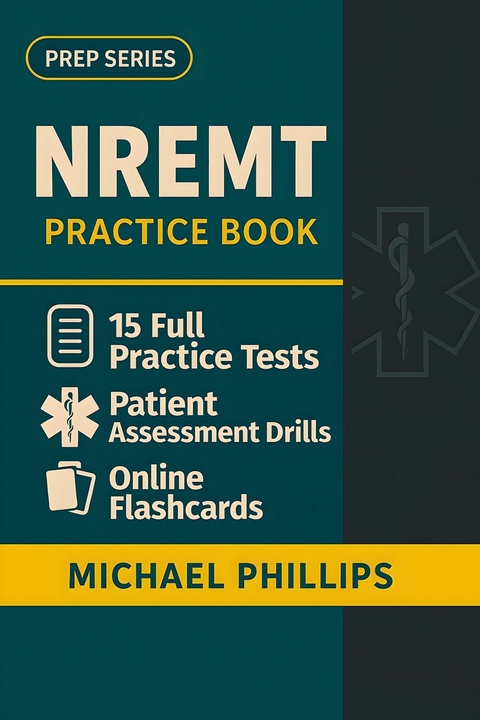
This practice book was built with one mission: to simulate the NREMT exam through 15 full-length practice tests that follow the actual structure and complexity of the EMT cognitive exam, each including clear answer explanations to help you learn instantly.
Every test covers the key domains evaluated by the NREMT: Airway, Cardiology, Medical, Trauma, OB/Peds, and EMS Operations. You get realistic scenarios, vital-sign interpretations, safety decisions, and step-by-step reasoning that match real emergency logic.
Whether you're testing for the first time or retaking to boost your score, these full-length exams help you sharpen your judgment, improve speed, and build confidence. And you don't need long study sessions. With just 30-40 minutes a day, this system keeps you consistent and exam-ready without burnout.
If you're unsure whether this will help, don't worry. Inside this book you'll find complete practice exams that reveal exactly what you know, what you need to review, and how close you are to passing. This is perfect if you want a cost-effective, structured preparation method without relying on expensive courses.
Whether you struggle with patient assessment, airway decisions, pediatric care, trauma sequences, or safety priorities, these tests train you to think exactly like the NREMT expects.
Here is just a fraction of what you'll discover inside this book:
15 full-length NREMT practice tests matching real exam style
• Answer explanations for every question to reinforce learning
• A 4-week practice plan to stay organized and consistent
• Scenario-based questions that mirror real EMS decision-making
• Coverage of all domains: Airway, Cardiology, Medical, Trauma, OB/Peds, EMS Ops
• Hundreds of exam-style items that build speed and accuracy
• Timed practice sessions to help you perform under pressure
• Up-to-date content aligned with the current NREMT blueprint
• A true testing simulation designed for EMT candidates who improve fastest through repetition
To get your copy right now, just scroll up and click 'Add to Cart.'
Practice Test 1
Logical Reasoning 1 (Q1–Q25)
Q1. You arrive at a grocery store where a 56-year-old male is diaphoretic and clutching his chest. He is alert, breathing 24/min, and has cool, pale skin. What should you do first?
A) Obtain a detailed SAMPLE history
B) Administer high-flow oxygen via NRB
C) Assist with his nitroglycerin
D) Begin rapid transport
E) Apply the AED
Correct: B
Why: Signs of poor perfusion + possible ACS require immediate oxygenation before other interventions.
Q2. A 4-year-old child is crying, has stridor, and is sitting upright drooling. What is the most appropriate first action?
A) Attempt to visualize the airway
B) Lay the child supine
C) Allow the child to remain in position of comfort
D) Provide high-pressure ventilations
E) Insert an OPA
Correct: C
Why: Epiglottitis patients must remain in a position of comfort to avoid airway collapse.
Q3. A construction worker fell 15 feet and is unconscious with snoring respirations. What should you do first?
A) Insert an OPA
B) Perform a jaw thrust
C) Apply a c-collar
D) Suction for 30 seconds
E) Provide oxygen via NRB
Correct: B
Why: Suspected trauma + snoring = airway obstruction requiring jaw thrust.
Q4. A 22-year-old diabetic patient is confused, diaphoretic, and answering questions incoherently. What should you do?
A) Administer oral glucose
B) Start rapid transport
C) Give high-flow oxygen
D) Check blood glucose
E) Apply the AED
Correct: D
Why: Altered diabetic patients require glucose assessment before treatment.
Q5. A patient exposed to a pesticide is vomiting and has pinpoint pupils and bradycardia. What should you do first?
A) Assist ventilations
B) Administer atropine
C) Remove patient from the environment
D) Irrigate the eyes
E) Administer activated charcoal
Correct: C
Why: Scene safety and removal from the toxic environment must occur before treatment.
Q6. A 68-year-old male with COPD is struggling to breathe at 8/min and has shallow respirations. Which is best?
A) NRB at 15 L/min
B) CPAP
C) Bag-mask ventilation
D) Nasal cannula at 2 L/min
E) No intervention
Correct: C
Why: Bradypnea with shallow breathing requires immediate ventilatory support.
Q7. A patient presents with abdominal pain and rigid tenderness after a stabbing. What should you do?
A) Check vital signs
B) Control external bleeding
C) Perform a detailed secondary exam
D) Rapid transport
E) Irrigate the wound
Correct: D
Why: Penetrating abdominal trauma with rigidity is high-priority for rapid transport.
Q8. A teenager with asthma is unable to speak more than one word at a time. What intervention should you perform?
A) Administer an EpiPen
B) Assist with his albuterol inhaler
C) High-flow O2 via NRB
D) CPAP
E) Finger sweep
Correct: B
Why: Severe asthma requires bronchodilator assistance if available.
Q9. A 30-year-old overdose patient is unconscious but breathing 6/min. What should you do first?
A) Apply Naloxone
B) Insert OPA and ventilate
C) Administer high-flow oxygen
D) Start CPR
E) Obtain SAMPLE
Correct: B
Why: Opioid overdose with inadequate respirations requires airway adjunct + ventilation first.
Q10. A 29-year-old pregnant woman is seizing. What should you prioritize?
A) Restrain the patient
B) Open the airway and suction
C) Apply NRB
D) Insert an OPA
E) Obtain blood pressure
Correct: B
Why: Active seizures require airway management and suctioning to prevent aspiration.
Q11. A patient has gurgling respirations after a motorcycle crash. What is the first intervention?
A) Suction the airway
B) Apply oxygen
C) Assist ventilations
D) Insert NPA
E) Rapid transport
Correct: A
Why: Gurgling indicates fluid in the airway that must be removed immediately.
Q12. A 12-year-old with a severe allergic reaction has hives and wheezing but normal mental status. Best action?
A) High-flow oxygen
B) EpiPen administration
C) Assist ventilations
D) Position supine
E) Give diphenhydramine
Correct: B
Why: Respiratory involvement in anaphylaxis requires epinephrine immediately.
Q13. A man with heat stroke is hot, dry, and unconscious. What is first priority?
A) Encourage oral hydration
B) Remove clothing and begin cooling
C) Apply warm packs
D) Transport immediately without intervention
E) Take vital signs
Correct: B
Why: Heat stroke requires immediate aggressive cooling.
Q14. You find a patient collapsed with agonal respirations at 4/min. What is the correct action?
A) Apply NRB
B) Start CPR
C) Bag-mask ventilation
D) Insert an NPA
E) Check glucose
Correct: C
Why: Agonal respirations require immediate ventilation support, not CPR if pulse present.
Q15. A 3-year-old is lethargic, has retractions, and a respiratory rate of 8. What must you do?
A) CPAP
B) NRB 15 L/min
C) Blow-by O2
D) Ventilate with BVM
E) Nothing
Correct: D
Why: Pediatric respiratory failure requires immediate assisted ventilations.
Q16. An unrestrained driver complains of neck pain. He is alert and stable. Best first step?
A) Rapid extrication
B) Manual c-spine stabilization
C) Detailed exam
D) Long board immediately
E) Remove helmet
Correct: B
Why: Suspected spinal trauma requires manual stabilization first.
Q17. A patient with carbon monoxide exposure is confused and dizzy. What should you do?
A) Apply oxygen via NRB
B) Insert nasal cannula
C) Provide ventilations
D) Perform glucose check
E) Obtain SAMPLE
Correct: A
Why: CO poisoning requires high-flow oxygen immediately.
Q18. A 19-year-old with abdominal trauma has weak radial pulses and cool skin. What is the priority?
A) Trendelenburg position
B) Obtain vitals
C) Rapid transport
D) Detailed exam
E) Apply cold packs
Correct: C
Why: Signs of shock after trauma mandate rapid transport.
Q19. A child has an airway obstruction but is coughing forcefully. Your action?
A) Abdominal thrusts
B) Encourage coughing
C) Back blows
D) Blind finger sweep
E) CPR
Correct: B
Why: Strong cough = partial obstruction; encourage coughing.
Q20. A patient with COPD is on home oxygen and now severely hypoxic. What should you do?
A) Withhold oxygen
B) Give high-flow oxygen
C) Only assist ventilations
D) Check blood pressure
E) Start CPR
Correct: B
Why: Hypoxia takes precedence over concerns about CO₂ retention.
Q21. A 60-year-old male with chest pain becomes unresponsive. Pulse is absent. What now?
A) Ventilate
B) Apply NRB
C) Check glucose
D) Begin CPR
E) Take vitals
Correct: D
Why: No pulse requires immediate CPR.
Q22. A patient with a head injury is vomiting repeatedly. What should you do?
A) Supine position
B) Trendelenburg
C) Recovery position
D) Restrain the patient
E) Apply warm packs
Correct: C
Why: Recovery position maintains airway in vomiting trauma patients.
Q23. A burn patient has soot around the mouth and singed nasal hairs. What must you prepare for?
A) Cardiac arrest
B) Airway compromise
C) Hypoglycemia
D) Seizure
E) Stroke
Correct: B
Why: Facial burns suggest impending airway swelling.
Q24. A patient with a broken femur has severe bleeding. What is your first step?
A) Splint the leg
B) Apply direct pressure
C) Apply cold pack
D) Start IV fluids
E) Trendelenburg
Correct: B
Why: Direct pressure is first-line control for severe bleeding.
Q25. A patient with hypoglycemia becomes unresponsive. Breathing is adequate. What is correct?
A) Administer oral glucose
B) Ventilate immediately
C) Apply AED
D) Recovery position
E) Encourage eating
Correct: D
Why: Unresponsive but breathing patients should be placed in the recovery position to protect the airway.
Logical Reasoning 2 (Q1–Q25)
Q1. A 44-year-old male is pale, sweating, and confused after working outside in the heat. Skin is hot and moist. What should you do first?
A) Encourage oral fluids
B) Move him to a cool environment
C) Apply cold packs to the neck
D) Check blood glucose
E) Apply NRB
Correct: B
Why: Removing from the hot environment is the immediate priority.
Q2. A patient is hyperventilating after a panic attack. Respirations 34, speaking clearly, and no distress. Best action?
A) Paper bag ventilation
B) Encourage slowing breathing
C) High-flow oxygen
D) Assist ventilations
E) Rapid transport
Correct: B
Why: Anxiety-induced hyperventilation improves with coached breathing.
Q3. A 70-year-old female with CHF presents with rales, severe dyspnea, and tripod posture. First action?
A) Administer furosemide
B) CPAP
C) Lay the patient flat
D) Obtain blood pressure
E) Give oral glucose
Correct:...
| Erscheint lt. Verlag | 4.11.2025 |
|---|---|
| Sprache | englisch |
| Themenwelt | Sachbuch/Ratgeber ► Beruf / Finanzen / Recht / Wirtschaft ► Bewerbung / Karriere |
| ISBN-10 | 0-00-109650-8 / 0001096508 |
| ISBN-13 | 978-0-00-109650-9 / 9780001096509 |
| Informationen gemäß Produktsicherheitsverordnung (GPSR) | |
| Haben Sie eine Frage zum Produkt? |
 EPUB (Adobe DRM)
Größe: 985 KB
Kopierschutz: Adobe-DRM
Adobe-DRM ist ein Kopierschutz, der das eBook vor Mißbrauch schützen soll. Dabei wird das eBook bereits beim Download auf Ihre persönliche Adobe-ID autorisiert. Lesen können Sie das eBook dann nur auf den Geräten, welche ebenfalls auf Ihre Adobe-ID registriert sind.
Details zum Adobe-DRM
Dateiformat: EPUB (Electronic Publication)
EPUB ist ein offener Standard für eBooks und eignet sich besonders zur Darstellung von Belletristik und Sachbüchern. Der Fließtext wird dynamisch an die Display- und Schriftgröße angepasst. Auch für mobile Lesegeräte ist EPUB daher gut geeignet.
Systemvoraussetzungen:
PC/Mac: Mit einem PC oder Mac können Sie dieses eBook lesen. Sie benötigen eine
eReader: Dieses eBook kann mit (fast) allen eBook-Readern gelesen werden. Mit dem amazon-Kindle ist es aber nicht kompatibel.
Smartphone/Tablet: Egal ob Apple oder Android, dieses eBook können Sie lesen. Sie benötigen eine
Geräteliste und zusätzliche Hinweise
Buying eBooks from abroad
For tax law reasons we can sell eBooks just within Germany and Switzerland. Regrettably we cannot fulfill eBook-orders from other countries.
aus dem Bereich