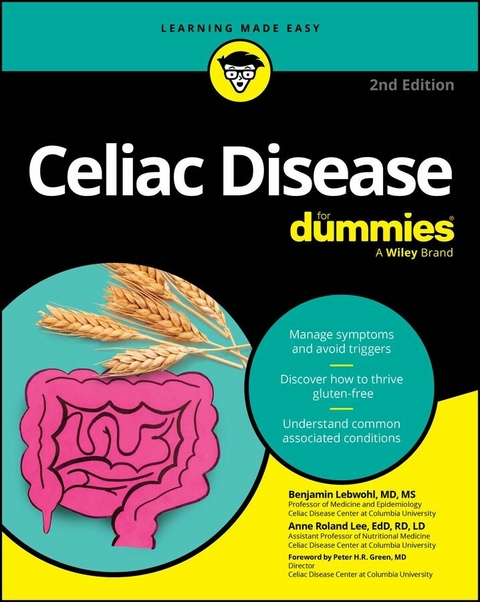
Celiac Disease For Dummies (eBook)
473 Seiten
For Dummies (Verlag)
978-1-394-35790-1 (ISBN)
A compassionate, thorough guide to this increasingly common gluten-related condition
Celiac Disease For Dummies is the ultimate reference for living with celiac disease, an autoimmune digestive disorder characterized by a reaction to foods containing gluten. For the newly diagnosed and anyone wanting to learn more about the disease, this book offers jargon-free explanations of symptoms, possible causes, and treatment options. This updated edition covers the latest risk factors, testing, and scientific insights on how celiac disease develops. With the right approach, you can greatly ease symptoms. Discover helpful lifestyle changes and get expert guidance on gluten-free living. This Dummies guide can empower you to address celiac disease head-on and improve your quality of life.
- Learn the latest on what celiac disease is and how to manage symptoms
- Heal your intestines, prevent celiac-related cell damage, and live gluten free
- Compare your treatment options and learn about new drug trials
- Get helpful information on caring for a child or loved one with celiac disease
Celiac Disease For Dummies is a welcome resource for anyone who has or suspects they have this common digestive condition.
Benjamin Lebwohl, MD, MS, is a gastroenterologist at Columbia University Irving Medical Center. He's the Director of Clinical Research at the Celiac Disease Center at Columbia University.
Anne Roland Lee, EdD, RD, LD, is a registered dietitian and an Assistant Professor of Nutritional Medicine at Columbia University.
Chapter 1
Finding Out You Have Celiac Disease
IN THIS CHAPTER
Understanding celiac disease
Coming to terms with the diagnosis of celiac disease and considering how it can make you feel
Treating celiac disease
Living well with celiac disease
Coping with a celiac disease diagnosis and finding support
When you first find out that you or your loved one has celiac disease, you may be shocked. No one likes to hear bad news, and, as so often happens in this type of situation, you may recall little other than the words celiac disease from the conversation you have with your doctor that day.
Over the next few days and weeks, your mind may race nonstop as you mull over your new diagnosis and try to come to grips with it. Or, if the diagnosis is brand new to you, perhaps you are right now in the process of trying to deal with the news.
Celiac Disease For Dummies provides you not just with the facts about celiac disease, but the tools to help you master it. In this chapter, our goal is to help you understand and come to terms with your diagnosis.
Getting to Know Celiac Disease
Celiac disease, also known as celiac sprue, non-tropical sprue, and gluten-sensitive enteropathy, is a condition in which consuming gluten — a protein found in wheat, rye, barley, and some other grains — leads, in susceptible people, to damage to the lining of the small intestine, resulting in the inability to properly absorb nutrients into the body. This can lead to many different symptoms, including fatigue, malaise (feeling generally poorly), bloating, and diarrhea. Left untreated or insufficiently treated, celiac disease can lead to damage to other organs. If properly treated, celiac disease typically leads to … nothing!
In your travels, you may see the word celiac spelled as coeliac. Both terms refer to the same condition. Celiac is the spelling far more commonly used in North America and, hence, the spelling we use throughout this book. Incidentally, the term celiac (or coeliac) comes from the Greek word Koila, which refers to the abdomen.
Doctors have known about celiac disease for a long time. Articles describing individuals suffering from diarrhea (most likely due to what we now call celiac disease) first appeared over two thousand years ago. It was, however, Dr. Samuel Gee who, in London, England in 1887, first described the condition in detail and even presciently observed that successful therapy was to be found in changing a patient’s diet, although he did not point to gluten as the culprit. That came later (see the “Discovering celiac disease” later in this chapter).
Knowing How Having Celiac Disease Feels
It could well be that you were diagnosed with celiac disease after having been unwell for quite some time. If so, then when you read this section’s heading (“Knowing How Having Celiac Disease Feels”), you may have said to yourself, “Hey, I can tell you how it feels. It feels crummy. I had belly pain and I had indigestion and I had …” Yup, those things sure can happen. But so too can many other symptoms or, on the other side of the spectrum, few or even no symptoms at all.
In Chapter 2, we look at the whole panoply of symptoms a person with celiac disease can experience. Some of these may lead you to nod your head in recognition (such as the symptoms we just mentioned), and some may take you by surprise (such as discovering the link between celiac disease and conditions as varied as skin rash and infertility).
Dealing with the Diagnosis of Celiac Disease
Some diseases are easy to diagnose. Tell a doctor you have spells where you see flashing lights followed by a throbbing headache, and, dollars to donuts, the doctor will quickly inform you that you may be suffering from migraine headaches.
Diagnosing celiac disease is often not that simple. It involves an interview and examination by a physician and necessitates investigations typically including blood tests and always having a fiberoptic scope passed through your mouth, down your esophagus, through your stomach, and into your small intestine where a biopsy is then taken. Okay, we admit, that may not sound particularly pleasant, but as you see in Chapter 3, it ain’t so bad at all.
The journey to a diagnosis of celiac disease can take a number of different paths. In Chapter 4, we discuss the different types of celiac disease based on symptoms (or lack thereof). Perhaps you’re already aware (and if you’re not, you soon will be because it’s a recurring theme in this book) of the key role that a nutrient called gluten plays in triggering celiac disease. As we discuss in Chapter 5, however, although gluten triggers the condition, that’s not quite the same as saying it causes the condition.
By way of analogy, if ever you were working on your computer and you routinely pressed a key only to suddenly have your computer crash, you could appropriately say that pressing the key triggered the crash, but an underlying operating system glitch caused the problem in the first place.
What, then, causes celiac disease? The quick answer is we don’t know. The more complicated answer is a combination of having a susceptibility to the condition by virtue of your genetic make-up in conjunction with some as yet unknown environmental factor. Chapter 5 contains the full story on the cause, as best we understand it.
Unless people are ill with some sort of gastrointestinal (GI) ailment, they understandably generally think little, if at all, about the incredibly complex processes involved in extracting the good from the food they eat and ridding their bodies of the stuff they don’t need. That makes sense. When celiac disease enters your life (either directly or by virtue of a family member now being affected by it), however, having some familiarity with your GI system proves beneficial. Chapter 5 explains how your GI system works when you’re healthy and how it malfunctions when you have celiac disease.
DISCOVERING CELIAC DISEASE
The first definitive report of celiac disease was made by Dr. Samuel Gee in London, England in 1887 in his seminal study “On the Coeliac Affection.” Dr. Gee astutely observed that “if the patient can be cured at all, it must be by means of diet.”
He experimented with various diets and noted that “A child, who was fed upon a quart of the best Dutch mussels daily, throve wonderfully, but relapsed when the season for mussels was over.” It is, perhaps no surprise to any parent that Dr. Gee also reported, “Next season (the child) could not be prevailed upon to take them.”
By 1950, the link between celiac disease and wheat was finally established. In that year, Dr. Willem-Karel Dicke, a Dutch pediatrician, reported that children with symptoms of celiac disease got better when wheat was removed from their diet.
Dicke was suspicious that wheat was the culprit for decades, but this theory only gained traction during World War II. In 1943, wheat products were in short supply in Holland due to a Nazi blockade. During that time, previously unwell children, now deprived of wheat-based products, had relief from their symptoms with them only to return upon the reintroduction of wheat into their diet after the end of the war.
With his theory validated by these tragic circumstances, Dicke went on to publish his findings regarding gluten as the culprit, and the gluten-free diet as the treatment.
Some people have no symptoms, gastrointestinal or otherwise But even they may end up diagnosed with celiac disease. In Chapter 6, we look at who should be screened (tested) for celiac disease and how the screening should be done.
As we mentioned earlier in this chapter, if left untreated or insufficiently treated, celiac disease can not only make you feel unwell, but it can lead to serious damage to your body (including causing complications like osteoporosis, anemia, and more).
In Chapter 7, we take a detailed look at these potential complications and how to avoid them. In Chapter 8, we look at the many ailments that are not directly caused by celiac disease but are associated with it. We describe the kinds of symptoms these ailments cause and the symptoms to which you should pay the most heed.
For many people, the most feared complication of celiac disease is cancer. Thankfully, celiac disease seldom leads to this, but it can. In Chapter 9, we make you aware of the types of cancer that are linked to celiac disease and, most important, early warning signs for which you should keep a close watch.
Treating Celiac Disease
Celiac disease can make you feel unwell. It can be a hassle to live with. It can cause complications, including damage to your body. Oh joy. So now the good news: You have ultimate power over this condition. Even better, this power is derived not from taking a truckload of pills — or, indeed, any pills at all; no, this power is derived from you modifying your diet to eliminate any and all gluten.
Modifying your diet to eliminate gluten intake, however, isn’t simple and requires lots of work and, like they say about the price of freedom, eternal vigilance....
| Erscheint lt. Verlag | 3.11.2025 |
|---|---|
| Sprache | englisch |
| Themenwelt | Sachbuch/Ratgeber ► Gesundheit / Leben / Psychologie |
| Schlagworte | celiac children • Celiac Diagnosis • Celiac disease book • celiac disease treatment • celiac explained • celiac help • celiac parenting • Celiac Symptoms • gluten allergy • gluten-free • gluten intolerance • Peter H. R. Green • undiagnosed celiac |
| ISBN-10 | 1-394-35790-7 / 1394357907 |
| ISBN-13 | 978-1-394-35790-1 / 9781394357901 |
| Informationen gemäß Produktsicherheitsverordnung (GPSR) | |
| Haben Sie eine Frage zum Produkt? |
 EPUB (Adobe DRM)
Kopierschutz: Adobe-DRM
Adobe-DRM ist ein Kopierschutz, der das eBook vor Mißbrauch schützen soll. Dabei wird das eBook bereits beim Download auf Ihre persönliche Adobe-ID autorisiert. Lesen können Sie das eBook dann nur auf den Geräten, welche ebenfalls auf Ihre Adobe-ID registriert sind.
Details zum Adobe-DRM
Dateiformat: EPUB (Electronic Publication)
EPUB ist ein offener Standard für eBooks und eignet sich besonders zur Darstellung von Belletristik und Sachbüchern. Der Fließtext wird dynamisch an die Display- und Schriftgröße angepasst. Auch für mobile Lesegeräte ist EPUB daher gut geeignet.
Systemvoraussetzungen:
PC/Mac: Mit einem PC oder Mac können Sie dieses eBook lesen. Sie benötigen eine
eReader: Dieses eBook kann mit (fast) allen eBook-Readern gelesen werden. Mit dem amazon-Kindle ist es aber nicht kompatibel.
Smartphone/Tablet: Egal ob Apple oder Android, dieses eBook können Sie lesen. Sie benötigen eine
Geräteliste und zusätzliche Hinweise
Buying eBooks from abroad
For tax law reasons we can sell eBooks just within Germany and Switzerland. Regrettably we cannot fulfill eBook-orders from other countries.
aus dem Bereich