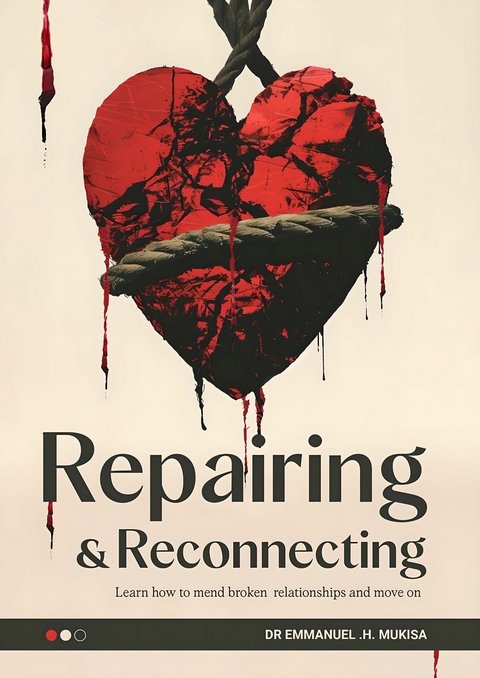
Repairing & Reconnecting (eBook)
155 Seiten
Publishdrive (Verlag)
978-0-00-109345-4 (ISBN)
Repairing and reconnecting helps you heal relationships, rebuild trust, and embrace new beginnings. It is your roadmap to mending broken relationships and creating deeper, more meaningful bonds. Packed with strategies for effective communication, forgiveness, and emotional healing, this book empowers you to take responsibility, rebuild trust, and strengthen connections.
Whether you're seeking to repair relationships or embrace new beginnings, Repairing and reconnecting provides the tools to navigate challenges, grow emotionally, and create healthier, more fulfilling connections.
How to Set Healthy Boundaries to Repair and Strengthen Relationships
Wholesome boundaries repair and strengthen relationships because they protect mutual respect and understanding in them. Setting boundaries is not about creating walls, distancing, or shutting your loved ones out; rather, it's defining what works for you and what treatment you will find acceptable from people around you. This finally enables one to take responsibility for one's emotional well-being and create a place of security and trust. This allows for a premise on which both parties can enter into healthier and more balanced relationships.
First, to set healthy boundaries, there needs to be self-awareness. One needs to understand their emotional triggers, values, and limits before they can communicate their needs. Take time to reflect upon what behaviors or situations cause you stress, discomfort, or resentment. That reflection probably will bring certain realizations in what areas you must set boundaries, so as to not get emotionally hurt. Well, the more clear you become about your requirements, the better are you at telling about them, therefore standing up constructively for your rights so that next time there cannot be any possibility of miscommunication.
Once you know what your needs are, it's a question of learning how to effectively communicate those needs to others. Healthy boundaries demand openness in communication-a way of letting others know what one is and is not going to tolerate. Clearly state what you can and can't do, but do so in an easy and polite way. For instance, one may say, "Please leave me some quiet time to myself in the evening to relax when one needs some extra time to get restored." This clarity leaves less room for the unintentional encroachments of one's boundary. It protects the limits of the one setting up such boundaries; on the other hand, being mindful and respectful of the boundaries of other people is not less important either. A healthy relationship is all about mutual respect, including respect for the limits set by others. You would respect the boundaries around you and build through that a relationship of trust and safety. For example, setting limits that are reasonable will not hurt the feelings of the person with whom one interacts; consider his needs, too. Such balance, in respect of the two parties involved and their respect toward one's limits, is part of this healthy and supportive dynamic.
Second, setting and maintaining boundaries concern consistency. Once one states his or her needs and limits, then these ought to be followed consistently. The point is, if you let someone continue to cross the boundary time and again without following through on your request, then the boundary isn't working. Follow through as needed; this should be reasonable and commensurate. When this fails-say, someone doesn't take personal space-the calm repetition of the communication of the boundary and why it's important to his or her well-being. Consistency is the means whereby one makes sure boundaries are respected, and that also instills the respect for the same boundaries.
Setting boundaries isn't always about saying "no," per se, but may involve compromise. Sometimes, boundaries are actually how you can open up space to really communicate effectively and find common ground. You may be in consensus with putting time investment into having a hard talk; you could even place this boundary while deciding the amount of time one session would have to be dedicated to discussing something, as you would not want yourself worn out. In this way, such a boundary does not shut down the conversation but keeps both parties respectful of each other's emotional limits, able even to revisit the topic when emotions are not running hot.
In those relationships which need restoration, the setting of boundaries deters the cyclic behavior of conflicts and emotional hurts. If the boundaries are well-set, it is easier to avoid situations that may bring in misunderstandings, resentment, and hurt feelings. For example, if the problem was related to space and time apart, then boundaries regarding frequency and timing when seeing each other give time for recouping and an avenue to approach this relationship from a place of clarity. These set the boundaries, which are proactive in the process of preventing further hurt and creating space where healing may occur.
The setting of healthy boundaries is learned by knowing how to say "no" without guilt. Most people find it hard to utter the word "no" because it may disappoint others or create friction in a relationship. On the other hand, it is equally important to learn how to say "no," for one's protection and better well-being to be preserved within a relationship. Saying "no" can give you time for priorities and make sure that you are not overcommitting yourself or going against what is important. This is when it happens on both sides, say, both people are comfortable setting limits; then mutual respect is built that eliminates the need to always people-please.
Let's get real: setting boundaries is just not always going to be easy, especially in those relationships where patterns have been set. Indeed, old habits are not easily broken, and others may not understand or respect your new limits overnight. Patience and polite reminders are important in such situations. When someone is overstepping the bounds regularly, calmly reiterate your limits while keeping firm yet respectful in tone. That reinforces limits without escalating tension. Sometimes, it is just the continuous setting of the boundary that changes relationships over time.
Setting boundaries isn't a protection mode but an opportunity for more growth. You will understand yourself and your values-better, anyway-soon as there is a bit more clarity with regard to the setting of your boundaries, those strong and resilient relationships surely will build upon well-set ones. When both respect each other's boundaries, then both feel heard and valued and supportive; that starts to build trust and deeper connection, ultimately nurturing the relationship and furthering its growth even more.
To do that, one sometimes needs to be in touch with uncomfortable emotions: the fear of rejection, guilt. You may feel apprehensive that setting limits will hurt the other person or deprive him. Yet, healthy boundaries are not about punishing or distancing oneself from others; they are about creating space for self-care and emotional well-being. If anyone really cares about you, then they respect your boundaries and know it's not an attack on them but a healthy expression of your needs.
Boundaries are not only needed in a romantic relationship, but they further extend into friendships, families, and working relationships. Every dynamic has a set of needs, and setting boundaries is done so the emotional space for all concerned is given due respect. For instance, the boundaries that people set towards how to communicate or topics not to touch avoid unnecessary conflicts between the relationships within a family. The boundaries in friendships entail the time taken with each other or how often one gets to be with each other. Observing boundaries within all your relationships brings in a very serene and respectable ambiance.
Setting boundaries also involves knowing when those boundaries are crossed and what to do about it. If someone does not respect your boundaries, always confront the situation in a quiet tone and directly. Because whenever intrusion into your boundary occurs, and you allow that intrusion, resentments arise and trust deteriorates; hence, speak when necessary and how it's making you feel. Where respect for the boundaries exists, it adds strength to the deepening of trust in a relationship.
Setting boundaries isn't some big act but rather an ongoing process that could mean a few changes over time. It changes as much as the relationships do: the needs and limits change with it. Being able to head back to your boundaries and revise them according to the changing circumstances requires flexibility. This can indicate that you need to alter how your needs are expressed for some significant transition or movement-for example, a life change or dynamic in the relationship. It is through flexibility, along with healthy limits, that the relationship can grow and evolve positively.
Setting boundaries may prevent burnout in relationships in the long term. Putting others first and your needs last will only lead to emotional burnout and resentment. In having boundaries, you are holding both people responsible for their own emotions. This not only protects your energy but will also create a balanced ongoing relationship dynamic. When both parties respect each other's boundaries, the relationship becomes more rewarding and supportive for both.
Healthy boundaries will go a long way in strengthening and repairing a relationship. Setting forth clearly what is and isn't acceptable, and giving respect to the needs of another, allows both persons to feel safe and supported in growing in life. Healthy boundaries ensure respect, trust, and understanding toward each other-foundation needed for rebuilding any kind of relationship. Setting these boundaries may be painful, with much repetition, but the payoff will be well worth the effort: better-balanced, more fulfilling, resilient relationships.
The Role of Forgiveness in Reconnecting and Moving Past Relationship Struggles
It is of great importance because it reunites and overcomes conflicts for both persons in the relationship. Forgiveness lifts off the chains of resentment which would encumber a positive process of change and effective mutual understanding; one forgives by choosing not to stay angry with oneself because of one person's gaffe that hurt others. It is not...
| Erscheint lt. Verlag | 30.10.2025 |
|---|---|
| Sprache | englisch |
| Themenwelt | Sachbuch/Ratgeber ► Gesundheit / Leben / Psychologie ► Lebenshilfe / Lebensführung |
| ISBN-10 | 0-00-109345-2 / 0001093452 |
| ISBN-13 | 978-0-00-109345-4 / 9780001093454 |
| Informationen gemäß Produktsicherheitsverordnung (GPSR) | |
| Haben Sie eine Frage zum Produkt? |
 EPUB (Adobe DRM)
Größe: 1,3 MB
Kopierschutz: Adobe-DRM
Adobe-DRM ist ein Kopierschutz, der das eBook vor Mißbrauch schützen soll. Dabei wird das eBook bereits beim Download auf Ihre persönliche Adobe-ID autorisiert. Lesen können Sie das eBook dann nur auf den Geräten, welche ebenfalls auf Ihre Adobe-ID registriert sind.
Details zum Adobe-DRM
Dateiformat: EPUB (Electronic Publication)
EPUB ist ein offener Standard für eBooks und eignet sich besonders zur Darstellung von Belletristik und Sachbüchern. Der Fließtext wird dynamisch an die Display- und Schriftgröße angepasst. Auch für mobile Lesegeräte ist EPUB daher gut geeignet.
Systemvoraussetzungen:
PC/Mac: Mit einem PC oder Mac können Sie dieses eBook lesen. Sie benötigen eine
eReader: Dieses eBook kann mit (fast) allen eBook-Readern gelesen werden. Mit dem amazon-Kindle ist es aber nicht kompatibel.
Smartphone/Tablet: Egal ob Apple oder Android, dieses eBook können Sie lesen. Sie benötigen eine
Geräteliste und zusätzliche Hinweise
Buying eBooks from abroad
For tax law reasons we can sell eBooks just within Germany and Switzerland. Regrettably we cannot fulfill eBook-orders from other countries.
aus dem Bereich