


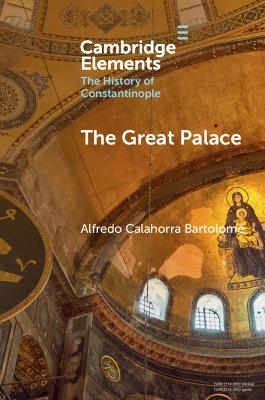
The Great Palace
Seiten
2026
Cambridge University Press (Verlag)
978-1-009-67548-2 (ISBN)
Cambridge University Press (Verlag)
978-1-009-67548-2 (ISBN)
- Noch nicht erschienen (ca. Februar 2026)
- Portofrei ab CHF 40
- Auch auf Rechnung
- Artikel merken
The Great Palace of Constantinople was the heart of Byzantium for almost a thousand years, serving as both a political and architectural model for Christendom and the Islamic world. This Element synthesises the historical and topographical evolution of the palace, examining its architectural typologies and the role of ritual and artistic objects.
The Great Palace of Constantinople was the heart of Byzantium for almost a thousand years, serving as both a political and architectural model for Christendom and the Islamic world. Despite its historical significance, reconstructing its layout remains challenging due to the scarce amount of archaeological evidence. This Element synthesises the historical and topographical evolution of the palace, examining its architectural typologies and the role of ritual and artistic objects in representing imperial power. It also addresses key historiographical issues, such as the identification and dating of the Peristyle of the Mosaics, as well as its role in imperial ceremonies. The research is based on textual sources, archaeology, and graphic documentation, culminating in a virtual reconstruction through 3D imaging. By integrating these methodologies, this Element aims to offer a comprehensive understanding of the Great Palace, its influence, and its role as a central stage for Byzantine ceremonial and ideological expression.
The Great Palace of Constantinople was the heart of Byzantium for almost a thousand years, serving as both a political and architectural model for Christendom and the Islamic world. Despite its historical significance, reconstructing its layout remains challenging due to the scarce amount of archaeological evidence. This Element synthesises the historical and topographical evolution of the palace, examining its architectural typologies and the role of ritual and artistic objects in representing imperial power. It also addresses key historiographical issues, such as the identification and dating of the Peristyle of the Mosaics, as well as its role in imperial ceremonies. The research is based on textual sources, archaeology, and graphic documentation, culminating in a virtual reconstruction through 3D imaging. By integrating these methodologies, this Element aims to offer a comprehensive understanding of the Great Palace, its influence, and its role as a central stage for Byzantine ceremonial and ideological expression.
1. Introduction and methodology; 2. Evidence for the study of the palace; 3. The upper palace; 4. The lower palace; Bibliography.
| Erscheint lt. Verlag | 28.2.2026 |
|---|---|
| Reihe/Serie | Elements in the History of Constantinople |
| Zusatzinfo | Worked examples or Exercises |
| Verlagsort | Cambridge |
| Sprache | englisch |
| Themenwelt | Sachbuch/Ratgeber ► Gesundheit / Leben / Psychologie ► Lebenshilfe / Lebensführung |
| Technik ► Architektur | |
| ISBN-10 | 1-009-67548-6 / 1009675486 |
| ISBN-13 | 978-1-009-67548-2 / 9781009675482 |
| Zustand | Neuware |
| Informationen gemäß Produktsicherheitsverordnung (GPSR) | |
| Haben Sie eine Frage zum Produkt? |
Mehr entdecken
aus dem Bereich



aus dem Bereich
die Prämenstruelle Dysphorische Störung als schwerste Form des PMS
Buch | Softcover (2023)
Kohlhammer (Verlag)
CHF 39,95
ein Praxishandbuch für Eltern, Lehrer und Therapeuten
Buch | Softcover (2023)
Kohlhammer (Verlag)
CHF 36,40
eine Geschichte über das Leben, die Liebe und das Glück
Buch | Hardcover (2025)
dtv (Verlag)
CHF 26,90


