


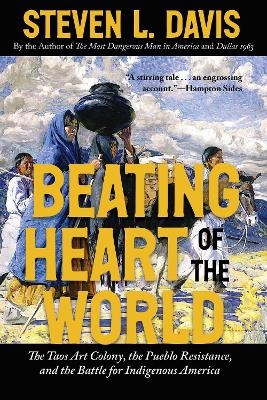
Beating Heart of the World
The Taos Art Colony, the Pueblo Resistance, and the Battle for Indigenous America
Seiten
2026
University of New Mexico Press (Verlag)
978-0-8263-6966-6 (ISBN)
University of New Mexico Press (Verlag)
978-0-8263-6966-6 (ISBN)
- Noch nicht erschienen (ca. Mai 2026)
- Versandkostenfrei
- Auch auf Rechnung
- Artikel merken
The fascinating true story of how Taos Pueblo’s Indigenous people recruited members of the famous Taos art colony to help spark a movement for Native justice that reshaped the nation.
When the first white artists arrived in Taos by horse-drawn wagons, centuries of military conquest and brutal government policies had pushed Indigenous people to the brink of collapse. New Mexico’s pueblos had become some of America’s last holdouts of traditional culture, resolutely preserving their sacred lands in the face of mounting pressure.
Many of the free-spirited newcomers in Taos came to admire the pueblos’ peaceful, communal societies and holy regard for the natural world. To these outsiders, pueblo civilization offered a marked contrast to America’s record of endless war, hyperindividualism, and environmental destruction.
Among those attracted to Taos was the “Queen of Bohemia,” a wealthy New York heiress who dabbled in peyote and personified radical chic. Mabel Dodge Luhan fell in love with Taos Pueblo leader Tony Lujan and hoped to inspire an American spiritual renaissance based on pueblo values. She brought world-famous luminaries to Taos, including D. H. Lawrence, Georgia O’Keeffe, and Carl Jung, along with the fiery social reformer John Collier.
As the art colony gained international fame, the US government targeted the pueblos for extinction, moving to seize their lands and destroy their cultures. This same grim scenario had played out countless times before in US history. It seemed that nothing could stop the brutal crush of conquest.
But the puebloans, who had once unleashed a fierce revolt against Spain in 1680, found a new way to fight back in the modern era. As master diplomats, they began recruiting the prominent creatives converging on Taos, shrewdly enlisting them as political allies. And these artists and writers, at a crucial moment in history, rose to join the pueblos and challenged their own culture’s prevailing genocidal policies.
Beating Heart of the World is the fascinating, fast-paced chronicle of a long-shot resistance movement that grew into a powerful national campaign for Indigenous justice. While a work of history, Beating Heart of the World speaks urgently to our own era as new resistance movements percolate—and as new generations increasingly look to ancient Indigenous wisdom to help guide sustainable pathways forward.
When the first white artists arrived in Taos by horse-drawn wagons, centuries of military conquest and brutal government policies had pushed Indigenous people to the brink of collapse. New Mexico’s pueblos had become some of America’s last holdouts of traditional culture, resolutely preserving their sacred lands in the face of mounting pressure.
Many of the free-spirited newcomers in Taos came to admire the pueblos’ peaceful, communal societies and holy regard for the natural world. To these outsiders, pueblo civilization offered a marked contrast to America’s record of endless war, hyperindividualism, and environmental destruction.
Among those attracted to Taos was the “Queen of Bohemia,” a wealthy New York heiress who dabbled in peyote and personified radical chic. Mabel Dodge Luhan fell in love with Taos Pueblo leader Tony Lujan and hoped to inspire an American spiritual renaissance based on pueblo values. She brought world-famous luminaries to Taos, including D. H. Lawrence, Georgia O’Keeffe, and Carl Jung, along with the fiery social reformer John Collier.
As the art colony gained international fame, the US government targeted the pueblos for extinction, moving to seize their lands and destroy their cultures. This same grim scenario had played out countless times before in US history. It seemed that nothing could stop the brutal crush of conquest.
But the puebloans, who had once unleashed a fierce revolt against Spain in 1680, found a new way to fight back in the modern era. As master diplomats, they began recruiting the prominent creatives converging on Taos, shrewdly enlisting them as political allies. And these artists and writers, at a crucial moment in history, rose to join the pueblos and challenged their own culture’s prevailing genocidal policies.
Beating Heart of the World is the fascinating, fast-paced chronicle of a long-shot resistance movement that grew into a powerful national campaign for Indigenous justice. While a work of history, Beating Heart of the World speaks urgently to our own era as new resistance movements percolate—and as new generations increasingly look to ancient Indigenous wisdom to help guide sustainable pathways forward.
Steven L. Davis is the winner of the PEN Center Award for Research Nonfiction and the author, coauthor, or editor of eight previous books, including Dallas 1963; The Most Dangerous Man in America: Timothy Leary, Richard Nixon and the Hunt for the Fugitive King of LSD; and Viva Texas Rivers! Adventures, Misadventures, and Glimpses of Nirvana along Our Storied Waterways. The retired literary curator of the Wittliff Collections at Texas State University, he now lives in Albuquerque, New Mexico.
| Erscheint lt. Verlag | 19.5.2026 |
|---|---|
| Verlagsort | Albuquerque, NM |
| Sprache | englisch |
| Maße | 152 x 229 mm |
| Gewicht | 507 g |
| Themenwelt | Sachbuch/Ratgeber ► Geschichte / Politik ► Regional- / Landesgeschichte |
| Geschichte ► Allgemeine Geschichte ► Neuzeit (bis 1918) | |
| Geisteswissenschaften ► Geschichte ► Regional- / Ländergeschichte | |
| ISBN-10 | 0-8263-6966-9 / 0826369669 |
| ISBN-13 | 978-0-8263-6966-6 / 9780826369666 |
| Zustand | Neuware |
| Informationen gemäß Produktsicherheitsverordnung (GPSR) | |
| Haben Sie eine Frage zum Produkt? |
Mehr entdecken
aus dem Bereich

aus dem Bereich
Geschichte einer wilden Handlung
Buch | Hardcover (2024)
C.H.Beck (Verlag)
CHF 47,60


