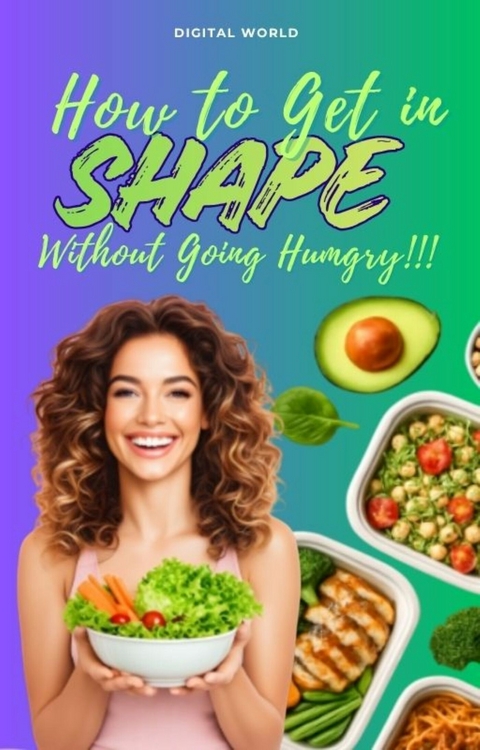
How Get in shape without going HUNGRY! (eBook)
302 Seiten
Publishdrive (Verlag)
9791431169626 (ISBN)

In a world overflowing with fad diets, miraculous promises, and contradictory nutrition information, *How to Get in Shape Without Going Hungry!* emerges as a realistic and transformative guide for those who want to achieve a healthy body without giving up the pleasure of eating.
The book reveals that sustainable weight loss doesn't depend on severe restrictions, but rather on understanding your own body, balancing habits, and adopting small, lasting changes. The work guides the reader through three essential steps: understanding the challenges of weight gain and loss, discovering practical strategies for conscious weight loss, and applying an action plan-the 10-Day Challenge-that combines intelligent nutrition with physical and emotional well-being.
Based on scientific evidence and real-life examples, the authors deconstruct myths about diets, calories, and 'forbidden foods,' explain how metabolism really works, and show that it's possible to maintain an active, enjoyable, and balanced life without guilt. The approach goes beyond aesthetics, addressing health, self-esteem, and food freedom, and proposing a healthier and more natural relationship with food. By the end of this reading, the reader will understand that the secret to losing weight and staying in shape lies in consistency, not deprivation-it's possible to take care of your body without losing the joy of life.
Discover how to achieve the body and health you desire-without radical diets, without hunger, and without guilt. Start transforming your relationship with food and the mirror today.
Keywords: healthy weight loss, nutritional re-education, metabolism, balance, health and well-being, 10-day challenge, mindful eating, sustainable habits, without restrictive diets, healthy body and mind.
ABOUT WEIGHT LOSS
Lose weight or slim down?
Nine out of ten patients who consult us have the same goal: "I want to lose weight." That's when the phrase isn't expressed in its full form: "I want to lose weight fast!"
Like everything these days, people want to lose weight as quickly and with as little effort as possible. The covers of "health" magazines feature various possibilities for (as they say) eliminating, melting, losing, or wiping away those extra pounds. All this advertising leads people to believe that it's actually very easy to lose three kilos in a week, for example. If that really worked, they'd just produce a cover about it, wouldn't they?
Let's see if what these publications promise is possible. To do so, we must first differentiate between losing weight and losing weight.
Let's understand what makes up our body weight. Generally speaking, we can divide the human body into two compartments: fat mass and fat-free mass. Fat mass is composed exclusively of adipose tissue, while fat-free mass is composed of water and metabolically active tissues (the other organs). As shown in the figure below, the sum of these two components forms our body weight.
Losing weight means stepping on a scale today and weighing, for example, 150 pounds. A week later, you step on the scale again and weigh 140 pounds. In other words, in one week, you managed to lose three pounds. But does that necessarily mean you lost weight? No!
Losing weight means becoming leaner, that is, having more lean body mass. A person can achieve this in three ways: increasing muscle mass (lean mass), decreasing the amount of adipose tissue (fat mass), or a combination of both. And losing weight, which is the main goal, is neither easy nor quick! It's a chronic process that occurs over time and, to be sustainable, depends on a series of lifestyle changes.
Why is it so hard to lose weight?
The biggest challenge is that to lose weight, you need to change your habits, and here we come up against two major barriers:
1. Eating is very tasty and directly affects different aspects of our lives, such as emotional and social aspects.
2.“Standing still” or exercising less than you should is comfortable and requires no effort.
Many of those who watch the program "Right Measure" and see the participants' excellent results come to the consultation thinking there must be something that's not being shown, a "trick," a way to achieve weight loss more easily. But the truth is, there's no magic formula. What is shown is the effect of regularly adopting new habits, which, if supported, will bring sustained results.
Any kind of change in our lives requires us to change as well. If we want to advance in our careers, for example, we'll hardly achieve it if we don't dedicate ourselves to it, taking specialized courses, learning a new language, meeting people... To achieve results, we have to act differently. Simple, right? It may seem so at first, but changing behaviors is one of the hardest things to do.
If we go out and ask a wide range of people what they understand by healthy eating, most will undoubtedly say that it should include fruits, vegetables, and greens, and that rice and beans are essential. However, despite knowing what would be proper, many people don't adopt a balanced diet daily.
Part of this difficulty can be attributed to the fact that we're living on autopilot. We're so consumed by our commitments that we no longer have time for anything, not even for self-care. In this rush, any change seems like too much effort to achieve. What we're saying is that we don't have time to take care of ourselves, our health, and our well-being. But how can a person want to be healthy if they constantly neglect their body's needs?
Change is difficult. We often manage to make some changes, but we tend to fall back into old habits. Think about it: how many times have you tried to incorporate a new habit only to forget it? Let's say you decided to take the stairs instead of the elevator. One day, however, you get home and, before you know it, you've already called the elevator and decided that "since" you called it, you'll use it that day. But the same thing happens the next day, and before you know it, the stairs have been completely forgotten.
The same goes for food. Imagine someone who always buys chocolate after lunch and decides to stop. One day, somewhat "without realizing it," they buy one and think, "Just today." But the habit repeats itself, and before they know it, their daily chocolate intake has returned.
It's very easy to fall back into old habits, so changing our behavior requires us to constantly focus on our attitudes and needs. Human behavior researchers suggest that a good way to adopt a new habit is to leave some "cues" in your day. For example, to remember to take the stairs, set an alarm on your phone for the time you normally arrive at work or home. Another effective way is to post reminders of your new goal—anything that keeps you focused and constantly reminds you of your current goal.
Change, in addition to commitment, also requires leaving a comfort zone that is difficult to overcome, as it often affects aspects that are deeper than we imagine, such as our emotions.
The most important thing about changing behavior is that these transformations must be sustainable. It's common for patients to arrive at the doctor's office saying that, as much as they enjoy eating or doing a certain thing, they're willing to give it up to lose weight. A common example is alcohol. The person commits to quitting drinking until they reach their goal, but if they enjoy it, what are the chances of going without beers with friends for an extended period? Sustainable weight loss, therefore, is achieved through changes that will be supported. Therefore, there's no point in resorting to radicalism.
Is just reducing calories enough?
When we refer to a negative energy balance, for many, it means consuming fewer calories. The problem is that when we change our diet, we run the risk of creating new problems. After all, food is a necessity for our bodies and an important source of pleasure. So, when someone decides to lose weight and undergoes a diet that deprives them of one or more foods, this ends up becoming a major source of stress instead of helping the process.
Imagine a person with a sweet tooth who starts a diet that requires them to cut out all sugar. No matter how hard they try in the first few days, they'll have a hard time sticking to this restrictive diet, especially since a common side effect of restriction is the creation of cravings or obsessions.
Many of you reading this book have probably managed to lose weight for a period of time, only to get it back. More than 80% of people who lose weight through diets regain it within five years. This is due to a series of metabolic, neuroendocrine, and behavioral adaptations in response to the decrease in body fat.2
To get an idea of how important fat is for the body, every time a person loses weight, the adipose tissue itself begins to release some hormones to prevent weight loss and make the person gain weight again.
Meet leptin
Leptin is a hormone produced primarily by adipose tissue, and its main function is to stimulate the area in the brain responsible for satiety. Because of this, it has become known as the satiety hormone.3
The concentrations of this hormone are controlled by the total amount of adipose tissue present in the body: the more adipose tissue, the more circulating hormone. Therefore, it would be logical to think that people with large amounts of adipose tissue should eat less, as they would feel more satiety and less hungry. This would be great, but it doesn't happen when fat accumulation becomes excessive; the body develops a resistance to this hormone, preventing the person from feeling its effects on satiety. This process is called leptin resistance.
As if that weren't enough, when a person begins to lose weight, the brain, which had been resistant to it, notices the decrease in leptin concentrations. Furthermore, leptin can regulate energy expenditure. When an individual begins to lose weight, not only does hunger stimulate the brain, but energy expenditure also decreases—in other words, our own body boycotts weight loss!
Besides leptin, there are a number of other hormones that regulate hunger and satiety and directly affect the weight loss process, hindering it or causing weight gain. These hormones have such a powerful effect that the pharmaceutical industry is frantically searching for a drug that targets them and aids weight loss. In fact, if we think about it, people gain weight not for a single reason, but rather for a combination of factors, and it's unlikely that any single drug will be able to address all of these factors.
Isabela and the medicines
When Isabela arrived at the clinic at 25, she was at her heaviest weight in her life. As we discussed her weight and health history, she told me she had always been "chubby," from infancy through childhood and adolescence, when she consulted a renowned doctor who prescribed a formula containing a series of medications, including appetite-suppressing hormones and other prohibited substances that speed up metabolism but cause dependence and various health problems—in other words, a "bomb." When she started taking it,...
| Erscheint lt. Verlag | 29.10.2025 |
|---|---|
| Sprache | englisch |
| Themenwelt | Sachbuch/Ratgeber ► Gesundheit / Leben / Psychologie ► Ernährung / Diät / Fasten |
| Schlagworte | 10-day challenge • Health and Well-Being • healthy body and mind • healthy weight loss • mindful eating • nutritional re-education • sustainable habits without restrictive diets |
| ISBN-13 | 9791431169626 / 9791431169626 |
| Informationen gemäß Produktsicherheitsverordnung (GPSR) | |
| Haben Sie eine Frage zum Produkt? |
 EPUB (Ohne DRM)
Digital Rights Management: ohne DRM
Dieses eBook enthält kein DRM oder Kopierschutz. Eine Weitergabe an Dritte ist jedoch rechtlich nicht zulässig, weil Sie beim Kauf nur die Rechte an der persönlichen Nutzung erwerben.
Dateiformat: EPUB (Electronic Publication)
EPUB ist ein offener Standard für eBooks und eignet sich besonders zur Darstellung von Belletristik und Sachbüchern. Der Fließtext wird dynamisch an die Display- und Schriftgröße angepasst. Auch für mobile Lesegeräte ist EPUB daher gut geeignet.
Systemvoraussetzungen:
PC/Mac: Mit einem PC oder Mac können Sie dieses eBook lesen. Sie benötigen dafür die kostenlose Software Adobe Digital Editions.
eReader: Dieses eBook kann mit (fast) allen eBook-Readern gelesen werden. Mit dem amazon-Kindle ist es aber nicht kompatibel.
Smartphone/Tablet: Egal ob Apple oder Android, dieses eBook können Sie lesen. Sie benötigen dafür eine kostenlose App.
Geräteliste und zusätzliche Hinweise
Buying eBooks from abroad
For tax law reasons we can sell eBooks just within Germany and Switzerland. Regrettably we cannot fulfill eBook-orders from other countries.
aus dem Bereich