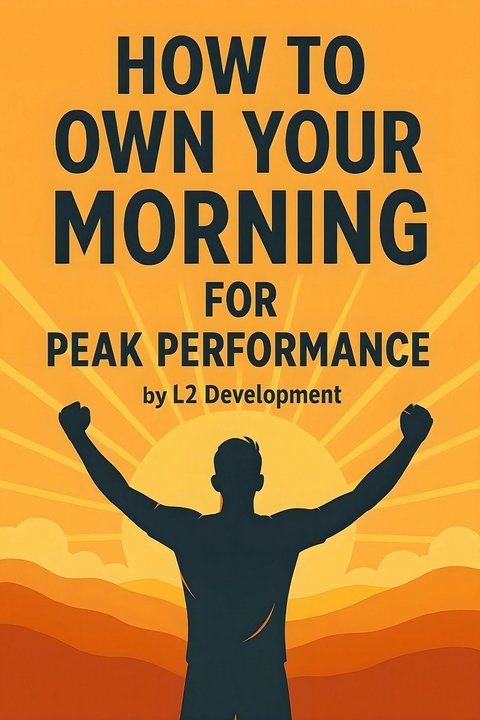
How to Own Your Morning for Peak Performance (eBook)
58 Seiten
Publishdrive (Verlag)
978-0-00-109073-6 (ISBN)
This is a science-backed, action-focused manual for high performers and ambitious individuals who want to own their mornings and dominate their days. It blends chronobiology, neuroscience, elite routines, and practical tactics into a no-fluff playbook that transforms the reader's identity into an early riser.
Chapter 2: The Mindset Shift – “I Am an Early Riser.”
Mastering early mornings begins with mastering your mindset. You can have all the clever alarms and hacks in the world, but if deep down you believe “I’m just not a morning person,” that belief will sabotage you. This chapter is about resetting your self-image, motivation, and mental scripts around mornings. We’re going to forge the identity and thought patterns of an early riser, so your actions follow naturally.
Adopt the Identity Right Now: The most critical change is to start thinking of yourself as an early riser – right away. This is what author James Clear calls identity-based habit formation. Instead of saying “I’m trying to wake up early,” say “I am an early riser.” Say it out loud. Tell others if it helps. When you identify as an “early riser,” your brain will work to make your behaviors congruent with that identity. On the other hand, if you cling to “I’m a night owl” or “I hate mornings,” any morning you struggle, your brain will use that as proof to reinforce the old identity (“See, we’re no good at this”). So we stop the negative self-talk, today. Banish phrases like “I’m not a morning person” or “I’m always tired” from your vocabulary. They’re not allowed anymore, even as jokes. Replace them with positive, progressive ones: “I’m becoming an early riser. I’m mastering my mornings.” It might feel odd at first, but these words matter. Every time you get up early, no matter how groggy, mentally declare it a victory and a confirmation: I am an early riser. Over time, the votes you cast with your actions and words solidify into an unshakeable identity.
Find Your Powerful “Why”: Motivation is highest at the beginning of a new goal, so harness it by getting crystal clear on why you want this. Take a moment to list the personal benefits you expect from rising early. Maybe it’s to have quiet time for exercise or reading, to work on a side business or project, or to end the frantic, rushed mornings that start your day with stress. Perhaps you want to be a role model for your kids or simply regain a sense of control over your schedule. Write down both the practical benefits (“I’ll finally have time to work out before work”) and the emotional benefits (“I’ll feel proud, disciplined, and in control”). This is your fuel. When it’s 5 AM and your bed has never felt cozier, you’ll recall that why – “I’m doing this to build the business I dream of,” or “I crave that peaceful coffee and journal time before the chaos,” – and it will pull you out of bed when willpower alone might not. Some people even put a sticky note on their alarm or bathroom mirror with a short reminder of their why, so it’s staring them in the face each morning. Do whatever it takes to keep your purpose front and center.
Visualize Morning Success: Each night, as you prepare for bed, spend a few minutes running a mental “movie” of your ideal morning. Close your eyes and visualize in detail: see yourself waking up strong and alert at your target time. Hear your alarm and picture yourself turning it off without hitting snooze. Feel your feet hitting the floor. Envision walking to the kitchen for a glass of water, the taste as you drink it, the sunrise light or cool water on your face, the feeling of pride as you start your routine. Also visualize the reward – maybe the calm of reading a book with coffee or the accomplishment of finishing a workout by 7 AM. By vividly rehearsing this, you are priming your subconscious to execute it. You’re giving your brain a script so that the real morning plays out more automatically. This technique may sound simple, but it’s powerful. Athletes use visualization to improve performance; you can use it to train your mind for morning victory.
Reframe Your Alarm Clock: Many of us treat the alarm like an enemy – a hated intruder stealing our sleep. Change that story. The alarm’s sound is not an attack, it’s an opportunity. It’s the starting pistol of your race day. When it blares, it signals that your time has begun – the part of the day you’ve claimed for yourself. Instead of groaning “Ugh, no…,” try to catch yourself and think, “Good – it’s time!”. This positive reframe can make a surprising difference. The alarm is helping you achieve your goals; it’s not your foe, it’s your coach yelling “go, go, go!” from the sidelines. As you practice this mindset, you may find you stop dreading the alarm and start seeing it as the sound of opportunity each morning.
Motivation vs. Discipline: In the early phase, motivation (your excitement to change) will get you started – perhaps it got you to read this guide – but motivation is fickle. It might be pouring rain one morning and your motivation evaporates. That’s where discipline must take over. Discipline means you do it regardless of how you feel in the moment. It’s a commitment to a system. One helpful mindset: the decision to wake up early is made the night before, when you set your alarm – not in the morning. When the alarm goes off, it’s not a question of “Will I get up?”; it’s a statement – “Time to get up, as planned”. Remove the inner debate entirely. As retired Navy SEAL Jocko Willink famously says, “Don’t think in the morning.” Decide in advance, then just execute. The moment you start negotiating with yourself at 5 AM (“Maybe just 10 more minutes…”), you invite failure. Highly disciplined people often operate on morning autopilot – alarm rings, feet on floor, no contemplation. You can train yourself into that autopilot by refusing to engage in bargaining. If a thought pops up urging you to skip, override it with a simple mental command: “We don’t do that anymore.” This kind of mental toughness – doing what you said you’d do even when you don’t feel like it – is like a muscle you strengthen with each rep (each day you follow through).
Challenge Negative Beliefs: Maybe you’ve long labeled yourself a “night owl” and think it’s hopeless to change. It’s true that genetics influence our sleep preferences, but research shows with gradual adjustments and light exposure, even hardcore night owls can successfully shift their schedule earlier – often with improvements to mood and performance. So don’t let a self-imposed label stop you. Also, if you’ve had miserable experiences with mornings, recognize a lot of that was likely due to poor setup (like too little sleep or jarring alarms), not because mornings inherently “suck.” We’ll be fixing those factors. Start telling yourself a different story: “I can become a morning person. I can actually enjoy mornings.” It will feel much more achievable once your routines support you. Every small win – each day you get up on time – reinforces the new belief that you are capable of this change.
Accountability & Tracking: To train your mindset, it helps to have tangible proof of your progress. Consider using a habit tracker or simple calendar to mark each day you wake up on time. Seeing a streak of X’s can be highly motivating – you won’t want to break the chain. Public or social accountability can help too: tell a friend or spouse about your plan so they can encourage you, or even have a friend join the challenge with you so you’re both up early (misery loves company, as they say – but in this case it’ll quickly turn into shared success). Another idea: text a buddy or post on a group chat the minute you wake up each day – knowing that others expect your “I’m up!” message can prod you out of bed on those tough mornings. These techniques strengthen your commitment when your internal voice wavers.
Embrace the Challenge: Finally, accept that it won’t always be easy – and that’s okay. Part of this journey is building resilience. There will be cold, dark mornings when every cell in your body wants to stay under the covers. Instead of seeing that as suffering, see it as training. You are doing something hard and that’s a good thing – it means you’re growing. When you push through, you’re training your mind to win over comfort. This mindset – discomfort is growth – will carry you through many early mornings and translate to other areas of life where you need grit. Keep promises to yourself and track your small wins; momentum will build and each day will feel a bit more natural. Soon enough, being an early riser will feel like “what you do” and eventually “who you are.”
Chapter 2: Key Takeaways
- Identity First: Start now identifying as an early riser. Language matters – replace “I’m not a morning person” with “I’m becoming an early riser”. Actions follow identity, so wear the new label proudly.
- Know Your Why: Clearly define the benefits you seek (quiet focus time, exercise, less stress, etc.) and remind yourself each night and morning. A strong purpose will pull you out of bed when motivation is low.
- Decide in Advance: Remove morning decision-fatigue. The night before, set your plan (wake time and first actions) and consider it non-negotiable. When the alarm rings, don’t think – just do.
- Positive Framing: Treat waking up early as a privilege and opportunity, not a chore. Reframe the alarm as a friendly signal that your day (and your goals) are...
| Erscheint lt. Verlag | 29.10.2025 |
|---|---|
| Sprache | englisch |
| Themenwelt | Sachbuch/Ratgeber ► Gesundheit / Leben / Psychologie ► Lebenshilfe / Lebensführung |
| ISBN-10 | 0-00-109073-9 / 0001090739 |
| ISBN-13 | 978-0-00-109073-6 / 9780001090736 |
| Informationen gemäß Produktsicherheitsverordnung (GPSR) | |
| Haben Sie eine Frage zum Produkt? |
 EPUB (Adobe DRM)
Größe: 4,4 MB
Kopierschutz: Adobe-DRM
Adobe-DRM ist ein Kopierschutz, der das eBook vor Mißbrauch schützen soll. Dabei wird das eBook bereits beim Download auf Ihre persönliche Adobe-ID autorisiert. Lesen können Sie das eBook dann nur auf den Geräten, welche ebenfalls auf Ihre Adobe-ID registriert sind.
Details zum Adobe-DRM
Dateiformat: EPUB (Electronic Publication)
EPUB ist ein offener Standard für eBooks und eignet sich besonders zur Darstellung von Belletristik und Sachbüchern. Der Fließtext wird dynamisch an die Display- und Schriftgröße angepasst. Auch für mobile Lesegeräte ist EPUB daher gut geeignet.
Systemvoraussetzungen:
PC/Mac: Mit einem PC oder Mac können Sie dieses eBook lesen. Sie benötigen eine
eReader: Dieses eBook kann mit (fast) allen eBook-Readern gelesen werden. Mit dem amazon-Kindle ist es aber nicht kompatibel.
Smartphone/Tablet: Egal ob Apple oder Android, dieses eBook können Sie lesen. Sie benötigen eine
Geräteliste und zusätzliche Hinweise
Buying eBooks from abroad
For tax law reasons we can sell eBooks just within Germany and Switzerland. Regrettably we cannot fulfill eBook-orders from other countries.
aus dem Bereich