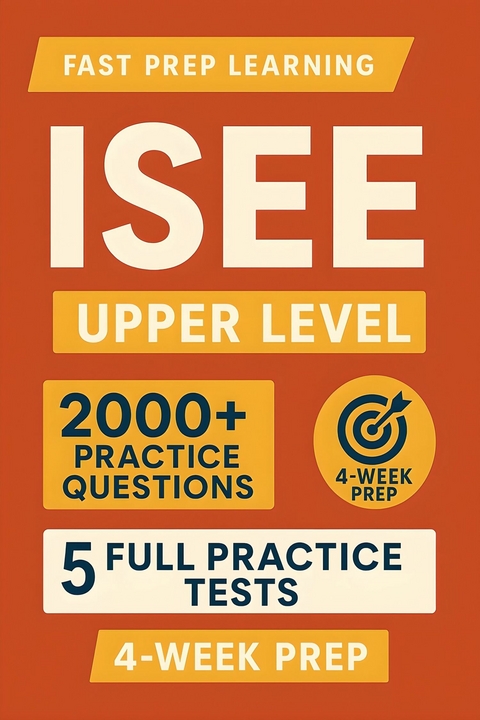
ISEE Upper Level (eBook)
300 Seiten
Publishdrive (Verlag)
9780001090651 (ISBN)
What if I told you that your child could walk into the ISEE test confident, prepared, and ready to secure not only admission-but possibly tuition-without wasting time on low-quality prep books?
If you're worried your child won't finish on time, miss key concepts, or feel overwhelmed on test day... using a study guide can alleviate all these fears.
It can drastically increase scoring, reduce exam time, and even help secure tuition.
It's so effective because all study materials are designed based on the previous examination curriculum. Every section inside this study guide follows the exact curriculum required to pass the ISEE Upper Level exam.
This means that whether you are looking to refresh your child's knowledge, improve areas where they may be struggling, or even aim for tuition-level scoring, this guide is the right fit.
The truth is-you don't have to aim for a scholarship to benefit from all the materials inside this guide.
You get one book that can serve multiple purposes.
And if you feel unsure about how effective this can be-don't worry.
Inside this book, you'll find all five sections verified on the ISEE exam: Verbal Reasoning, Quantitative Reasoning, Reading Comprehension, Mathematics Achievement, and Essay.
Each section is divided into the main subjects that need to be covered. For example, if your child is lacking knowledge in arithmetic patterns, they will find a dedicated chapter, Number Series, inside Quantitative Skills. This chapter takes them from absolute ground zero.
It includes:
Clear theory, explaining each term
Learning objectives associated with the chapter
Examples of how problems appear on the test
Plenty of practice questions with step-by-step explanations
It's like having a tutor by your child's side at every step.
Your child doesn't need a lot of time to get started. Even just 30 minutes or less per day-depending on the level they are aiming for-can be enough.
This guide is ideal if you're looking for cost-effective study materials. To be completely clear, it's designed for families who want to save money on tutors while still ensuring their child has the best possible chance of getting into a good school.
Here's just a small fraction of what you'll discover inside this book:
More than 2,000 cumulative questions with step-by-step explained answers - not just the result, but how to reach it.
Questions with the right level of difficulty - most guides have questions that are easier than the actual exam.
Training designed to finish the exam well under 2 hours - so time won't be a problem, which is usually an issue.
Each chapter includes practice sets, with clearly indicated levels of difficulty and suggested timing for completion.
A 4-week study planner structured around weekly goals - whether aiming for tuition-level performance or confidently passing at 95%, the planner structures the material for success.
Tutor-like guidance - hiring a tutor can be costly or impossible; this manual feels like having a personal guide helping your child throughout the learning process.
Skill checklists at the end of each section, so your child can tick off topics as they master them.
Glossary & high-frequency mistakes - tricky terms like coefficient and congruent are clearly explained, along with the most common mistakes students make, especially in Mathematics and Quantitative Skills.
MA1
Arithmetic & Number Theory (Student Pages)
What you’ll learn: integer properties; factors/multiples; GCD/LCM; fraction/decimal/percent fluency; remainders & modular thinking in word problems.
Lesson L1: Factors, Multiples, and Primes (concise)
- Prime factorization quickly (tree or division).
- GCD via prime overlap; LCM via prime max exponents.
- If a∣ba/mid ba∣b then any multiple of aaa divides any multiple of bbb proportionally.
Lesson L2: Fractions ↔ Decimals ↔ Percents
- Convert with ease: ab→/frac{a}{b}/toba→ decimal by place-friendly factors (e.g., ×25 to make denominator 100).
- Percentage multipliers: +p% ⇒ ×(1+p/100); −p% ⇒ ×(1−p/100).
Lesson L3: Remainders & Modular Thinking
- n≡r(modm)n/equiv r/pmod mn≡r(modm) means same remainder on division by mmm.
- Use cycles: powers mod 10, 4, 8, 9, 11 show short periods.
Guided Examples
GE1 (LCM/GCD): The LCM of 84 and 90 divided by their GCD equals…
GE2 (Remainders): Find the remainder when 720257^{2025}72025 is divided by 8.
Problem Set (14)
- Prime factorize 360.
- gcd(126,210)= ?/gcd(126, 210)=/ ?gcd(126,210)= ?
- lcm(45,84)= ?/text{lcm}(45, 84)=/ ?lcm(45,84)= ?
- If xxx is divisible by 12 and 18, what’s the least positive xxx?
- Simplify 84126/frac{84}{126}12684.
- Compute 25%25/%25% of 48.
- A price is increased by 20% then decreased by 20%. Net change?
- Convert 0.3750.3750.375 to a fraction in lowest terms.
- Which is larger: 715/frac{7}{15}157 or 920/frac{9}{20}209?
- Remainder of 10,00310{,}00310,003 divided by 9.
- Last digit of 3873^{87}387.
- Smallest positive nnn with n≡5(mod7)n/equiv 5/pmod 7n≡5(mod7) and n≡2(mod5)n/equiv 2/pmod 5n≡2(mod5).
- If aaa and bbb are relatively prime and a∣bca/mid bca∣bc, then a∣ca/mid ca∣c (True/False).
- The least integer >100 divisible by both 6 and 15.
Solutions MA1 (step-by-step)
GE1: 84=22⋅3⋅7, 90=2⋅32⋅584=2^2/cdot3/cdot7,/ 90=2/cdot3^2/cdot584=22⋅3⋅7, 90=2⋅32⋅5.
- gcd=21⋅31=6/gcd=2^1/cdot3^1=6gcd=21⋅31=6.
- lcm=22⋅32⋅5⋅7=1260/text{lcm}=2^2/cdot3^2/cdot5/cdot7=1260lcm=22⋅32⋅5⋅7=1260.
- Ratio =12606=210=/frac{1260}{6}=210=61260=210.
GE2: Mod 8, 7≡−17/equiv-17≡−1. Then 72025≡(−1)2025=−1≡77^{2025}/equiv(-1)^{2025}=-1/equiv 772025≡(−1)2025=−1≡7. Remainder 7.
- 360=23⋅32⋅5360=2^3/cdot3^2/cdot5360=23⋅32⋅5.
- 126=2⋅32⋅7, 210=2⋅3⋅5⋅7⇒gcd=2⋅3⋅7=42126=2/cdot3^2/cdot7,/ 210=2/cdot3/cdot5/cdot7/Rightarrow /gcd=2/cdot3/cdot7=42126=2⋅32⋅7, 210=2⋅3⋅5⋅7⇒gcd=2⋅3⋅7=42.
- 45=32⋅5, 84=22⋅3⋅7⇒lcm=22⋅32⋅5⋅7=126045=3^2/cdot5,/ 84=2^2/cdot3/cdot7/Rightarrow /text{lcm}=2^2/cdot3^2/cdot5/cdot7=126045=32⋅5, 84=22⋅3⋅7⇒lcm=22⋅32⋅5⋅7=1260.
- LCM of 12 and 18: 12=22⋅3, 18=2⋅32⇒lcm=22⋅32=3612=2^2/cdot3,/ 18=2/cdot3^2/Rightarrow /text{lcm}=2^2/cdot3^2=3612=22⋅3, 18=2⋅32⇒lcm=22⋅32=36.
- 84126=22⋅3⋅72⋅32⋅7=23/frac{84}{126}=/frac{2^2/cdot3/cdot7}{2/cdot3^2/cdot7}=/frac{2}{3}12684=2⋅32⋅722⋅3⋅7=32.
- 0.25×48=120.25/times48=120.25×48=12.
- 1.2×0.8=0.96⇒1.2/times0.8=0.96/Rightarrow1.2×0.8=0.96⇒ net −4%-4/%−4%.
- 0.375=375/1000=3/80.375=375/1000=3/80.375=375/1000=3/8.
- Compare cross-multiplying: 7⋅20=1407/cdot20=1407⋅20=140 vs 9⋅15=135⇒7159/cdot15=135/Rightarrow /frac{7}{15}9⋅15=135⇒157 larger.
- Sum of digits =1+0+0+0+3=4⇒=1+0+0+0+3=4/Rightarrow=1+0+0+0+3=4⇒ remainder 4.
- Cycle of last digit of powers of 3: 3,9,7,13,9,7,13,9,7,1 (period 4). 87≡3(mod4)⇒787/equiv 3/pmod 4/Rightarrow 787≡3(mod4)⇒7.
- Solve CRT: numbers ≡5(mod7)/equiv 5/pmod7≡5(mod7): 5,12,19,26,…5,12,19,26,/dots5,12,19,26,…. Check mod 5/mod 5mod5: 5≡0, 12≡25/equiv0,/ 12/equiv25≡0, 12≡2. So n=12n=12n=12.
- True. (Euclid’s lemma.)
- LCM(6,15)=30. Least >100 multiple of 30 is 120.
MA2 Algebra & Functions (Student Pages)
What you’ll learn: linear equations/inequalities & absolute value; polynomials (add/subtract/multiply/factor); simple quadratics; sequences (arithmetic/geometric); function rules/evaluation.
Lesson L1: Linear & Absolute Value
- Solve ∣ax+b∣=c|ax+b|=c∣ax+b∣=c as ax+b=cax+b=cax+b=c or ax+b=−cax+b=-cax+b=−c; check extraneous if inequality flips.Lesson L2: Polynomials & Factoring
- Common patterns: a2−b2=(a−b)(a+b)a^2-b^2=(a-b)(a+b)a2−b2=(a−b)(a+b), x2+bx+c=(x+m)(x+n)x^2+bx+c=(x+m)(x+n)x2+bx+c=(x+m)(x+n) where m+n=b,mn=cm+n=b, mn=cm+n=b,mn=c.
Guided Examples
GE1: Solve ∣2x−5∣=11|2x-5|=11∣2x−5∣=11.
GE2: Factor x2−7x+12x^2-7x+12x2−7x+12.
Problem Set (12)
- Solve 3x−7=2x+93x-7=2x+93x−7=2x+9.
- Solve ∣x+4∣=3|x+4|=3∣x+4∣=3.
- Factor x2−9x^2-9x2−9.
- Expand (x−2)(x+5)(x-2)(x+5)(x−2)(x+5).
- If f(x)=2x2−3x+1f(x)=2x^2-3x+1f(x)=2x2−3x+1, find f(4)f(4)f(4).
- Sequence arithmetic: a1=4,d=5a_1=4,d=5a1=4,d=5. Find a18a_{18}a18.
- Geometric sequence b1=6,r=12b_1=6,r=/tfrac{1}{2}b1=6,r=21. Find b5b_5b5.
- Solve 2∣x−3∣<62|x-3|<62∣x−3∣<6.
- Solve x2−5x=0x^2-5x=0x2−5x=0.
- Factor 2x2+7x+32x^2+7x+32x2+7x+3.
- If f(x)=3x−2f(x)=3x-2f(x)=3x−2, solve f(2a+1)=10f(2a+1)=10f(2a+1)=10 for aaa.
- Vertex of y=x2−6x+5y=x^2-6x+5y=x2−6x+5.
Solutions MA2 (step-by-step)
GE1: 2x−5=11⇒x=82x-5=11/Rightarrow x=82x−5=11⇒x=8 or 2x−5=−11⇒x=−32x-5=-11/Rightarrow x=-32x−5=−11⇒x=−3.
GE2: Numbers summing to 7 and multiplying to 12 → 3,43,43,4: (x−3)(x−4)(x-3)(x-4)(x−3)(x−4).
- x=16x=16x=16.
- x=−1x=-1x=−1 or x=−7x=-7x=−7.
- (x−3)(x+3)(x-3)(x+3)(x−3)(x+3).
- x2+3x−10x^2+3x-10x2+3x−10.
- 2(16)−12+1=212(16)-12+1=212(16)−12+1=21.
- a18=4+17⋅5=89a_{18}=4+17/cdot5=89a18=4+17⋅5=89.
- 6⋅(1/2)4=6/16=3/86/cdot(1/2)^4=6/16=3/86⋅(1/2)4=6/16=3/8.
- ∣x−3∣<3⇒0<x<6|x-3|<3/Rightarrow...
| Erscheint lt. Verlag | 17.10.2025 |
|---|---|
| Sprache | englisch |
| Themenwelt | Sachbuch/Ratgeber ► Beruf / Finanzen / Recht / Wirtschaft ► Bewerbung / Karriere |
| ISBN-13 | 9780001090651 / 9780001090651 |
| Informationen gemäß Produktsicherheitsverordnung (GPSR) | |
| Haben Sie eine Frage zum Produkt? |
 EPUB (Adobe DRM)
Größe: 1,3 MB
Kopierschutz: Adobe-DRM
Adobe-DRM ist ein Kopierschutz, der das eBook vor Mißbrauch schützen soll. Dabei wird das eBook bereits beim Download auf Ihre persönliche Adobe-ID autorisiert. Lesen können Sie das eBook dann nur auf den Geräten, welche ebenfalls auf Ihre Adobe-ID registriert sind.
Details zum Adobe-DRM
Dateiformat: EPUB (Electronic Publication)
EPUB ist ein offener Standard für eBooks und eignet sich besonders zur Darstellung von Belletristik und Sachbüchern. Der Fließtext wird dynamisch an die Display- und Schriftgröße angepasst. Auch für mobile Lesegeräte ist EPUB daher gut geeignet.
Systemvoraussetzungen:
PC/Mac: Mit einem PC oder Mac können Sie dieses eBook lesen. Sie benötigen eine
eReader: Dieses eBook kann mit (fast) allen eBook-Readern gelesen werden. Mit dem amazon-Kindle ist es aber nicht kompatibel.
Smartphone/Tablet: Egal ob Apple oder Android, dieses eBook können Sie lesen. Sie benötigen eine
Geräteliste und zusätzliche Hinweise
Buying eBooks from abroad
For tax law reasons we can sell eBooks just within Germany and Switzerland. Regrettably we cannot fulfill eBook-orders from other countries.
aus dem Bereich