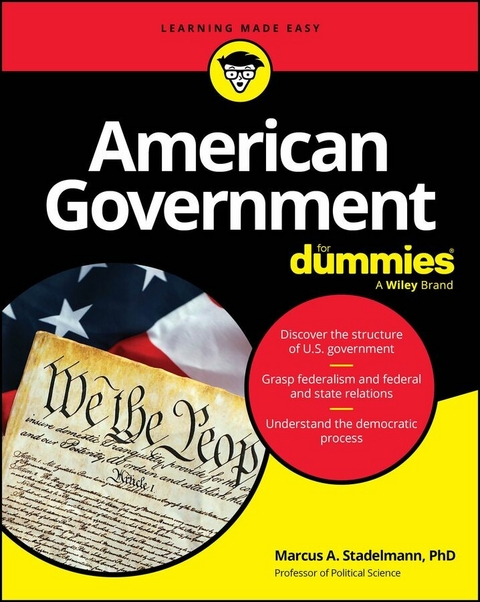
American Government For Dummies (eBook)
492 Seiten
For Dummies (Verlag)
978-1-394-37575-2 (ISBN)
A source of unbiased, factual information on the U.S. government
American Government For Dummies helps you easily understand the concepts and historical events that define the U.S. government system. This readable guide covers all the content in a typical course on American government or civics, and it offers curious readers a way to learn more about how the country is run. You'll get clear, impartial, and trustworthy explanations of topics such as the three branches of government, political parties, how campaigns and elections work, and public and foreign policy. It's everything you need to become government-savvy.
Inside:
- Understand the history of the U.S. system of government and how it operates today
- Learn about opinion polls, elections, interest groups, political parties, and campaigns
- Untangle the differences among the Senate, House of Representatives, Judiciary, and other important institutions
- Get clarity on the importance of voting and discover other ways you can contribute
American Government For Dummies is a perfect for anyone looking to brush up on the foundations of the U.S. government-for a class, or simply to become more informed on the systems and structures that shape daily life.
Marcus A. Stadelmann, PhD, is a professor of political science at the University of Texas at Tyler. He is the author of U.S. Presidents For Dummies and Political Science For Dummies and has been teaching American government for more than 40 years.
Chapter 1
Designing a New Country and a New Constitution
IN THIS CHAPTER
Settling the country
Initiating a revolution
Creating a new form of government
Having problems
Writing a new constitution
Debating and compromising
Adding a Bill of Rights
Succeeding and having a new country
Throughout the 17th and 18th century, thousands of people migrated to North America. Most came for greater economic opportunities than they could find in Europe; others came for religious freedom. The British Empire took interest in the American continent in the 16th century. In 1587, the first English settlement was set up at Roanoke Island in North Carolina. It was established by Sir Walter Raleigh and disappeared under mysterious circumstances. In 1607, the English tried again, and this time established a colony in Jamestown, Virginia. The colony developed for almost a century but had to live under harsh conditions, constantly fighting the native population. Jamestown did leave the country an important legacy. The colonists established a representative assembly to govern their own affairs, a precedent the country later followed.
Creating Colonies
By 1732, all 13 colonies were in place. There was local self-government, but the colonies were controlled by the British crown. With the British little interested in the colonies, they enjoyed quite a bit of self-rule. Soon, the 13 colonies had their own legislatures set up, and passed laws and even levied taxes. Each of them also had a document similar to a constitution in place.
For example, Pennsylvania had a document called a Frame of Government and Massachusetts had one entitled the Body of Liberties. Great Britain did not stop the colonies from self-rule as long as they remained a part of the empire and were economically profitable to trade with.
Relations between the British Empire and the colonies remained friendly until the middle 1750s, when the French and Indian War broke out. Britain not only had to fight the French Empire but also various Indian tribes in the war over control of parts of North America. Even though the British won the war, it almost bankrupted the country. Being broke, the British needed revenue badly, so they turned to the American colonies for money. They decided to tax the colonies directly, which had never been done before.
Fighting the French and cracking down
The French and Indian War, fought between Britain and France and various Indian tribes from 1754 until 1763, changed everything. The French, headquartered in Canada, fought the British for control of North America. The Treaty of Paris, which settled the conflict in 1763, gave Britain control over most of North America. However, the war had cost Britain $130 million pounds, which it now had to recoup.
Britain decided to make the colonies help pay for the war by imposing taxes on them. The Sugar Act, passed in 1764, increased the tax on refined sugar and molasses. The colonists were outraged; how could they be taxed if they were not represented in the British Parliament? So, between 1765 and 1766, the colonists attacked tax agents of the British and boycotted British goods. Suddenly, British merchants were hurt by the boycotts and protested to their home government, and the whole Act was repealed by 1766.
Taxing the colonies
Beginning in 1763, the British Parliament began imposing a series of taxes on the colonies and placed new import duties (tariffs) on textiles, coffee, wine, and other goods.
Among these taxes were the Sugar Act, the Townshend Acts, and the Quartering Act. The taxes culminated with the Stamp Act of 1765, which raised taxes on all printed materials, including newspapers, legal documents, and even playing cards. In other words, the British Empire began taxing the colonies heavily.
To make matters worse, many Americans had fought with the British against the French and now expected to claim free land in the west, which used to be owned by the French Empire. The British blocked them by passing the Proclamation of 1763, prohibiting settlers from moving westward to prevent a new war with Indian tribes. The settlers figured they could just ignore the British, like they had for decades, but this time it was different. After fighting the French, the British army was now in the U.S., and thousands of soldiers stayed. The British now had the manpower to enforce British law. To take care of its soldiers, the British Parliament had passed the Quartering Act in 1765, which required colonial assemblies to house British troops in barns and warehouses. Finally, the British allowed the Americans to trade only with the British Empire and no other empire, such as France or Spain. So profitable trade with the French and Spanish Empires became illegal. The colonists were furious.
Not surprisingly, the colonies reacted to the imposition of taxes. The rallying cry became “No taxation without representation.” The colonists began to boycott British products, and the British government gave in and repealed the Stamp Act. However, the colonists had now seen that the British Empire was not as powerful as they had thought. They would give in to the colonists’ demands if the colonies resisted. This resulted in the infamous Boston Tea Party in 1773.
Responding to tyranny
The same day it repealed the Stamp Act, the British Parliament passed the Declaratory Act, which stipulated that the king and Parliament had full power to enact laws binding on the colonies. So, Parliament continued to pass acts raising revenue from the colonists for the British crown.
The Townshend Acts passed in 1767, imposing duties on items such as tea, glass, and paper, created a Board of Customs Commission to enforce the new tax laws and collect the duties. Britain was now able to collect taxes instead of having to rely on the colonial governments to raise taxes on their behalf and then hand over the money, which rarely happened. The Townshend Acts further suspended the New York State Assembly for refusing to house British troops. Riots broke out in Boston, and the British brought in thousands of troops to quell them. In the subsequent Boston Massacre, panicked British troops starting shooting at demonstrators, killing several. Now more and more colonists started to support a rebellion against the British Empire.
Again, the colonists at first boycotted British goods, and the British Parliament responded by repealing parts of the taxes imposed by the Townshend Acts in 1770; with one exception: the tax on tea.
Then, in 1773, the Tea Act was passed by the British Parliament. It was passed to help the British East India Company, which was about to go bankrupt. The Tea Act allowed for the East India Company to have a monopoly over the tea trade globally, which put small colonial traders out of business. The East India Company further started to sell tea in the colonies at a lower price than native merchants, in turn destroying native tea merchants. On December 16, 1773, colonists disguised as Mohawk Indians boarded three British ships in Boston Harbor and threw their cargo, 342 chests of tea, overboard in turn destroying it. This event is pictured in Figure 1-1.
Tea was one of the most sought-after products in the world back in the 18th century. The 342 chests of tea had a market value of 9,600 British pounds. That would be about $2.5 million today.
N. Currier/Library of Congress/Public domain
FIGURE 1-1: The Boston Tea Party.
The outraged British Parliament in turn passed the Intolerable Acts in 1774. These were designed to punish the colonists. The Acts closed Boston Harbor until the colonists paid for the products they had destroyed, weakened the Massachusetts colonial government by abolishing town meetings, and required that colonists not only harbor British soldiers in their own homes but also feed them. Massachusetts was now under British military control. This was the last straw for the colonists.
Inciting a rebellion
In September 1774, 56 leaders from 12 colonies got together in Philadelphia to respond to the British actions. This was called the First Continental Congress. It denounced British policy and organized a boycott of British goods. It further called upon the colonial militia to arm itself and began to hoard weapons in an arsenal in Concord, Massachusetts. The British governor of Massachusetts sent troops to seize the weapons stored in Concord. The troops were attacked by a small militia of colonists. They called themselves minutemen, because they claimed that they could be ready for military duty at a minute’s warning. They were subsequently defeated by the British troops. The British did reach Concord and destroyed the weapons cache, but on the way back they were attacked by more militia. By the time they made it back to Boston, they had lost several hundred men. A revolution had begun.
Fighting a Revolution
In the beginning, most colonists figured that a solution with the British was possible. They assumed that the colonies would receive some local autonomy but remain part of the British Empire. However, things soon changed. At the Second Continental Congress held in 1775, a delegate for Virginia called for the first time for independence from Great Britain, and the Congress commissioned a declaration to discuss not only the grievances against the British but also a reason for independence from Britain. A committee was appointed, and a...
| Erscheint lt. Verlag | 27.10.2025 |
|---|---|
| Sprache | englisch |
| Themenwelt | Sachbuch/Ratgeber ► Geschichte / Politik ► Politik / Gesellschaft |
| Sozialwissenschaften ► Politik / Verwaltung | |
| Schlagworte | America 101 • American Civics • American Congress • American democracy • American Government • american government 101 • books about congress • civics class • civics for dummies • civics study guide • politics 101 • us constitution 101 • US Government |
| ISBN-10 | 1-394-37575-1 / 1394375751 |
| ISBN-13 | 978-1-394-37575-2 / 9781394375752 |
| Informationen gemäß Produktsicherheitsverordnung (GPSR) | |
| Haben Sie eine Frage zum Produkt? |
 EPUB (Adobe DRM)
Kopierschutz: Adobe-DRM
Adobe-DRM ist ein Kopierschutz, der das eBook vor Mißbrauch schützen soll. Dabei wird das eBook bereits beim Download auf Ihre persönliche Adobe-ID autorisiert. Lesen können Sie das eBook dann nur auf den Geräten, welche ebenfalls auf Ihre Adobe-ID registriert sind.
Details zum Adobe-DRM
Dateiformat: EPUB (Electronic Publication)
EPUB ist ein offener Standard für eBooks und eignet sich besonders zur Darstellung von Belletristik und Sachbüchern. Der Fließtext wird dynamisch an die Display- und Schriftgröße angepasst. Auch für mobile Lesegeräte ist EPUB daher gut geeignet.
Systemvoraussetzungen:
PC/Mac: Mit einem PC oder Mac können Sie dieses eBook lesen. Sie benötigen eine
eReader: Dieses eBook kann mit (fast) allen eBook-Readern gelesen werden. Mit dem amazon-Kindle ist es aber nicht kompatibel.
Smartphone/Tablet: Egal ob Apple oder Android, dieses eBook können Sie lesen. Sie benötigen eine
Geräteliste und zusätzliche Hinweise
Buying eBooks from abroad
For tax law reasons we can sell eBooks just within Germany and Switzerland. Regrettably we cannot fulfill eBook-orders from other countries.
aus dem Bereich