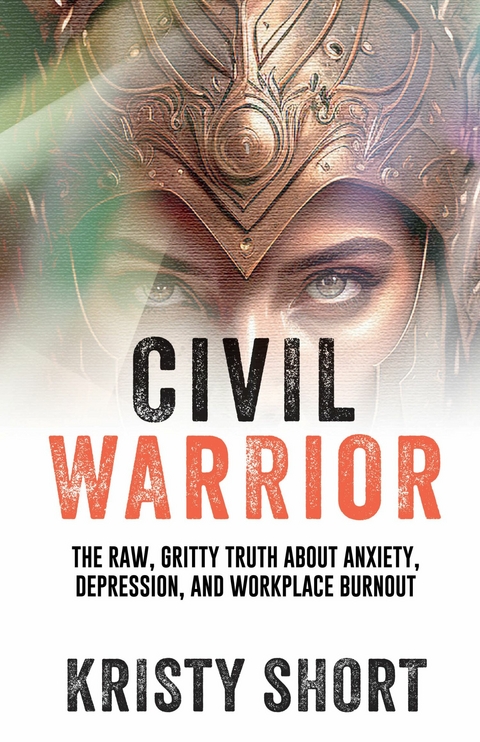
CIVIL WARRIOR (eBook)
124 Seiten
Bookbaby (Verlag)
979-8-3178-2080-0 (ISBN)
Kristy Short, EdD has spent her life writing. She's published four young adult books and has worked as a writer across disciplines for more than 30 years. This is her first memoir/self-help(ish) book-the culmination of a lifetime battling anxiety, depression, and most recently, workplace burnout. She is passionate about fostering awareness of mental health and self-care-even if she has to kick a few snickering bathroom-bitch asses along the way.
Suicide contracts, crippling panic attacks, dark depressions, and synapse-destroying workplace burnout-it's all in there. One woman's life journal posted for public consumption. CIVIL WARRIOR is a fretfully honest and sometimes frenetic retelling of Kristy Short's most affecting moments and how she fought her way back to life and living more than once. Spanning three decades, CIVIL WARRIOR details Short's heart-rending spirals and lifelong battle with that little bitch she calls Anxiety, along with all the other "e;parts"e; that occupy her overactive brain Depression, Shame, Fear, Loathing, Compassion, Kindness, Gratitude. Every last one of them. You'll move with her from the stone-cold bottom of the well to a place of light, gravity, and comfort. If you've ever retreated to a dark closet to rock and sob and beg for a moment of mental peace (or something like), it may feel like this book was written just for you. A weight-lifting assurance that you are not alone. It's storytelling at its finest familiar, truthful, and without apology.
CHAPTER 2
GETTING TO KNOW HER (THAT LITTLE BITCH)
To really understand Anxiety, I had to take the time to get to know her.
It may sound hokey, but give me a hot minute to explain. Anxiety had long been one of my most dominantly vocal parts, so by my late twenties, I grew accustomed to her presence and accepted it—no matter how much pain she rained down. As the years passed, I embraced her as a familiar figure—forever lingering, watching, waiting. She wasn’t going anywhere, and I had learned the hard way that ignoring her didn’t work. In fact, it only ever served to royally piss her off.
The thing about Anxiety and Depression is that they don’t discriminate. They couldn’t give even the tiniest of rat’s asses about your social status, body type, job title, or the diversity of your financial portfolio. They’re ready and willing to attack and devour anyone—anywhere, any time. Resisting is futile. Walking through the pain, trudging through the sewage of emotions and exhaustion, is the only way to get to the other side. To elevate to a place where you and your many parts can co-exist in a state of civility and understanding.
That’s what I did, and so can you. We all have it in us to make that pungent, funkified shit walk, no matter how deep we sink.
What you resist, persists
Carl Jung, Swiss psychiatrist (and a pretty smart dude), really knew what he was talking about. Resisting thoughts, emotions, or situations serves only to make them stronger and more disruptive.
And don’t I know it. Avoiding Anxiety only ever pushed me deeper in the well. One solid truth from my early-twenties tussle is that she’s stubborn and sturdy. She’s got endurance on her side, giving her a clear advantage in any emotional standoff.
Those first few years of resistance resulted in a debilitating implosion. I spent my days and my energy playing emotional whack-a-mole. Swinging relentlessly to bash Anxiety’s brains in and praying she was dead and gone.
My own resistance held me hostage, distracting me long enough to transition power from my prefrontal cortex (the stomping ground of higher-level cognitive functions) to the amygdala (also known as “lizard brain,” where Anxiety lives and lurks). I had unknowingly brought on the ass-whipping of a lifetime. One that led me to conclude, definitively, that resisting Anxiety does not work. Quite the opposite—it feeds her and fortifies her strength until your brain turns against you with an AR-like assault of untruths.
You have to meet Anxiety head-on, be curious, and ask her questions—really get to know her. You have to spread your arms and free fall into the darkness. I know it sounds scary, but that leap of faith was my ticket to a more satisfying plane of existence.
You have to meet Anxiety head-on, be curious, and ask her questions— really get to know her. You have to spread your arms and free fall into the darkness. I know it sounds scary, but that leap of faith was my ticket to a more satisfying plane of existence.
Cultivate curiosity
Once I opened my eyes and allowed myself to take a good long look into my brain and its many parts, the natural outcome was curiosity.
I found myself digging deep and asking questions: Who is this Anxiety part, and what does she want? What’s her purpose? What’s her function within the larger family? What does she look like?
I started by giving her an identity and form. In essence, I brought her to life. Anthropomorphizing Anxiety helped me see her for who she really is—just another misunderstood part. It also depleted her power. She was no longer the monster in hiding, obscured by darkness and the unknown. I had humanized her.
The more curious I became, the more open she was to revealing herself to me. My questions drew her out of the very cave I’d tried to confine her to, enabling us to interact freely and with far less conflict. In a relatively short time, I developed an understanding of her place in my big expansive brain—like where she lives (the limbic system) and her basic functions (to motivate, encourage, and protect me from danger).
I reviewed our history and walked through the moments she’d been the hardest on me—those full-nelson experiences of panicked strangulation. As I dissected each, I began to see a pattern: Alert, protect, resist. Alert, protect, resist.
When I attempted to extinguish negative emotions and stressors, she amplified them. It was a push and pull between two mighty forces—her focus on sounding the alarm, and mine on silencing it. Take the big stuff:
My intent is not to oversimplify here. All of these abridged examples represent a major life change that did not happen overnight or without a degree of mental and emotional turmoil. I evaluated every event from every possible angle, identifying more than a few worst-case scenarios that would spike my anxiety and send me back to bed.
But at the end of all my obsessive evaluation, I was able to free myself from the darkest of the darkness. Sometimes, you just have to take a chance if change is to come. I mean, what’s the alternative? Living in perpetual discomfort and fear? I think most of us would agree, it’s not the best of life plans.
I came to know Anxiety well. We developed a kinship of sorts—me checking in with her regularly and her taking my requests to simmer down like a champ. And where did this take us? In simplest terms: to a place of sustainable satisfaction—me taking on the role of nurturer over captor and her emerging as one of my most dedicated protectors. Once I learned to respect her place (and purpose) in my vast Internal Family System, I found that I could manage the intensity and frequency of her alarms—mitigating debilitating panic attacks and moments of mental paralysis.
It’s hard to imagine having a conversation with an emotion, but I do talk to many of my parts on a fairly regular basis—especially in times of spiked anxiety. It’s an exercise in getting to know them, but also one in calming the brain. When you’re focused on the discussion, by default your thoughts are redirected to a logical space (your prefrontal cortex). I close my eyes, picture Anxiety, and then launch in—addressing whatever new alert has surfaced. After a few minutes, my breathing relaxes and the steady frenetic drum beat in my chest dissipates. It’s a practice—much like meditation—with the primary goal being to quiet the mind and simply be in the moment.
To help you visualize this technique, here’s a brief transcript from one of my many conversations with Anxiety:
Setting the stage is important. Most of my conversations take place after a heart-racing jump scare. Those moments of unanticipated attack that leave me winded and questioning the origin of my unprovoked panic. Why the sudden ambush? What happened that made me the target of a guerilla warfare-style attack? In those moments, I stop what I’m doing, close my eyes, and let the discussion commence.
ME: I feel you in my chest. Why exactly are you there? I seriously have no idea.
ANXIETY: [Shrugs]
ME: I need more. The nagging in my chest is distracting me from work. Can we resolve this? ANXIETY: Assumption is telling me to alert you. [This is a natural and common response because I’m the most dedicated of pre-supposers.] [NOTE: During conversations, sometimes other parts show up. To continue, I simply ask them to step aside.]
ME: Assumption, you’re in the way. Can you please step aside? [He does.]
ANXIETY: I’m uneasy. Something is coming. I need to know the outcome or the alerts will continue.
ME: [I think hard. I know this particular feeling. It’s familiar—coming from a place of uncertainty.] Is there a coming event, appointment, conversation that I’m dreading? Is it the anniversary of something I want to avoid? Is it full-blown avoidance about a pending uncomfortable conversation?
ANXIETY: It’s January.
ME: It is. The anniversary of Dad’s death. Arguably, the worst day of my life on annual repeat.
ANXIETY: That’s it. My work is done. Now, get back to work. Who else is gonna pay the mortgage?
You can clearly see what’s happening here. My discussion with Anxiety is a shared dialogue with myself. The silence—the act of being in the moment—gives me the space I need to investigate the root of my panic. To scroll through coming or past events and bring my panic into focus. From this place, I’m better positioned to pinpoint the source of my anxiety—and then put it to bed. Even if only for a catnap.
For the record, the above transcript represents an actual conversation from January 2025....
| Erscheint lt. Verlag | 28.10.2025 |
|---|---|
| Sprache | englisch |
| Themenwelt | Sachbuch/Ratgeber ► Gesundheit / Leben / Psychologie ► Psychologie |
| ISBN-13 | 979-8-3178-2080-0 / 9798317820800 |
| Informationen gemäß Produktsicherheitsverordnung (GPSR) | |
| Haben Sie eine Frage zum Produkt? |
 EPUB (Ohne DRM)
Größe: 586 KB
Digital Rights Management: ohne DRM
Dieses eBook enthält kein DRM oder Kopierschutz. Eine Weitergabe an Dritte ist jedoch rechtlich nicht zulässig, weil Sie beim Kauf nur die Rechte an der persönlichen Nutzung erwerben.
Dateiformat: EPUB (Electronic Publication)
EPUB ist ein offener Standard für eBooks und eignet sich besonders zur Darstellung von Belletristik und Sachbüchern. Der Fließtext wird dynamisch an die Display- und Schriftgröße angepasst. Auch für mobile Lesegeräte ist EPUB daher gut geeignet.
Systemvoraussetzungen:
PC/Mac: Mit einem PC oder Mac können Sie dieses eBook lesen. Sie benötigen dafür die kostenlose Software Adobe Digital Editions.
eReader: Dieses eBook kann mit (fast) allen eBook-Readern gelesen werden. Mit dem amazon-Kindle ist es aber nicht kompatibel.
Smartphone/Tablet: Egal ob Apple oder Android, dieses eBook können Sie lesen. Sie benötigen dafür eine kostenlose App.
Geräteliste und zusätzliche Hinweise
Buying eBooks from abroad
For tax law reasons we can sell eBooks just within Germany and Switzerland. Regrettably we cannot fulfill eBook-orders from other countries.
aus dem Bereich