Compassion (eBook)
222 Seiten
Publishdrive (Verlag)
979-13--4263721-4 (ISBN)
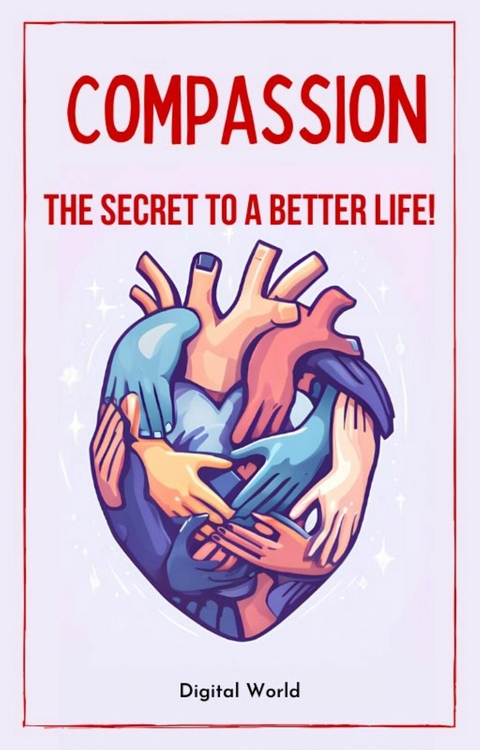
Compassion - The Secret to a Better Life! offers a profound reflection on the transformative power of compassion and its essential role in humanity's survival. Drawing on experience with projects at institutions focused on human assistance, the book presents a journey that combines philosophy, neuroscience, the history of religion, and contemporary ethics, demonstrating that compassion is more than a spiritual ideal-it is a practical and urgent necessity in a polarized world.
The book traces a fascinating historical panorama of the religious and philosophical traditions that place compassion at the center of moral life-from Confucius, Buddha, and the sages of the Axial Period, to the teachings of Jesus, Muhammad, and the rabbis of the Talmud. The author demonstrates that all great cultures, at some point, recognized the value of treating others as we would like to be treated. This 'golden rule' spans centuries as a common thread among diverse beliefs, revealing that true spirituality arises from a commitment to empathy and mutual respect.
But the book goes beyond theory. The book presents a practical twelve-step program, inspired by personal transformation processes, to cultivate compassion in everyday life. The author argues that we are, in part, prisoners of a 'reptilian brain' that fuels selfishness and aggression, but also endowed with an emotional structure-the limbic system-capable of generating empathy, tenderness, and solidarity. Reeducating the mind, therefore, is a revolutionary act: a constant work of self-awareness, discipline, and surrender.
Throughout the book, science and spirituality intersect. The author discusses how neuroscience proves that emotions such as love, gratitude, and kindness strengthen the brain and human well-being, while contemporary culture-driven by competition, consumption, and indifference-stifles these natural impulses. The central message is clear: without compassion, progress becomes hollow and civilization risks self-destruction.
With lucid and inspiring writing, Compassion - The Secret to a Better Life! is an invitation to personal and collective change. It shows that compassion is not a weakness, but a moral strength. It is the bridge between reason and emotion, between faith and action, between self and other. An urgent call for each reader to become a reflection of the world they wish to see-more just, peaceful, and humane.
Step One - Learn More About Compassion
All twelve steps will be educational in the deepest sense of the word; the Latin educere means "to bring out," and this program is designed to bring out the compassion that, as we have seen, potentially exists within every human being and can become a beneficial force in our lives and in the world. We are trying to reshape our reactions and create mental habits that lead us to be kinder, gentler, and less fearful of others. Reading and learning more about compassion will be an important part of the process and should become a lifelong habit, but it is not enough. Learning to drive isn't just about reading the manual; you have to get in the car and practice until the hard-earned skills become ingrained in you. Learning to swim isn't about sitting by the pool, watching the movements of those in the water; you have to dive in and learn to float. If you persevere, you will buy a skill that initially seemed impossible. It's the same with compassion: we can study the neurological makeup of the brain and the precepts of our tradition, but we won't make any progress until we truly change our ways of acting and learn to think and act toward others following the Golden Rule.
To begin with, it might be interesting, as a symbolic commitment, to visit www.charterforcompassion.org and sign up for the Compassion Charter. The charter is essentially an invitation to practice compassion, and the website will allow you to track your progress week by week in various parts of the world. However, since it is a joint document and does not reflect the vision of a specific tradition, you should connect it with a myth that motivates you. There is no effectiveness in teaching that is limited to a series of directives. We need inspiration and motivation to reach a mental level deeper than the rational and touch the emotions originating in the limbic region of the brain. Therefore, it is important to examine your tradition, religious or secular, and discover what it teaches about compassion. This teaching will be familiar to you, will correspond to some of your deepest aspirations, hopes, and concerns, and will show the implications of this journey toward compassion.
In the Suggested Readings at the end of the book, you'll find works that will help you expand your knowledge of your own tradition and the traditions of others. You might want to create a discussion group for everyone to follow the Twelve Steps together. People from other religious and secular traditions could be part of this group, as the comparative study of other religions and ideologies can enrich the understanding of their own religion and ideology. Perhaps you'd like to compile an anthology of texts that particularly inspire you and record what you've learned about the myth that leads us to the deeper meaning of compassion.
The concept of mythology requires explanation because it has lost much of its original force in our modern scientific world. Myth is not a fanciful fairy tale. In popular language, the word "myth" is commonly used to choose something that is not true. Accused of a past misdeed, a politician will likely say it is nothing more than a "myth"—that it didn't happen. But in the pre-modern world, the purpose of myth was not to provide factual or historical information. The Greek "mythos" derives from the verb musteion, "to close the mouth or eyes." It is associated with silence, obscurity, and darkness. Myth was an attempt to express some of the more elusive aspects of life, which logical discourse cannot easily convey. Myth is more than history: it is an attempt to explain the deeper meaning of an event. It is something that, in a sense, happened once—but also always happens. It has to do with a timeless and universal truth.
If one had asked the ancient Greeks whether they believed there was sufficient concrete evidence for the famous story of Demeter, goddess of the harvest and wheat, and her beloved daughter Persephone—did Hades really abduct Persephone and imprison her in the underworld? Did Demeter actually obtain her release? How could one prove that Persephone returned annually to the upper world?—they would have found such questions obtuse. The truth of the myth, they might have said, was clear to all: it was clear in the revival of the world each spring, in the continual rebirth of the crops, and above all, in the profound truth that death and life are inseparable. There is no new life unless the seed sinks into the soil and dies; there is no life without death. The rituals associated with the myth, performed annually at Eleusis (where Demeter would have stayed while searching for Persephone), were carefully designed to help the devout accept their mortality; afterward, many were able to contemplate the prospect of their own death with greater serenity.
Therefore, myth only makes sense when translated into action—into ritual or everyday procedure. It is only comprehensible if it is transmitted as part of a process of transformation. It has been rightly defined as a primitive form of psychology. Stories of gods navigating labyrinths or battling monsters exposed an archetypal truth, not a concrete fact. They aimed to introduce people to the labyrinthine world of the psyche and teach them how to navigate this mysterious space and confront their own demons. The hero myth showed them what they must do to discover their own heroic potential. In their scientific study of the psyche, Sigmund Freud and C.G. Jung instinctively turned to these ancient narratives. Myth could place the individual in the correct spiritual posture, but it was up to them to take the next step. In our science-driven world, we seek reliable information and have lost the ability to interpret these emblematic stories of gods rising from the grave or seas parting, and with that, religion has become problematic. Without practical application, myths can remain as obscure and abstract as the rules of a game that seem complicated and boring, until the moment you pick up the dice and start playing; then everything falls into place and makes sense. Along the way, we will examine some traditional myths to discover what they teach us about the imperative of compassion—and how we should go about incorporating them into our lives. Since I could not expound the teachings of all the major traditions here, I have had to focus on a few seminal prophets and sages. But this brief overview can give us a sense of the universality of the ideal of compassion and the circumstances in which it appeared.
We've seen that some brain mechanisms and hormones produce positive emotions like love, compassion, gratitude, and a willingness to forgive, but they aren't as powerful as the four basic drives, the most primitive instinctive reflexes found in our old reptilian brain. Nevertheless, the great sages found it possible to redirect their minds and, by putting some distance between their thinking selves and these potentially destructive instincts, found a new peace. They didn't achieve this by isolating themselves on a mountaintop or in the vastness of the desert. They lived in societies not unlike our own, which underwent intense political conflicts and fundamental social changes. In all cases, the catalyst for the great spiritual shift was the repulsion toward violence, which, as a result of this upheaval, had reached unprecedented levels. These new spiritualities appeared at a time when the new, calculating, rational brain was co-opting the old brain in an exciting process that made life more enjoyable, but which, for many, was a cause for concern.
For millennia, humans lived in small, isolated groups and tribes, using reason to organize their societies efficiently. In a time when survival depended on sharing limited resources, altruism and generosity, as well as physical strength and wisdom, must have been highly valued qualities in a tribal leader. How could someone who didn't share what they had in times of abundance expect anyone to help them in times of need? The clan's survival required members to subordinate their personal desires to the needs of the group and be willing to give their lives for the community. Every individual had to become a positive presence in the minds of others, even when absent. He had to win the friendship of his tribe members so that they would search for him if he were lost or injured during a hunt. But the four basic drives were also crucial to the tribal ethos, as essential to the community as they were to each of its members. Therefore, tribalism generally proved aggressive territorialism, a desire for status, loyalty to the leader and the group, distrust of outsiders, and an unwavering determination to get more and more food, even if it led other communities to starve. Tribalism was likely essential to the survival of Homo sapiens, but it may have become problematic when humans developed enough technology to manufacture lethal weapons and began to compete for territory and resources on a larger scale. It did not disappear when they began building cities and nations. And it still appears today in refined and wealthy societies that have no doubts about their own survival.
However, as humans became more secure, gained greater control over their environment, and built villages and cities, some individuals had more leisure to examine their inner lives and find ways to curb their most destructive impulses. Between approximately 900 and 200 BC, in the period the German philosopher Karl Jaspers called the "Axial Age," a religious revolution occurred that proved decisive for humanity's...
| Erscheint lt. Verlag | 27.10.2025 |
|---|---|
| Sprache | englisch |
| Themenwelt | Sachbuch/Ratgeber ► Gesundheit / Leben / Psychologie ► Lebenshilfe / Lebensführung |
| Schlagworte | golden rule • Gratitude • Human well-being • kindness strengthen • reptilian brain • risks self-destruction • urgent call for each reader to become a reflection |
| ISBN-13 | 979-13--4263721-4 / 9791342637214 |
| Informationen gemäß Produktsicherheitsverordnung (GPSR) | |
| Haben Sie eine Frage zum Produkt? |
 EPUB (Ohne DRM)
Digital Rights Management: ohne DRM
Dieses eBook enthält kein DRM oder Kopierschutz. Eine Weitergabe an Dritte ist jedoch rechtlich nicht zulässig, weil Sie beim Kauf nur die Rechte an der persönlichen Nutzung erwerben.
Dateiformat: EPUB (Electronic Publication)
EPUB ist ein offener Standard für eBooks und eignet sich besonders zur Darstellung von Belletristik und Sachbüchern. Der Fließtext wird dynamisch an die Display- und Schriftgröße angepasst. Auch für mobile Lesegeräte ist EPUB daher gut geeignet.
Systemvoraussetzungen:
PC/Mac: Mit einem PC oder Mac können Sie dieses eBook lesen. Sie benötigen dafür die kostenlose Software Adobe Digital Editions.
eReader: Dieses eBook kann mit (fast) allen eBook-Readern gelesen werden. Mit dem amazon-Kindle ist es aber nicht kompatibel.
Smartphone/Tablet: Egal ob Apple oder Android, dieses eBook können Sie lesen. Sie benötigen dafür eine kostenlose App.
Geräteliste und zusätzliche Hinweise
Buying eBooks from abroad
For tax law reasons we can sell eBooks just within Germany and Switzerland. Regrettably we cannot fulfill eBook-orders from other countries.
aus dem Bereich