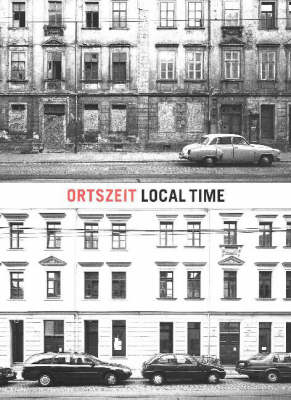
Ortszeit / Local Time
Edition Axel Menges (Verlag)
978-3-936681-15-4 (ISBN)
- Titel ist leider vergriffen;
keine Neuauflage - Artikel merken
Stefan Koppelkamm, graphic and exhibition designer, author and photographer used this historical moment to photograph buildings and townscapes in East Berlin and in other locations in the former GDR whose condition often pointed back to the time before the Second World War. His motives were curiosity about a country that was largely unknown beyond its own borders and the desire to capture in images a condition that would soon disappear. Between 2001 and 2004 Koppelkamm visited the same places again and captured their current state from the same viewpoint.
The photographs were taken with a large-format camera and make it possible to read all the traces time has left in detail, revealing the dramatic social and economic changes that have taken place in the last fifteen years. Comparison of the two points in time will differ according to the viewer's biographical perspective. Something that seemed strange to the photographer has been transformed into something apparently familiar. Viewers who grew up in the milieu photographed may find that the converse applies.
The title "Local time" is to be understood in the transferred sense: local time means that times are valid for different places that can often deviate from the actual time difference between two places by decades or more.
Stefan Koppelkamm studied at the Gesamthochschule in Kassel, and after a longer stay in the USA he now lives in Berlin and teaches communication design at the Kunsthochschule Berlin-Weißensee. Ludger Derenthal is director of the Museum für Foto-grafie in Berlin founded in 2004 and belonging to the Staatliche Museen zu Berlin. He is responsible among other things for the book Bilder der Trümmer- und Aufbaujahre. Fotografie im sich tei-lenden Deutschland - a study of Germany as it was dividing, and thus a testament to the other end of the period the present book deals with.
Dr. Ludger Derenthal, geb. 1964, studierte Kunstgeschichte und Geschichte in Bonn und München; seit 2003 Leiter der Sammlung Fotografie der Kunstbibliothek, veröffentlichte zahlreiche Publikationen über Fotografie des 20. Jahrhunderts, Dada und Surrealismus sowie Skulptur im öffentlichen Raum.
Since the publication of his book Gewächshäuser und Wintergärten im 19. Jahrhundert (Stuttgart, 1981), Koppelkamm has repeatedly engaged with historic and actual aspects of architecture, cities and landscapes. Just as his last book, Ortszeit Local Time (Edition Axel Menges, 2005) could be seen as a search for a collective memory stored within architecture, Screening is a treatise on spaces and buildings that have no connection with their architectonic or social context. After studying film at the Otto-Falckenberg-Schule in Munich, Roland Schimmelpfennig went to work at the Münchner Kammerspiele, followed by the Schaubühne in Berlin, the Burgtheater in Vienna and the Deutsches Theater in Berlin.
| Zusatzinfo | m. zahlr. Duotone-Fotos. |
|---|---|
| Sprache | englisch; deutsch |
| Gewicht | 1485 g |
| Themenwelt | Kunst / Musik / Theater ► Fotokunst |
| Sachbuch/Ratgeber ► Freizeit / Hobby ► Fotografieren / Filmen | |
| Schlagworte | Architekturfotografie • Deutsche Demokratische Republik (DDR), Kunst; Fotografie • Deutsche Demokratische Republik, Kunst; Fotografie • Fotografen/-innen (Einz.) • Fotografen/-innen (Einzelne Personen) • Fotograf / Fotografin (Einzelne Personen) • Koppelmann, Stefan |
| ISBN-10 | 3-936681-15-5 / 3936681155 |
| ISBN-13 | 978-3-936681-15-4 / 9783936681154 |
| Zustand | Neuware |
| Informationen gemäß Produktsicherheitsverordnung (GPSR) | |
| Haben Sie eine Frage zum Produkt? |
aus dem Bereich