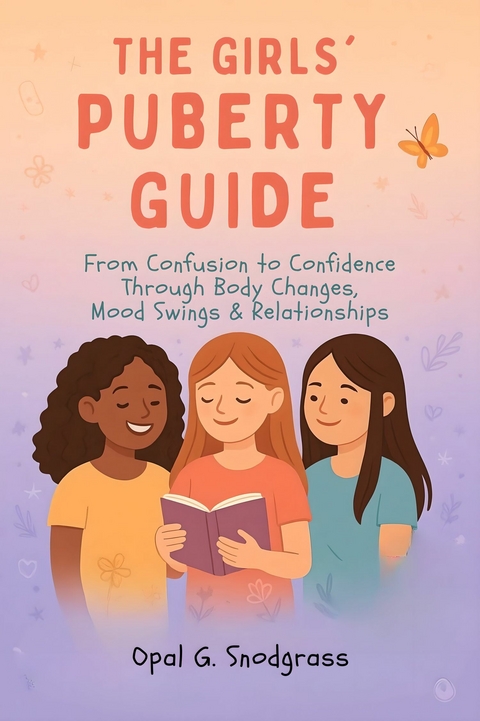
The Girls' Puberty Guide (eBook)
102 Seiten
Seahorse Pub (Verlag)
978-0-00-108452-0 (ISBN)
Empower your daughter to navigate the thrilling yet turbulent journey of growing up with this must have guide. This essential resource transforms overwhelming transformations into empowering milestones for girls aged 8-12 and their families.
Imagine your tween facing her first growth spurt, breast development, or menstrual cycle with excitement instead of anxiety. This comprehensive handbook demystifies it all-explaining hormonal shifts, emotional rollercoasters, and social dynamics in clear, age-appropriate language backed by medical insights. From understanding unique timelines and body hair changes to mastering menstruation products and building emotional intelligence, each chapter offers practical tools like interactive journals, quizzes, and conversation starters to foster open family dialogues.
Unlike generic advice, Snodgrass draws on 23 years of psychology expertise to address real-world concerns: handling peer comparisons, managing mood swings, nurturing healthy friendships, and establishing lifelong self-care habits. Foreword by a pediatrician and packed with evidence-based strategies, this guide honors diverse cultural perspectives while encouraging self-acceptance and resilience.
Perfect for mothers seeking to guide their preteens through adolescence without embarrassment or misinformation. Whether reading together or independently, this book builds body positivity, communication skills, and support networks for a smoother transition to womanhood.
Equip your girl with knowledge that lasts a lifetime-order now and watch her bloom from confused to confident!
Chapter 1
Understanding Your Unique Timeline
Maya sat at lunch watching her friends and feeling completely puzzled. Her best friend Zoe had started wearing a training bra last month and seemed so excited about it. Meanwhile, their friend Keisha looked exactly the same as she had in third grade, and she didn't seem worried about it at all. Maya found herself somewhere in the middle, noticing small changes but wondering when the bigger ones would happen. She felt confused because everyone seemed to be on completely different schedules.
During quiet moments, Maya's mind filled with questions she felt too embarrassed to ask out loud. Was she developing too slowly compared to Zoe? Should she be concerned that she looked different from Keisha? Why did some girls in her grade look so much older while others still looked like little kids? Maya wondered if there was something wrong with her timeline or if she was somehow behind where she should be. These thoughts made her feel anxious and uncertain about her own development.
What Maya didn't realize is that every single girl has her own special timing for growing up, kind of like how everyone has a different birthday or learns to ride a bike at different ages. There's no "right" time or "wrong" time for puberty to begin. Some girls start their growth adventure at eight years old, while others don't begin until they're twelve or thirteen. Both timelines are completely normal and healthy. Your body has its own internal clock that knows exactly when it's ready to start making changes.
If you've ever felt like Maya, wondering about your own timing or comparing yourself to friends, you're definitely not alone. Almost every girl goes through these same questions and feelings. The amazing thing is that once you understand how individual timelines work, those worried feelings can transform into excitement about your own unique development process. Your timeline is perfectly designed for you, and learning about it is the first step toward feeling confident about the changes ahead.
What is Puberty Really?
Puberty is your body's natural process of growing from a child's body into an adult body, and it's one of the most normal things that will ever happen to you. Think of it like your body's built-in upgrade system that activates when you're ready for new capabilities and functions. During puberty, special chemicals called hormones start sending messages throughout your body, telling different parts to grow, change, and develop new abilities. This process is completely automatic and happens because your body is incredibly smart and knows exactly how to transform itself at the right time.
The reason puberty happens is actually pretty amazing when you think about it. Your body is preparing for adulthood by developing all the systems and capabilities you'll need as a grown-up. Your brain grows new connections that help you think in more complex ways and understand emotions better. Your muscles and bones become stronger to support your adult height and strength. Your reproductive system develops so that someday, if you choose to, you could have children of your own. All of these changes work together to help you become the capable, strong adult you're meant to be.
Puberty involves three main categories of changes that all work together during your development. Physical changes include growing taller, developing breasts, getting curves, and starting your menstrual cycle. Emotional changes involve developing deeper feelings, becoming more independent, and learning to handle more complex emotions. Social changes include forming different types of friendships, becoming more interested in your appearance, and starting to think about your future in new ways. All of these changes are connected and help you grow into a well-rounded, capable person.
Here's something really important to understand about timing: puberty can begin anywhere from age eight to age sixteen, and every age within that range is completely normal. Some girls start noticing the first signs of puberty when they're still in elementary school, while others don't see changes until they're in high school. Your individual timing depends on many factors that are unique to you, including your genetics, nutrition, overall health, and environment. There's no "best" age to start puberty, just the right age for your individual body.
Puberty Fact or Fiction Quiz:
- Fiction: All girls start puberty at age 12. Fact: Normal puberty can begin anywhere from age 8 to 16.
- Fact: Genetics play a big role in when you'll start puberty.
- Fiction: If you start puberty early, something is wrong. Fact: Early development within normal ranges is perfectly healthy.
- Fact: Puberty changes happen gradually over several years, not all at once.
Your Body's Special Schedule
Think of your puberty timeline like having your own personal calendar or roadmap that's different from everyone else's. Just like how you might have a different bedtime than your sister or prefer different foods than your best friend, your body follows its own unique schedule for development. This schedule is built into your genetics and influenced by your individual health, nutrition, and environment. Your body's internal clock knows exactly when to start each phase of development, and it will follow that schedule perfectly even if it looks different from your friends' timelines.
Medical professionals use something called Tanner stages to describe the different phases of pubertal development, but you don't need to worry about memorizing these or figuring out exactly which stage you're in. The important thing to understand is that development happens in a generally predictable order, but the timing can vary greatly between individuals. For most girls, the first signs might include a growth spurt, the beginning of breast development, or the appearance of body hair. These early changes might be followed by further breast development, more significant growth, body shape changes, and eventually the start of menstrual periods. However, the exact order and timing of these changes is unique to each person.
The age ranges for normal pubertal development are much wider than most people realize, and this is really important for you to understand. Breast development can begin anywhere from age 8 to 13. Growth spurts typically happen between ages 9 to 14. First menstrual periods usually occur between ages 10 to 16. These wide ranges mean that if you're 10 years old and haven't noticed any changes yet, you're completely normal. If you're 8 years old and already starting to develop, you're also completely normal. If you're 12 and feel like you're in the middle of lots of changes, that's normal too.
Several factors influence when your body decides to begin puberty, and understanding these can help you feel more comfortable with your own timing. Genetics is probably the biggest factor, which means you might follow a similar pattern to your mom, sisters, or other women in your family. Good nutrition and overall health support normal development, while chronic stress or illness might delay it slightly. Your ethnicity can also play a role, as different populations tend to have slightly different average timelines. However, individual variation within any group is always significant, so family patterns give you general ideas rather than exact predictions.
Interactive Development Observation Journal: Start a private journal where you can note changes you observe in yourself, how you feel about them, and any questions that come up. This isn't about tracking every detail obsessively, but rather about becoming more aware of your own development in a positive way.
Family Patterns and Heritage
Your genetic heritage plays a significant role in determining your pubertal timeline, kind of like how you might have inherited your mom's eye color or your dad's height. The women in your family often provide clues about what your own development might look like, though it's important to remember that you'll still have your own unique experience. If your mom started developing early, you might too. If your older sister had a later timeline, yours might be similar. However, genetics is just one piece of the puzzle, and environmental factors can influence timing as well.
Understanding your family's developmental patterns can be helpful and reassuring, but it's important to approach these conversations respectfully and understand that not all families are comfortable discussing these topics in detail. Some families share information openly, while others prefer to keep these matters more private. Both approaches are perfectly okay, and you should never feel pressured to ask questions that make you or your family members uncomfortable. If your family is open to sharing, you might learn interesting information about when the women in your family started developing, what their experiences were like, and how they felt during puberty.
Cultural and ethnic background can also provide some general information about developmental patterns, though individual variation within any group is always significant. Research shows that girls of African descent tend to begin puberty slightly earlier on average, while girls of Asian descent might begin slightly later, and girls of European descent fall somewhere in the middle. However, these are just general trends, and there are many individuals within each group who don't follow the average pattern. Your individual timeline is much more important than any general population trends.
It's crucial to understand that family patterns and cultural trends give you general ideas rather than exact predictions about your...
| Erscheint lt. Verlag | 21.10.2025 |
|---|---|
| Sprache | englisch |
| Themenwelt | Sachbuch/Ratgeber ► Gesundheit / Leben / Psychologie ► Familie / Erziehung |
| ISBN-10 | 0-00-108452-6 / 0001084526 |
| ISBN-13 | 978-0-00-108452-0 / 9780001084520 |
| Informationen gemäß Produktsicherheitsverordnung (GPSR) | |
| Haben Sie eine Frage zum Produkt? |
 EPUB (Adobe DRM)
Größe: 1,6 MB
Kopierschutz: Adobe-DRM
Adobe-DRM ist ein Kopierschutz, der das eBook vor Mißbrauch schützen soll. Dabei wird das eBook bereits beim Download auf Ihre persönliche Adobe-ID autorisiert. Lesen können Sie das eBook dann nur auf den Geräten, welche ebenfalls auf Ihre Adobe-ID registriert sind.
Details zum Adobe-DRM
Dateiformat: EPUB (Electronic Publication)
EPUB ist ein offener Standard für eBooks und eignet sich besonders zur Darstellung von Belletristik und Sachbüchern. Der Fließtext wird dynamisch an die Display- und Schriftgröße angepasst. Auch für mobile Lesegeräte ist EPUB daher gut geeignet.
Systemvoraussetzungen:
PC/Mac: Mit einem PC oder Mac können Sie dieses eBook lesen. Sie benötigen eine
eReader: Dieses eBook kann mit (fast) allen eBook-Readern gelesen werden. Mit dem amazon-Kindle ist es aber nicht kompatibel.
Smartphone/Tablet: Egal ob Apple oder Android, dieses eBook können Sie lesen. Sie benötigen eine
Geräteliste und zusätzliche Hinweise
Buying eBooks from abroad
For tax law reasons we can sell eBooks just within Germany and Switzerland. Regrettably we cannot fulfill eBook-orders from other countries.
aus dem Bereich