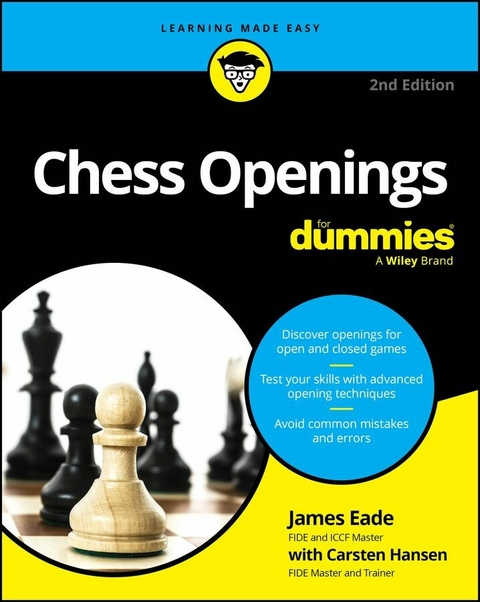
Chess Openings For Dummies (eBook)
743 Seiten
For Dummies (Verlag)
978-1-394-34501-4 (ISBN)
Set yourself up for success by understanding the art of the chess opening
Chess Openings For Dummies helps beginning and intermediate chess players improve their game by making the first few moves count. With a strong opening, you can dictate the flow of the game, control the center, and keep your king safe. This book shows you how to make tactical early moves that put you on a strong footing for the rest of the game. Chess master James Eade shares his expert knowledge for coming out triumphant in open, semi-open, closed, and semi-closed games. Plus, you'll discover the perks of advancing with flank openings and learn the major mistakes to avoid. Learn the importance of online competitions, computers, and faster-paced chess events and their impact on the game. In language anyone can understand, this Dummies guide helps you gain a strategic advantage in chess.
- Discover the most effective openings for open and closed games
- Advance your game with new and advanced opening techniques
- Learn why certain openings have become more popular-and why you should use them
- Gain the upper hand in the first few moves and keep opponents on their toes
Looking to improve your chess openings? Chess Openings For Dummies makes it easy.
James Eade became a United States Chess Federation chess master in 1981. International organizations awarded him the master title in 1990 (for correspondence) and in 1993 (for regular tournament play). Today, he writes about and teaches chess.
Carsten Hansen is a FIDE Master (1990) and Trainer (2016) and is one of the most prolific authors of chess books, with more than sixty books to his credit.
Set yourself up for success by understanding the art of the chess opening Chess Openings For Dummies helps beginning and intermediate chess players improve their game by making the first few moves count. With a strong opening, you can dictate the flow of the game, control the center, and keep your king safe. This book shows you how to make tactical early moves that put you on a strong footing for the rest of the game. Chess master James Eade shares his expert knowledge for coming out triumphant in open, semi-open, closed, and semi-closed games. Plus, you'll discover the perks of advancing with flank openings and learn the major mistakes to avoid. Learn the importance of online competitions, computers, and faster-paced chess events and their impact on the game. In language anyone can understand, this Dummies guide helps you gain a strategic advantage in chess. Discover the most effective openings for open and closed games Advance your game with new and advanced opening techniques Learn why certain openings have become more popular and why you should use them Gain the upper hand in the first few moves and keep opponents on their toes Looking to improve your chess openings? Chess Openings For Dummies makes it easy.
Chapter 1
Understanding Chess Openings
IN THIS CHAPTER
Understanding what a chess opening is
Choosing openings that fit your playing style
Getting familiar with chess notation
Chess is typically divided into three phases: the opening, the middlegame, and the endgame. Although the exact point of transition from one phase to another can sometimes be ambiguous, each phase of the game has properties that distinguish it from the others. The opening phase of the game is typically all about mobilizing your forces as quickly and as efficiently as possible.
In this chapter, we explain how you know when an opening has been established. We also ask you to sit back and think about your style of play, because how you play the game helps determine what type of openings you favor. Finally, we include a quick review of basic chess notation.
Identifying a Chess Opening
The first phase of a chess game is called the opening. In this phase of the game, players will concentrate on two things: the rapid mobilization of their forces and grabbing space.
In the following sections, we explain what makes an opening an opening, and we show you how one move turns into an opening.
Distinguishing “the” opening from “an” opening
In chess, opening can mean two different but related things, and it all depends on whether “the” or “an” comes before opening.
- The phrase “the opening” refers to the phase of the game when you get your pieces (by pieces, I’m referring to the rooks, bishops, knights, queen, and king — basically, everything but the pawns) off the back rank and reposition them where they can do the most good. (The other phases of the game are the middlegame and the endgame.)
- The phrase “an opening” refers to a specific sequence of moves. When a move or a specific sequence of moves by pawns and/or pieces is given a name, you have yourself a “chess opening.” These openings are what we cover throughout this book.
There are countless chess openings. Some are named after players, some after locations (countries, cities, rivers, resorts, and even boats), and some are named after animals! But to be considered an opening, for the purposes of this book, a sequence of moves must have a name. (We cover chess naming conventions, which are frequently a source of head-shaking, in Chapter 3.)
Chess players and scholars generally agree on what to call a particular opening, but sometimes it depends on where you are. For example, the Ruy López, which we cover in Chapter 7, is called the Spanish Opening in some parts of the world. Throughout this book, we refer to the generally accepted opening names as they’re used in the United States.
Seeing how a move turns into an opening
Openings are defined and categorized by their pawn structure and piece placement. Although the pawns may not appear to have a lot of power when you’re in the thick of a game, at the start of the game, they open lines for your pieces to take advantage of and restrict your opponent’s pieces and pawns from squares.
The most frequently played opening move is 1.e4 because it does the most to help you develop your pieces (or move the pieces from their starting position). However, the move 1.e4 is not considered a specific opening (see Figure 1-1).
Ranks, files, and diagonals are collectively referred to as lines. The move 1.e4 opens a line for both the queen and the bishop. They’re now free to move from their starting positions.
If Black responds to the move 1.e4 with 1 … . e5, you have a position that can be classified as a double king pawn, which is a type of opening known as an open game. (We cover the variety of chess opening types in Chapter 3.) But these opening moves are not yet a particular opening because they don’t have a name.
However, if White continues with 2.Bc4, you have yourself a named opening! This position is called the Bishop’s Opening, which we cover in Chapter 5 (see Figure 1-2).
FIGURE 1-1: An opening move, but not an opening.
FIGURE 1-2: The Bishop’s Opening.
Watching an opening transform right before your eyes
According to Wikipedia, The Oxford Companion to Chess lists 1,327 named chess openings and variations. A variation is an alternate line of play within a particular opening. Not that we have counted all of them, but we are sure there are even more. The reason we know this is that new variations are invented or discovered all the time, and at some point, what used to be an opening move becomes an opening. Indeed, I (Carsten) have written about variations that didn’t have a name before I named them!
It’s also possible to arrive at a particular opening or variation by different move orders, or to start out in one opening and end up in another, which is called transposing. Many opening systems offer the possibility of transposing from one opening into another, and top-notch players use this possibility to keep their opponents guessing.
It’s not so much the exact sequence of moves that matters, but the position you arrive at. As long as you understand the general ideas behind that position, you’ll be able to navigate through the maze of possibilities at your disposal.
Finding an opening that’s right for you
People have different styles of play when it comes to chess. Your style doesn’t necessarily have anything to do with how you behave in real life. You may be shy and retiring in your everyday encounters, but a real tiger when it comes to chess, or vice versa.
I (James) first became serious about chess when Bobby Fischer challenged Boris Spassky for the World Championship in 1972. I had suffered a skiing injury and spent some of my enforced downtime with a chess book that featured a lot of Nimzo-Indian Defenses (see Chapter 16) and French Defenses (see Chapter 10). They became the openings that I chose to play in tournaments.
I noticed, however, that the majority of players in those tournaments played Sicilian Defenses (see Chapter 9) and King’s Indian Defenses (see Chapter 17). It became clear to me that this was because Fischer played those openings. Fischer was a trendsetter.
But what about you? Do you want to play something that’s in fashion now, or do you want to go your own way? Out of all the available openings that exist in chess, which ones are right for you?
There is no right or wrong chess style. Two great players became World Champions in the 1960s, and their styles could not have been more different. Mikhail Tal (1936–1992) became World Champion in 1960 and was one of the fiercest attacking players of all time. On the other side of the ledger was Tigran Petrosian (1929–1984), who became World Champion in 1963. He was a staunch defender who was extremely difficult to beat.
Ask yourself what appeals to you the most about chess. Do you always want to be the aggressor and go on the attack at all costs? Check out the openings in Chapter 4. They may be right up your alley.
CHESS FASHION SENSE
A chess opening can become popular simply because a famous player uses it. Another opening can become unpopular if a move is discovered that seems to give the advantage to one player over the other. Openings can be rehabilitated, too — sometimes, even newer moves are discovered that change the evaluation yet again.
Chess openings have been exposed to enormous scrutiny, but there still are no final answers as to which variations are best. Chess programs running on powerful computers have ranked the openings, and some previously thought sound have been shown to be suspect. We always felt that the “latest and greatest” wasn’t for us. We wanted to play something we understood, and it was fine by us if it wasn’t popular with other players. Play what you like, and don’t worry about chess fashion.
The different openings can be grouped by type, as we explain in more detail in Chapter 3. In general terms, openings that feature open lines and easy piece development are grouped in Part 1 of this book. Openings with closed lines and more limited piece mobility are grouped in Part 4.
You may already know what type of player you are, and the organization of this book will steer you toward the type of opening that suits you best. If you don’t know what type of chess player you are, browse through openings from each type and see which one appeals to you the most.
After you figure out the type of opening you like, take a closer look at some of the specific openings in that section. You’ll find games where White’s strategy succeeds and games where Black’s strategy comes out on top. If you feel an intuitive attraction to any particular opening, pay attention to that feeling!
If an opening seems too complicated — or if it just doesn’t feel right to you — keep looking. Matching the right opening to your style of play makes you a better player, and it guarantees you more playing pleasure in the long run.
Reviewing Chess Shorthand
Throughout this book, we use game scores from notable games to explain how an opening...
| Erscheint lt. Verlag | 20.10.2025 |
|---|---|
| Sprache | englisch |
| Themenwelt | Sachbuch/Ratgeber ► Freizeit / Hobby ► Spielen / Raten |
| Schlagworte | best chess books • book on chess • Chess Book • chess fundamentals • chess opening • chess opening book • chess strategy • chess tactics • flank openings • How to Win at Chess • learn chess • master chess openings • modern chess openings • queen's gambit |
| ISBN-10 | 1-394-34501-1 / 1394345011 |
| ISBN-13 | 978-1-394-34501-4 / 9781394345014 |
| Informationen gemäß Produktsicherheitsverordnung (GPSR) | |
| Haben Sie eine Frage zum Produkt? |
 EPUB (Adobe DRM)
Kopierschutz: Adobe-DRM
Adobe-DRM ist ein Kopierschutz, der das eBook vor Mißbrauch schützen soll. Dabei wird das eBook bereits beim Download auf Ihre persönliche Adobe-ID autorisiert. Lesen können Sie das eBook dann nur auf den Geräten, welche ebenfalls auf Ihre Adobe-ID registriert sind.
Details zum Adobe-DRM
Dateiformat: EPUB (Electronic Publication)
EPUB ist ein offener Standard für eBooks und eignet sich besonders zur Darstellung von Belletristik und Sachbüchern. Der Fließtext wird dynamisch an die Display- und Schriftgröße angepasst. Auch für mobile Lesegeräte ist EPUB daher gut geeignet.
Systemvoraussetzungen:
PC/Mac: Mit einem PC oder Mac können Sie dieses eBook lesen. Sie benötigen eine
eReader: Dieses eBook kann mit (fast) allen eBook-Readern gelesen werden. Mit dem amazon-Kindle ist es aber nicht kompatibel.
Smartphone/Tablet: Egal ob Apple oder Android, dieses eBook können Sie lesen. Sie benötigen eine
Geräteliste und zusätzliche Hinweise
Buying eBooks from abroad
For tax law reasons we can sell eBooks just within Germany and Switzerland. Regrettably we cannot fulfill eBook-orders from other countries.
aus dem Bereich