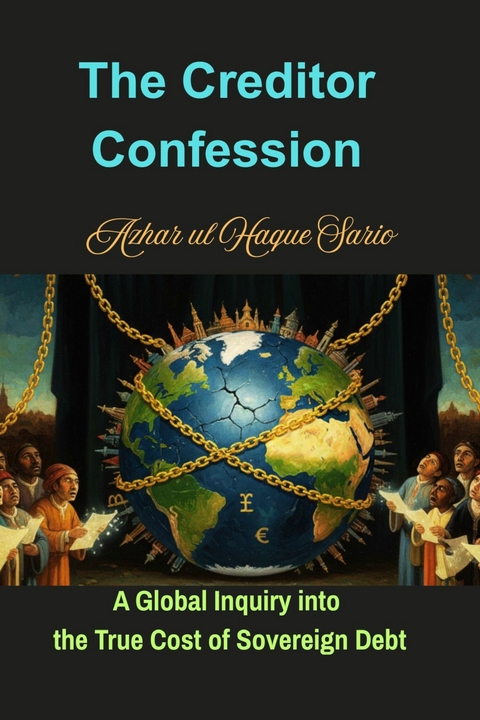
The Creditor Confession (eBook)
200 Seiten
Azhar Sario Hungary (Verlag)
978-3-384-73493-8 (ISBN)
This book tells the real story of sovereign debt, a story that is profoundly human. We often talk about national debt using sterile language. We hear about bond yields and debt-to-GDP ratios. This report reframes the conversation. It's a metaphorical 'confession' of the true, hidden costs. It moves beyond policy to look at the lived consequences of debt crises. The book uses key concepts to explain what's happening. These include 'conditionality,' where lenders like the IMF set policies. This can mean a loss of national sovereignty. It also explores the 'doom loop,' the cycle between a weak government and its banks. The report uses 15 distinct country case studies as testimony. Each chapter is a confession of a specific drawback. We see the surrender of economic sovereignty in Greece. We explore the debt-fueled environmental damage in Ecuador's Amazon. We see hyperinflation in Zimbabwe and the social unrest in Argentina. From Japan's demographic crisis to Bolivia's 'Water War' , the book paints a stark picture. It reveals a system where the costs are socialized, but the gains remain private.
Most books on this topic get lost in technocratic details. They focus on fiscal consolidation and policy effectiveness. This book provides value by doing something different. It refuses to treat sovereign debt as just a financial transaction. Instead, it exposes debt as a complex architecture of power. This architecture shapes the political, economic, and social fabric of entire societies. Where other analyses see numbers, this inquiry finds the human story. It shows how the 'burden of adjustment' is placed on the most vulnerable people. It connects the dots between an IMF agreement and the collapse of a nation's health system. It links structural adjustment to the hollowing out of a rural economy. It even explores how economic hardship can fuel extremism and social collapse. This book's advantage is its unflinching focus on the true costs, revealing the confession of a system that erodes public services and social welfare.
This author has no affiliation with the board and it is independently produced under nominative fair use.
Bolivia – The Cochabamba Water War: Debt-Driven Privatization and the Fight for Public Resources
8.1 The Neoliberal Mandate: Privatization for Debt Relief
Bolivia, at the dawn of the 1990s, was a nation walking a razor's edge. The country was still emerging from the shadow of the 1980s, a decade marked by catastrophic hyperinflation and deep-seated economic instability. To save the economy from total collapse, the government had implemented a series of "shock therapy" policies. These policies, while successful in taming inflation, left the nation deeply impoverished and heavily reliant on external financial support.
This support came primarily from the powerful Bretton Woods institutions: the International Monetary Fund (IMF) and the World Bank. By the late 1990s, Bolivia was classified as a "Heavily Indebted Poor Country" (HIPC). This designation made it eligible for a special program of debt relief, a lifeline that could potentially free up millions of dollars for social spending on health and education.
But this lifeline came with thick, heavy strings attached.
The IMF and the World Bank were not operating in a vacuum. They were the primary engines of a global economic philosophy known as the "Washington Consensus." This was a set of ten core policy prescriptions that became the standard playbook for development. The consensus argued that the path to economic growth was through free markets, liberated from government interference. This meant deregulation, opening borders to free trade, and, most critically, the privatization of state-owned enterprises.
The thinking was straightforward, at least on paper. Governments, it was argued, were inherently inefficient, bureaucratic, and often corrupt. Public utilities, like water systems or power grids, were supposedly better managed by the private sector. A private company, driven by the profit motive, would be more efficient. It could invest the capital needed to modernize aging infrastructure, expand services to underserved areas, and run the system like a business, not a bloated government agency.
For Bolivia, this ideology was not a choice; it was a mandate. To qualify for the HIPC debt relief program, the Bolivian government was required to implement a series of Structural Adjustment Programs (SAPs). A key, non-negotiable condition of these programs was the privatization of its remaining public assets. This included the national oil and gas company, the telecommunications provider, and the municipal water systems in its major cities, including Cochabamba.
The pressure was immense and explicit. The World Bank, in its negotiations, made it unequivocally clear that Bolivia's access to future loans and its qualification for $600 million in debt relief were entirely conditional on selling off its water systems. This was not a partnership; it was an ultimatum.
This dynamic represented a profound erosion of national sovereignty. Key decisions about Bolivia's most essential resources were not being made in the legislative halls of La Paz or in the city council of Cochabamba. They were being made in boardrooms in Washington, D.C., by economists and technocrats who saw water as a commodity, an "economic good" to be managed, rather than a fundamental human right.
The Bolivian government, facing a crushing debt burden and the threat of being cut off from the international financial system, felt it had no choice but to comply. The government, led by the former dictator-turned-democrat Hugo Banzer, proceeded to push the privatization policy through, overriding local objections and concerns. They were satisfying the demands of their external creditors, but in doing so, they were setting the stage for a monumental clash with their own citizens. The technocratic solution for debt relief was about to collide with the social and cultural reality of a population that believed water, like the air itself, could not be owned.
8.2 The Aguas del Tunari Concession and Rate Shock
With the mandate from the international lenders firmly in place, the Bolivian government moved to privatize Cochabamba's public water utility, SEMAPA. The process was notoriously opaque. In September 1999, the government awarded a 40-year concession to a single bidder: a newly formed international consortium named Aguas del Tunari.
This was not a small local company. It was a global corporate powerhouse. The dominant partner, holding the largest stake, was International Water, a subsidiary of the massive U.S. engineering and construction firm Bechtel. Other major partners included Abengoa from Spain and Edison from Italy, along with a few Bolivian investors. In essence, the control of Cochabamba's water supply was handed over to a group of foreign corporations.
The contract itself was a testament to the power imbalance. It was negotiated in secret and its terms were incredibly favorable to the consortium. Aguas del Tunari was guaranteed a minimum 16% annual rate of return on its investment, a figure that would be adjusted annually for inflation. This clause meant that the company was legally entitled to its profit, regardless of its performance, efficiency, or the ability of the local population to pay. The risk was transferred entirely from the corporation to the consumer.
To further protect this monopoly, the government passed a sweeping new law, Law 2029. This law was the legal instrument that ignited the fire. It didn't just privatize the city's pipe system; it effectively gave Aguas del Tunari ownership of all water sources. This included water from community-owned wells, cooperatively-built irrigation systems, and even rainwater collected in rooftop cisterns.
For the people of Cochabamba, particularly the urban poor and the rural campesinos on the city's outskirts, this was an existential threat. For generations, these communities had developed their own independent water systems, known as usos y costumbres (uses and customs). They had pooled their own money and labor to dig wells and build irrigation canals, creating autonomous systems completely separate from the failing public grid. Law 2029 effectively outlawed these traditional practices. It meant that a family could, in theory, be billed by Aguas del Tunari for collecting rain on their own roof.
The impact was immediate and brutal.
Almost as soon as the company took control in January 2000, water bills skyrocketed. This was the "Tarifazo," or rate shock. Increases of 50% or 100% were common. For many of the city's poorest families, the bills suddenly shot up by 200% or more.
It is difficult to overstate what this meant in human terms. In a city where the minimum wage was less than $100 a month, families were suddenly handed water bills of $20 or $25. This single bill consumed up to a quarter of their entire monthly income. People were forced to make impossible choices: Do we pay for water, or do we buy food? Do we pay the water bill, or do we pay for our children's school fees?
The public’s anger was not just about the price. It was about the injustice. The rate increases were not tied to any improvement in service. The water pressure did not get better; the taps did not suddenly run clean. The money was simply being used to finance the corporation's debt and guarantee its 16% profit.
Furthermore, the corporation began charging for water from wells that people had built with their own hands. This was perceived as outright theft. It was an expropriation of a public resource and a communal heritage, all to service a private, foreign-owned monopoly. The policy, born in the abstract world of neoliberal economics, had now manifested as a direct assault on the fundamental right to life. The people of Cochabamba, from factory workers and teachers to peasant farmers and street vendors, began to organize. The "Water War" was about to begin.
8.3 The Uprising: A Coalition of the Dispossessed
The rate shock from Aguas del Tunari was not just a policy adjustment. It was an explosion that tore through the social fabric of Cochabamba. The response was not a slow burn of political lobbying; it was a rapid, unified, and visceral popular eruption. This uprising gave birth to one of the most remarkable social movements of the era: the Coordinadora de Defensa del Agua y de la Vida (The Coalition in Defense of Water and Life).
This was not a single-issue group. It was a broad-based, decentralized, and powerful alliance that managed to unite citizens across every conceivable divide. It was a true coalition of the dispossessed. Leadership emerged organically from the grassroots, most visibly represented by Oscar Olivera, a charismatic shoe factory union leader. But he was just one voice in a chorus.
The Coordinadora brought together urban factory workers who saw their wages evaporate, and middle-class professionals—teachers, engineers, and small business owners—who were incensed by the sheer arrogance of the contract and the injustice of the rate hikes. They were joined by environmental groups, progressive local economists, and legions of university students who provided the energy and communication for the new movement.
But the coalition's true power, its unshakeable foundation, came from the fusion of the city with the countryside.
Crucially, the Coordinadora included the campesinos (peasant farmers) and, most importantly, the regantes (traditional irrigators) from the surrounding valleys. These rural...
| Erscheint lt. Verlag | 20.10.2025 |
|---|---|
| Sprache | englisch |
| Themenwelt | Sachbuch/Ratgeber ► Beruf / Finanzen / Recht / Wirtschaft ► Wirtschaft |
| Sozialwissenschaften ► Politik / Verwaltung | |
| Schlagworte | Austerity • Globalization • IMF • Neoliberalism • Political Economy • Sovereign debt • Structural adjustment |
| ISBN-10 | 3-384-73493-9 / 3384734939 |
| ISBN-13 | 978-3-384-73493-8 / 9783384734938 |
| Informationen gemäß Produktsicherheitsverordnung (GPSR) | |
| Haben Sie eine Frage zum Produkt? |
 EPUB (Ohne DRM)
Digital Rights Management: ohne DRM
Dieses eBook enthält kein DRM oder Kopierschutz. Eine Weitergabe an Dritte ist jedoch rechtlich nicht zulässig, weil Sie beim Kauf nur die Rechte an der persönlichen Nutzung erwerben.
Dateiformat: EPUB (Electronic Publication)
EPUB ist ein offener Standard für eBooks und eignet sich besonders zur Darstellung von Belletristik und Sachbüchern. Der Fließtext wird dynamisch an die Display- und Schriftgröße angepasst. Auch für mobile Lesegeräte ist EPUB daher gut geeignet.
Systemvoraussetzungen:
PC/Mac: Mit einem PC oder Mac können Sie dieses eBook lesen. Sie benötigen dafür die kostenlose Software Adobe Digital Editions.
eReader: Dieses eBook kann mit (fast) allen eBook-Readern gelesen werden. Mit dem amazon-Kindle ist es aber nicht kompatibel.
Smartphone/Tablet: Egal ob Apple oder Android, dieses eBook können Sie lesen. Sie benötigen dafür eine kostenlose App.
Geräteliste und zusätzliche Hinweise
Buying eBooks from abroad
For tax law reasons we can sell eBooks just within Germany and Switzerland. Regrettably we cannot fulfill eBook-orders from other countries.
aus dem Bereich