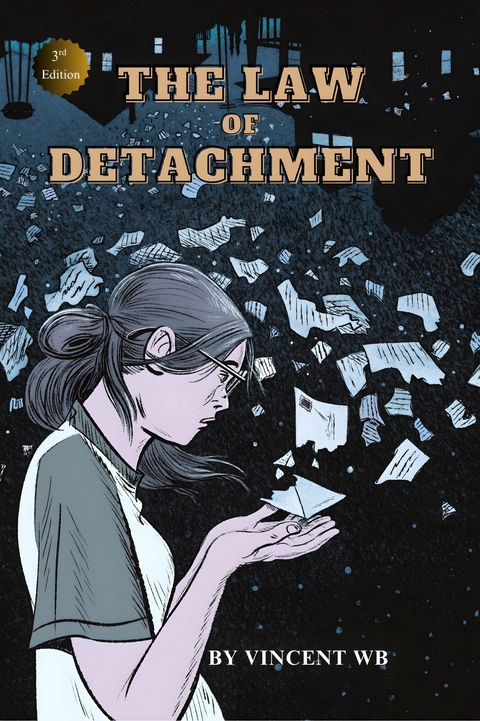
The Law of Detachment (eBook)
257 Seiten
Publishdrive (Verlag)
978-0-00-107944-1 (ISBN)
What if letting go was the very thing that set your soul free?
In a world obsessed with control, perfection, and constant striving, The Law of Detachment offers a radical shift: true power comes not from clinging-but from releasing.
In this life-changing book, Vincent WB, bestselling African author and spiritual visionary, takes you on a powerful journey through the art of surrender. Blending soulful storytelling, practical psychology, and timeless wisdom, this book shows you how to let go of what no longer serves you and finally claim the peace, purpose, and power you deserve.
Whether you're holding on to a relationship, a dream, a past identity, or the fear of the unknown-this book will guide you back to yourself.
Inside, you'll discover how to:
Stop overthinking and detach from painful outcomes
Let go of fear, scarcity, and people-pleasing
Build emotional resilience through mindfulness and reflection
Navigate change, rejection, and uncertainty with grace
Tap into spiritual flow, trust divine timing, and release control
Achieve success without burnout by focusing on presence over pressure
Through real-life transformations, reflective prompts, and powerful practices, The Law of Detachment is more than a book-it's a spiritual companion. A wake-up call. A guide to your next level.
Perfect for fans of The Untethered Soul, The Power of Now, and The Law of Attraction.
CHAPTER 1: INTRODUCTION TO THE LAW OF DETACHMENT
Definition and Misconceptions
Let’s get something straight from the beginning: detachment doesn’t mean not caring.
It doesn’t mean being cold, emotionless, or shutting yourself off from people and life. That’s one of the biggest misconceptions. I get it—when you hear “detach,” it can sound like you’re supposed to stop loving, stop dreaming, or stop hoping. But that’s not what this law is about at all.
The Law of Detachment is the ability to let go of your grip on how things must happen, while still caring deeply about what you desire. It’s choosing peace over pressure, trust over obsession, and flow over force. It’s understanding that attachment—to outcomes, people, control—is the root of so much suffering.
Let me ask you a question: Have you ever wanted something so badly that it consumed your thoughts? A relationship, a job, a goal, a dream? You tried to plan every detail, control every step, and hold it so tightly in your mind that you could almost feel your knuckles turning white. And when things didn’t go exactly the way you imagined, it hurt. Deeply.
You’re not alone if you’ve ever felt this way. I’ve been there too.
The truth is, attachment gives us a false sense of security. It tells us, “If I just hold on tighter, I won’t lose this.” But often, the tighter we hold on, the faster things slip through our fingers. Detachment, ironically, is what helps us keep our peace, and sometimes even attract what we desire—without the anxiety and desperation.
So let’s define detachment clearly:
Detachment is the conscious practice of releasing control, expectations, and emotional dependency on outcomes—while still taking inspired action and remaining open to possibilities.
It’s a mindset. A skill. A form of emotional maturity. And it is, without question, one of the most powerful shifts you can make in your life.
Now, that doesn’t mean it’s easy.
In fact, learning to detach—especially in a world that tells us to hustle harder, chase harder, want harder—feels like swimming upstream. But when you begin to understand it, everything starts to change. The anxiety loosens. The self-worth stops swinging on the pendulum of results. And you begin to experience something rare: inner freedom.
Detachment vs. Indifference
There’s a huge difference between detachment and indifference, and if we don’t separate the two early on, you might be tempted to abandon this concept altogether.
Indifference says, “I don’t care.”
Detachment says, “I care, but I’m not controlled by this.”
Indifference closes the heart. Detachment opens it, but with boundaries.
Indifference shuts down. Detachment stands strong in presence and peace.
Take a moment and imagine this: You’re in a relationship where you genuinely care for the other person. You love them, want the best for them, and enjoy your time together. But you don’t obsess over what they do, say, or feel. You don’t make their mood your responsibility. You don’t panic if they need space or make a decision that wasn’t in your script. That’s detachment. You are still loving, still present, still invested—but your peace is not tied to their every move.
Indifference would be something else entirely. You’d be disengaged. Dismissive. Emotionally checked out. You might still be there physically, but you’re not really there at all.
That’s not what we’re aiming for in this book.
I used to confuse the two myself. For a while, I thought detachment meant I had to “turn off” my emotions and pretend things didn’t affect me. It felt fake. It felt disconnected. And honestly, it made me a version of myself I didn’t like. But the deeper I explored detachment, the more I realized: it’s not about feeling less—it’s about being less ruled by what you feel.
Let me share a story. A few years ago, I was working on a project I believed would change my life. I poured everything into it—time, energy, even my identity. I was convinced that success in this one thing would validate my worth. So I clung to it. I obsessed. I made decisions from fear and desperation. And when it fell apart, I crumbled.
What I learned later was this: it wasn’t the failure of the project that hurt the most—it was my attachment to the outcome. I had pinned my self-worth to a result I couldn’t control. That was never sustainable.
Detachment would have allowed me to give it my best, without tying my value to its success. To let go of needing a particular result and trust that whatever happened, I would still be whole.
That’s the difference. Indifference would have meant not trying at all. Detachment meant showing up fully—then releasing the outcome.
Detachment as Empowerment
Now here’s where things get beautiful: Detachment is not weakness—it’s radical strength.
Most of us are taught that caring deeply and being strong means holding on. That persistence and loyalty mean clinging tight. But what if real power came from the ability to let go?
Think about it. When you’re attached to a specific outcome, your emotions become dependent on things you can’t control. That’s not power—that’s emotional slavery. But when you’re detached, you become grounded, centered, steady. You can still pursue your goals, love deeply, and show up fully—but you’re not shaken by every twist and turn along the way.
Let me ask you: How much of your stress comes from needing things to happen a certain way?
What would shift if you could let go of that need and trust that, no matter what, you’re still okay?
Detachment gives you that superpower.
It empowers you to act from clarity instead of fear, to love from wholeness instead of lack, and to live from alignment instead of grasping.
Here’s another thing I discovered during a difficult relationship chapter in my life: I used to think loving someone meant never letting go. That it was noble to fight until there was nothing left to fight with. But that mindset broke me. Because I wasn’t loving from strength—I was attaching from fear. I was afraid of being alone. Afraid of failure. Afraid of starting over.
Detachment taught me something revolutionary: I could love someone deeply and still walk away if it meant choosing peace over pain. That wasn’t abandonment. That was alignment.
You can’t force someone to love you the way you want. You can’t control how things unfold. But you can choose how you show up—and when you choose from detachment, you choose from power, not pressure.
In fact, most of the growth I’ve experienced in my life didn’t come from holding on—it came from letting go.
Letting go of needing approval.
Letting go of chasing perfection.
Letting go of how I thought life should go.
And each time I detached, I gained something better: clarity, freedom, self-respect, peace.
So let’s come back to the heart of it:
Detachment is not the absence of care—it’s the presence of inner stability.
It’s not giving up—it’s giving in to the flow of life.
It’s not walking away from your dreams—it’s walking with them, without chains.
In the chapters to come, we’ll go deeper. We’ll explore what surrender really means, how to balance goals with trust, how to detach in relationships, and what it looks like to live from a place of grounded peace. You’ll get practical tools, ancient wisdom, and stories that resonate.
But for now, just remember this:
You’re allowed to care deeply and still let go.
You’re allowed to want something and not obsess over it.
You’re allowed to live with passion—without pressure.
That is the Law of Detachment. And once you start living by it, life becomes lighter.
You stop chasing.
You start flowing.
You begin to breathe again.
Welcome to your journey of letting go—and becoming free.
Origins in Ancient Wisdom
The concept of letting go isn’t new. In fact, it's one of the oldest teachings humanity has ever tried to understand. Long before modern psychology and self-help books, ancient sages, monks, and mystics spoke about the power and necessity of detachment.
If you’ve ever read a quote like, “Attachment is the root of all suffering,” from the Buddha, or “Let go and let God,” from spiritual traditions, you’ve already encountered the seed of this philosophy. These are not just poetic ideas—they’re practical truths that echo across civilizations and cultures.
In Buddhism, detachment—or non-attachment—is central to achieving enlightenment. The Second Noble Truth states that suffering arises from tanha, or craving and clinging. The antidote? Letting go. Releasing the grip on desires, expectations, and the illusion of permanence. Not because desire is inherently wrong, but because clinging to what changes guarantees suffering.
In Taoism, the concept of Wu Wei (translated as “non-action” or “effortless action”) teaches us to flow with the natural rhythm of life instead of forcing outcomes. Lao Tzu wrote, “By letting it go, it all gets done. The world is won by those who let it go.” That’s not laziness—it’s trust. It's the understanding that our control is limited, and harmony begins where resistance ends.
In Hinduism, detachment is practiced through...
| Erscheint lt. Verlag | 13.10.2025 |
|---|---|
| Sprache | englisch |
| Themenwelt | Sachbuch/Ratgeber ► Gesundheit / Leben / Psychologie ► Lebenshilfe / Lebensführung |
| ISBN-10 | 0-00-107944-1 / 0001079441 |
| ISBN-13 | 978-0-00-107944-1 / 9780001079441 |
| Informationen gemäß Produktsicherheitsverordnung (GPSR) | |
| Haben Sie eine Frage zum Produkt? |
 EPUB (Adobe DRM)
Größe: 2,3 MB
Kopierschutz: Adobe-DRM
Adobe-DRM ist ein Kopierschutz, der das eBook vor Mißbrauch schützen soll. Dabei wird das eBook bereits beim Download auf Ihre persönliche Adobe-ID autorisiert. Lesen können Sie das eBook dann nur auf den Geräten, welche ebenfalls auf Ihre Adobe-ID registriert sind.
Details zum Adobe-DRM
Dateiformat: EPUB (Electronic Publication)
EPUB ist ein offener Standard für eBooks und eignet sich besonders zur Darstellung von Belletristik und Sachbüchern. Der Fließtext wird dynamisch an die Display- und Schriftgröße angepasst. Auch für mobile Lesegeräte ist EPUB daher gut geeignet.
Systemvoraussetzungen:
PC/Mac: Mit einem PC oder Mac können Sie dieses eBook lesen. Sie benötigen eine
eReader: Dieses eBook kann mit (fast) allen eBook-Readern gelesen werden. Mit dem amazon-Kindle ist es aber nicht kompatibel.
Smartphone/Tablet: Egal ob Apple oder Android, dieses eBook können Sie lesen. Sie benötigen eine
Geräteliste und zusätzliche Hinweise
Buying eBooks from abroad
For tax law reasons we can sell eBooks just within Germany and Switzerland. Regrettably we cannot fulfill eBook-orders from other countries.
aus dem Bereich