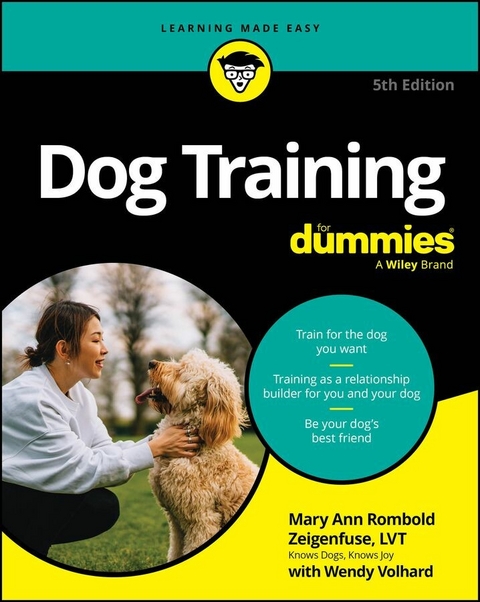
Dog Training For Dummies (eBook)
621 Seiten
For Dummies (Verlag)
978-1-394-35631-7 (ISBN)
A hands-on, step-by-step guide to training dogs, regardless of breed, age, or personality
Wondering how you can get Fido to stop climbing up on the furniture? Hoping that your labradoodle will finally learn how to 'sit' and 'stay?'
In the fifth edition of Dog Training For Dummies, readers will benefit from a compilation of the best, most effective training methods for dogs of all ages, personalities, and breeds. Readers will learn basic training commands, different techniques for obedience training, breed-specific strategies for modifying behavior, and more.
The book explains how to housetrain your dog and changes and adjustments that can be made to create a happier home and environment for your dog. It also shows you how to address the most common problematic dog behaviors, like excessive barking when someone comes to your door.
Inside the book:
- Expert tips for properly socializing your dog to interact with other dogs and people of all ages
- Strategies for improving your dog walking abilities and training your dog for bedtime
- Recommendations for the best dog training and dog management equipment, including the latest tech
Perfect for all dog owners, Dog Training For Dummies covers the tips, tricks, strategies, and techniques you need to understand to make training your dog a rewarding and successful experience.
Mary Ann Rombold-Zeigenfuse, LVT has more than 40 years' experience in dog training. She owns and operates Best Friends Obedience, a top training school in Kentucky.
Wendy Volhard has spent more than 30 years teaching dog owners how to communicate effectively with their pets. She is the creator of the 'Motivational Method,' a unique approach to dog training.
A hands-on, step-by-step guide to training dogs, regardless of breed, age, or personality Wondering how you can get Fido to stop climbing up on the furniture? Hoping that your labradoodle will finally learn how to sit and stay? In the fifth edition of Dog Training For Dummies, readers will benefit from a compilation of the best, most effective training methods for dogs of all ages, personalities, and breeds. Readers will learn basic training commands, different techniques for obedience training, breed-specific strategies for modifying behavior, and more. The book explains how to housetrain your dog and changes and adjustments that can be made to create a happier home and environment for your dog. It also shows you how to address the most common problematic dog behaviors, like excessive barking when someone comes to your door. Inside the book: Expert tips for properly socializing your dog to interact with other dogs and people of all ages Strategies for improving your dog walking abilities and training your dog for bedtime Recommendations for the best dog training and dog management equipment, including the latest tech Perfect for all dog owners, Dog Training For Dummies covers the tips, tricks, strategies, and techniques you need to understand to make training your dog a rewarding and successful experience.
Chapter 1
Dog Training: The Key to Your Dog’s Safety and Your Sanity
IN THIS CHAPTER
Knowing what you're teaching Buddy when you’re training together
Recognizing a well-trained dog
Reviewing the training models
Understanding the six basic commands
Becoming familiar with factors that influence success
Exploring additional training
Getting started
So, you have a dog? You are so lucky. You want to train your dog, right? Lucky dog. There is nothing you can do to build a bond more quickly between you and your dog than training together, working as a team, and spending time productively. Lucky team.
You want your dog to want to be with you, work for you, and then do it all again — for a treat, for praise, for play, because it’s worth your dog’s while. This chapter serves as a jumping-off point as you begin to develop your relationship with your dog. Training can be fun for you and for your dog. The results are what make all the time you put into training your dog worthwhile, but the journey of training is what can be so much fun — spending time with the dog who will become your best friend.
Someone once wrote: “All owners think they have the best dog in the world, and luckily they are all right.” Hence, the role of the dog will be played by your dog, and we refer to them in this book as Buddy, your buddy. Please insert your dog partner’s name where necessary. We want your relationship with your dog to be a joy. No Dog; No Joy! Know Dog; Know Joy!
Understanding Why You’re Training Buddy: To Do Something or Not to Do Something
Your dog is learning from the moment you meet each other, so you want to make sure that you know what they’re learning from you. Are you a pushover, a littermate, or the leader of the pack? You want your dog to see you as the pack leader, the coach. That means you set the rules, what games to play, when to eat, when to sleep, when to exercise, and when to train. Dogs don’t know you’re training them. All they know is you are spending time together, which is magical.
The important question when training your dog is this: Are you training your dog to do something or to not do something? The answer really can be both. You’re teaching Buddy to be a good dog, to do this instead of doing that. To do something would be to sit here while you come in the door and greet your dog. To not do something would be not to jump up as you come in the door. Teaching your dog to sit while greeting you is so much more fun than teaching your dog not to jump up on you. As often as possible, you’re going to teach Buddy what you want them to do rather than what you don’t want them to do.
Identifying a Well-Trained Dog
A well-trained dog is a joy to have around. They’re welcome almost anywhere because they behave around people and other dogs. They know how to stay and come when called. They are a pleasure to take for a walk because they don’t pull and can be let loose for a romp in the park. They can be taken on trips and family outings. They’re a member of the family in every sense of the word. This is your goal for Buddy, to be a well-trained dog!
The most important benefit of training your dog is safety: for you, for others, and for your dog’s own safety. A dog that listens and does what they’re told rarely gets into trouble. A trained dog is a free dog — they can be trusted to stay when told, not to jump on people, to come when called, and to walk nicely with you.
For decades, I (Mary Ann) have taught dog-training classes, private lessons, seminars, and weeklong training camps. Working closely with veterinarians allows me to spend a lot of time doing behavior counseling with their clients. I ask people to tell me what a well-trained dog should look like and what they want to successfully train their dogs to do. They want a dog to be housetrained (Chapter 8 can help you with that task). Sadly, more dogs are given up to shelters for failure to become house-trained than any other issue. After that, in order of importance, a well-trained dog is one who
- Doesn’t jump on people
- Doesn’t pull on the leash
- Does come when called
- Doesn’t beg at the table
- Doesn’t bother guests
Note that these requirements, with one exception, are expressed in the negative — that is, “Dog, don’t do that.” For purposes of training, we express these requirements in the positive — teach your dog exactly what you expect from them. Here’s what the new list of requirements for a well-trained dog looks like:
- Sit when I tell you. (Chapter 11 gives you the how-to.)
- Walk on a loose leash. (Chapter 12 is your go-to.)
- Come when called. (Chapter 10 explains how to teach the Come command.)
- Go somewhere and chill out. (Head to Chapter 13 for more information.)
- Lie down when I tell you and stay there. (Chapter 11 can help.)
The Sit and Down-Stay commands (see Figure 1-1) are the building blocks for a well-trained dog; if Buddy knows these commands and nothing else, you can still live with them. Of course, your Buddy may have some additional issues that need ironing out, some of which are more matters of management than training. (Chapter 11 discusses these essential commands in greater detail.)
© John Wiley & Sons, Inc.
FIGURE 1-1: Well-trained dogs.
For instance, a favorite pastime of some dogs is raiding the garbage. Prevention is the cure here: Put the garbage where your dog can’t get to it. By moving the trashcan to a secured location, you’re managing the environment that fixes the problem. By purchasing a trash container that can’t be raided, again you’re managing the environment and fixing Buddy’s bad behavior. Management is much easier and more quickly successful than having to train an unwanted behavior out of your dog. Of course, teaching the Leave It command and giving Buddy other things to occupy his attention is also great training. Management and training work hand in hand and together result in the best possible dog you can live with and be most proud of.
WHAT IS AN UNTRAINED DOG?
The untrained dog has few privileges. When guests come to visit, they’re locked away because they’re too unruly. When the family sits down to eat, they’re locked up or put outside because they beg at the table. They’re never allowed off leash because they run away and stay out for hours at a time. Nobody wants to take them for a walk because they pull, and they never get to go on family outings because they’re a nuisance.
Dogs are social animals, and one of the cruelest forms of punishment is to deprive them of the opportunity to interact with family members on a regular basis. Isolating a dog from contact with humans is inhumane. Spending quality time with your dog by training them will make them the beloved pet they deserve to be.
Selecting a Training Model
You have many ways to train a dog, ranging from rather primitive to fairly sophisticated. Even technology has had its impact on dog training. For example, rather than fenced yards, people often now have invisible fences, which contain dogs within their confines by means of an electrical shock or tone.
Our approach to training is for people who like their dogs and have them first and foremost as pets and companions or for people who want to like their dogs. Either way, we like your dog and want them to be the best possible dog and you to be the best possible trainer for your dog.
The training involves three phases:
- The teaching phase: In the teaching phase, the dog is taught specific commands in an area free of distractions so they can focus on you and be successful.
- The practicing phase: When the dog reliably responds to the commands they have learned, distractions are introduced (we explain distractions in more detail in Chapter 10). As the dog progresses in this practice phase, the distractions become increasingly more difficult to simulate real-life situations.
- The testing phase: In the testing phase, the dog is expected to demonstrate that they’re a well-mannered pet around other dogs and people.
The ultimate object of any training is to have your dog respond reliably to your commands. Ideally, they respond to your first command. Telling your dog to do something only to have them ignore you is frustrating. Think of Buddy’s response in terms of choices. Do you want to teach Buddy to think they have a choice of responding to you? You want a dog that understands — after you have taught them — that they must do what you tell them, no matter what is happening around them. A truly trained dog listens for your voice above all distractions.
Distractions do cause Buddy to struggle to hear your voice above other things, as does the genetic influence of those things that Buddy was bred to do instinctively, that which is in harmony with Buddy's basic nature. Are all dogs the same to train or does the breed or mixture of breeds make a difference? Like people, dogs are individuals and have individual needs. Understanding breed characteristics and different...
| Erscheint lt. Verlag | 13.10.2025 |
|---|---|
| Sprache | englisch |
| Themenwelt | Sachbuch/Ratgeber ► Natur / Technik ► Natur / Ökologie |
| Sachbuch/Ratgeber ► Natur / Technik ► Tiere / Tierhaltung | |
| Schlagworte | dog behaviors • dog training commands • dog training for beginners • dog training strategies • dog training tips • easy dog training • how do I train my dog? • problem dog behaviors • training big dogs • training old dogs • training small dogs |
| ISBN-10 | 1-394-35631-5 / 1394356315 |
| ISBN-13 | 978-1-394-35631-7 / 9781394356317 |
| Informationen gemäß Produktsicherheitsverordnung (GPSR) | |
| Haben Sie eine Frage zum Produkt? |
 EPUB (Adobe DRM)
Kopierschutz: Adobe-DRM
Adobe-DRM ist ein Kopierschutz, der das eBook vor Mißbrauch schützen soll. Dabei wird das eBook bereits beim Download auf Ihre persönliche Adobe-ID autorisiert. Lesen können Sie das eBook dann nur auf den Geräten, welche ebenfalls auf Ihre Adobe-ID registriert sind.
Details zum Adobe-DRM
Dateiformat: EPUB (Electronic Publication)
EPUB ist ein offener Standard für eBooks und eignet sich besonders zur Darstellung von Belletristik und Sachbüchern. Der Fließtext wird dynamisch an die Display- und Schriftgröße angepasst. Auch für mobile Lesegeräte ist EPUB daher gut geeignet.
Systemvoraussetzungen:
PC/Mac: Mit einem PC oder Mac können Sie dieses eBook lesen. Sie benötigen eine
eReader: Dieses eBook kann mit (fast) allen eBook-Readern gelesen werden. Mit dem amazon-Kindle ist es aber nicht kompatibel.
Smartphone/Tablet: Egal ob Apple oder Android, dieses eBook können Sie lesen. Sie benötigen eine
Geräteliste und zusätzliche Hinweise
Buying eBooks from abroad
For tax law reasons we can sell eBooks just within Germany and Switzerland. Regrettably we cannot fulfill eBook-orders from other countries.
aus dem Bereich