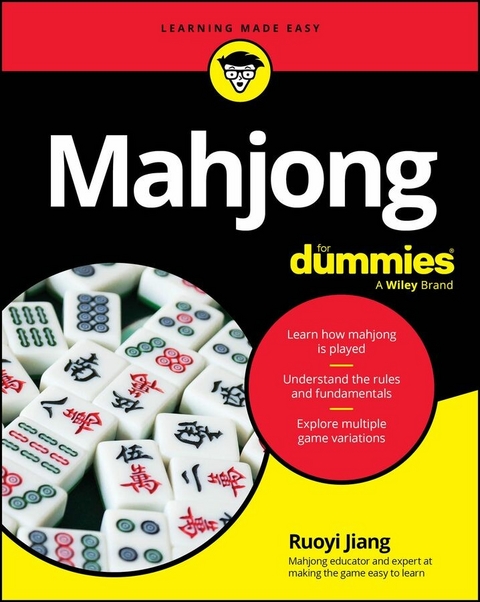
Mahjong For Dummies (eBook)
409 Seiten
For Dummies (Verlag)
978-1-394-33524-4 (ISBN)
Start enjoying mahjong games with family and friends, at local tournaments, and by hosting your own parties
Mahjong For Dummies will teach you how to play traditional Chinese mahjong, American mahjong, and many other variations. This simple book breaks down the rules, explains the different mahjong styles, and offers easy-to-understand explanations and diagrams. Get playing right away, without getting bogged down by technicalities. After all, the essence of mahjong is the shared experience! When you're ready, you can find advanced strategies and more complex rules, clearly explained. Confidently begin playing and organizing your own games, thanks to this clear Dummies guide.
- Learn the rules of mahjong in an accessible and engaging style, with a focus on enjoying the game
- Improve your skill and understanding with charts, diagrams, scorecards, and cheat sheets
- Grasp the game's mechanics so you can make the right decisions, manage risk, and improve your chance of winning
- Read about the cultural context and rich history of Mahjong
Mahjong For Dummies offers something for everyone and is great for complete beginners and experienced players alike.
Ruoyi Jiang is the founder and Creative Director of Chop Suey Club, a platform that promotes and celebrates Chinese-diaspora culture around the world. She introduced a new wave of mahjong culture to the U.S. through immersive classes and curated events.
Start enjoying mahjong games with family and friends, at local tournaments, and by hosting your own parties Mahjong For Dummies will teach you how to play traditional Chinese mahjong, American mahjong, and many other variations. This simple book breaks down the rules, explains the different mahjong styles, and offers easy-to-understand explanations and diagrams. Get playing right away, without getting bogged down by technicalities. After all, the essence of mahjong is the shared experience! When you're ready, you can find advanced strategies and more complex rules, clearly explained. Confidently begin playing and organizing your own games, thanks to this clear Dummies guide. Learn the rules of mahjong in an accessible and engaging style, with a focus on enjoying the game Improve your skill and understanding with charts, diagrams, scorecards, and cheat sheets Grasp the game's mechanics so you can make the right decisions, manage risk, and improve your chance of winning Read about the cultural context and rich history of Mahjong Mahjong For Dummies offers something for everyone and is great for complete beginners and experienced players alike.
Introduction
“十亿人民九亿麻,还有一亿在观察”
“Among a billion people, nine hundred million are playing mahjong, and the rest are watching.”
— CHINESE SAYING
Congratulations on opening the door to the fascinating world of mahjong! The moment you picked up this book, you joined a lineage of players stretching across centuries and continents.
I didn’t start playing mahjong until my thirties. Growing up in Beijing, I watched neighbors shuffle tiles deep into the night, clouds of cigarette smoke curling above the table. My family, convinced mahjong was a corruptive pastime, never let me learn the game. To them, mahjong meant gambling, noise, and bad habits. And they weren’t entirely wrong.
Mahjong’s very design is tied to money. The suits — Dots, Bamboos, and Characters — symbolize old Chinese coins, strings of coins, and a myriad of coins. Even the square table echoes the round coin with its square center. The scoring system is built on risk, stakes, and exchange. Small sums of cash sharpen attention: Every mistake has a cost, every win carries weight. In entrepreneurial cultures like China, where fortune favors the bold, many won’t play without money on the table. Even the American version reflects this — its 25-point increments trace back to quarters.
So yes, mahjong’s reputation as a form of gambling has roots. But at heart, it is a deeply social pastime, perfect for laughter, rivalry, and connection.
Years later, in New York, a friend gifted me a mahjong table. Suddenly, the sounds and rhythms of my childhood came rushing back. I’ll never forget my first real win — the tile I needed falling onto the table in slow motion, the rush of disbelief as I added it to my hand.
This late start gave me a beginner’s perspective, which is why I understand how overwhelming the rules can feel at first: the Winds, the wall, the etiquette. But with time, the rhythms become second nature. That’s why I wrote this book, for people like me: curious, determined, and starting fresh.
At its simplest, mahjong is a four-player game of pattern-making. You draw and discard tiles until you’ve assembled a winning hand. It’s luck, yes — but also memory, psychology, and strategy.
Mahjong is not one single game but a family of games with a shared ancestry. When someone says, “I know how to play mahjong,” you always have to ask: which kind?
Mahjong’s roots are in China, blossoming in the late Qing Dynasty from older card games like madiao (马吊), which already featured suits that resemble today’s tile groups. As the game spread through teahouses and port cities, flimsy paper gave way to sturdy bone-and-bamboo tiles, better for boisterous players and the sea winds. From there, mahjong became a cultural traveler, shaped not by one inventor but by countless communities.
In the 1920s, a Japanese soldier brought mahjong to Japan, where a teacher codified it into Japanese Riichi mahjong At the same time, American merchants ferried sets overseas, where Jewish women streamlined the rules and founded the National Mah Jongg League. In wartime Sichuan, players stripped away suits to create a lightning-fast “blood battle.” Taiwanese players expanded hand size to heighten drama. Across Southeast Asia, quirky versions added Animal tiles and wildcards. Each community carved the game anew and left its mark.
That’s why mahjong has never been frozen in time — it is alive and constantly evolving, which is why today you’ll find not just one version but a dazzling variety of rule sets and traditions.
About This Book
I don’t attempt to cover every variant in this book. Instead, I’ve chosen seven of the most distinctive and widely played — the ones you’re most likely to encounter in families, clubs, or online:
- Cantonese Mahjong (Old Hong Kong Style): The “mother” of many styles, elegant and straightforward, globally widespread
- American Mah Jongg (National Mah Jongg League): Racks, Jokers, Charleston passing, and the yearly card
- Japanese Riichi: Competitive, dramatic, and mathematical, with betting sticks and unique Yaku Dora rules
- Taiwanese Mahjong: Largest hand with 16 tiles, rewarding boldness and complexity
- Sichuan Mahjong (Blood Battle): Fast-paced with the fewest tiles played, famous for the continuous-play format
- Singapore and Malaysian Mahjong: Playful bonus tiles and allows for three-player games
- Vietnamese Mahjong: With the largest tile count, emphasizing bonus scoring
Beneath all these variations, the essence remains: Mahjong is a social game. The four-player structure is no accident — it’s a scientifically harmonious genius design. Anthropologists describe four as the first true “society”: stable enough for roles and rhythms to form, yet dynamic enough for shifting alliances and rivalries in balance. Mathematically, the geometry of the square table and the rotation of Winds encode balance and symmetry, with each player aligned to a point on the compass. Even the rhythm of drawing and discarding beats like four chambers of a heart.
This harmony of four explains why mahjong feels alive in a way few other games do. Players don’t just sit around a table; they form a living square, constantly reshaping each other’s choices. Mahjong is not merely played; it is enacted — a choreography of balance and disruption within the square of four.
This is also why mahjong has historically been a stage for more than just play. In The Joy Luck Club, women gather to share survival and secrets through the tiles. In The Marvelous Mrs. Maisel, Jewish women cement friendships and influence over mahjong tables. In Crazy Rich Asians, mahjong becomes an allegory: Sometimes the real victory is in letting go of small wins. From immigrant women exchanging support to wives of officials trading information behind closed doors, the mahjong table has long been a site of community, strategy, and power.
There are books about mahjong’s history, and others devoted to specific styles, especially American Mah Jongg. What I couldn’t find was a clear, approachable guide that
- Starts from zero with detailed step-by-step instructions
- Respects cultural depth without being academic
- Compares distinctive styles side by side
- Explains not just how but also why rules exist
- Incorporates bilingual terminology for quick reference
When I was first learning the game, I made my own diagrams and cheat sheets. That pamphlet grew into this book: a companion written by someone who was once just as confused as any first-timer.
This book is for that curious first-timer, the second-generation kid reconnecting with family, the American player branching out, the intercultural family bridging traditions, the gamer adding mahjong to their repertoire — anyone who wants a reason to gather friends and laugh around a table.
I also wrote it for bilingual learners. Each style includes terminology in both English and the original language (Chinese, Japanese, or Vietnamese), bridging language gaps and making teaching easier.
Here’s what you’ll find in the chapters ahead:
- Tiles and setup: How to identify every tile, build the wall, and deal hands
- Game flow: How turns work, how to draw, discard, and call tiles
- Winning hands: Essential patterns and how to assemble them
- Scoring: From basic calculation to special multipliers, broken down simply
- Strategies: How to read the table, defend, and know when to risk big or play it safe
- The “Big Seven” variants: Cantonese, American (NMJL), Japanese Riichi, Taiwanese, Sichuanese, Singapore/Malaysian, and Vietnamese
- Extras: Etiquette, how to host a mahjong night, where to play online, and cultural trivia
You’ll also find diagrams, cheat sheets, cultural notes, and strategy tips.
On thing I will stress time and again over the course of this book is the following: For those who are learning to play with friends or family, check which style they are playing because the styles are not interchangeable. An American Mah Jongg player may not know Chinese mahjong, and vice versa. Don’t stress about memorizing every rule; most exist to ensure fairness. In practice, table agreements matter more than written law, and they often shift by region, neighborhood, or household. When in doubt, always ask your fellow players.
Mistakes will happen — sometimes funny, sometimes frustrating. But the more you play, the more natural it feels. By the end of this book, you won’t just know the rules — you’ll know how to sit down with confidence, adapt to different styles, and, most importantly, enjoy yourself. Because once you shout “Mahjong!” for the first time, you’ll be hooked.
Conventions Used in This Book
No, not mahjong conventions yet! You’ll be introduced to those as you make your way through the book proper. The conventions I mean here are ones that enable you to navigate this book as easily as possible.
For example, when I describe the steps you need...
| Erscheint lt. Verlag | 13.10.2025 |
|---|---|
| Sprache | englisch |
| Themenwelt | Sachbuch/Ratgeber ► Freizeit / Hobby ► Spielen / Raten |
| Schlagworte | American mahjong • american mahjong book • American Mah Jongg • beginner mahjong • Chinese mahjong • how play mahjong • Mahjong • mahjong book • mahjong for beginners • mah jongg book • mahjong rules • mahjong strategy • play mah jongg |
| ISBN-10 | 1-394-33524-5 / 1394335245 |
| ISBN-13 | 978-1-394-33524-4 / 9781394335244 |
| Informationen gemäß Produktsicherheitsverordnung (GPSR) | |
| Haben Sie eine Frage zum Produkt? |
 EPUB (Adobe DRM)
Kopierschutz: Adobe-DRM
Adobe-DRM ist ein Kopierschutz, der das eBook vor Mißbrauch schützen soll. Dabei wird das eBook bereits beim Download auf Ihre persönliche Adobe-ID autorisiert. Lesen können Sie das eBook dann nur auf den Geräten, welche ebenfalls auf Ihre Adobe-ID registriert sind.
Details zum Adobe-DRM
Dateiformat: EPUB (Electronic Publication)
EPUB ist ein offener Standard für eBooks und eignet sich besonders zur Darstellung von Belletristik und Sachbüchern. Der Fließtext wird dynamisch an die Display- und Schriftgröße angepasst. Auch für mobile Lesegeräte ist EPUB daher gut geeignet.
Systemvoraussetzungen:
PC/Mac: Mit einem PC oder Mac können Sie dieses eBook lesen. Sie benötigen eine
eReader: Dieses eBook kann mit (fast) allen eBook-Readern gelesen werden. Mit dem amazon-Kindle ist es aber nicht kompatibel.
Smartphone/Tablet: Egal ob Apple oder Android, dieses eBook können Sie lesen. Sie benötigen eine
Geräteliste und zusätzliche Hinweise
Buying eBooks from abroad
For tax law reasons we can sell eBooks just within Germany and Switzerland. Regrettably we cannot fulfill eBook-orders from other countries.
aus dem Bereich