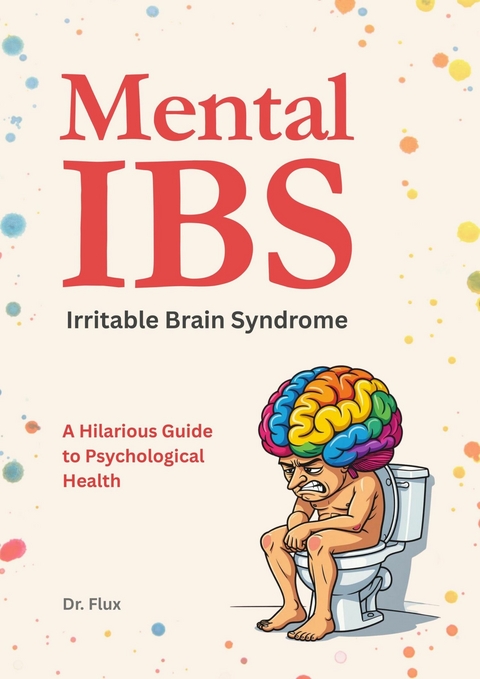
Mental IBS - Irritable Brain Syndrome (eBook)
175 Seiten
Publishdrive (Verlag)
978-0-00-107874-1 (ISBN)
Your therapist keeps asking if you've 'processed' your feelings. Your gastroenterologist keeps asking if you're 'regular.' Plot twist: they're asking the same question.
Welcome to the uncomfortable truth that your gut and brain are basically twins-one processes burritos, the other processes your ex's Instagram stories at 2 AM. Both will stage midnight revolts if you keep feeding them garbage.
Dr. Flux diagnoses the mental maladies you didn't know had names: Cognitive Constipation (hoarding grudges from 2015 like winning lottery tickets), Deliberation Diarrhea (voice notes requiring intermission breaks), Impression Indigestion (binging podcasts while your own life remains undigested), and Leaky Mind Syndrome (absorbing everyone's trauma until you're spiritually waterlogged).
Part comedy, part intervention, this book offers actual treatment protocols disguised as savage humor-from emergency procedures for emotional flatulence to detox plans for the experientially obese but wisdom-malnourished.
Your colon processed last Tuesday's lunch in 12 hours. Your brain is still running highlight reels from 2012. One organ understands its job. The other needs this book.
Cognitive Constipation
When the Mind Forgets How to Let Go
Breaking News
Local Man's Opinions Declared Historical Landmarks:
The Preservation Society announced today that Richard M.'s political views, formed entirely during his freshman year of college in 2009, have been officially declared historical landmarks and will be protected from any attempts at renovation or demolition.
"These beliefs have remained structurally unchanged for fifteen years," said the Society's spokesperson. "They represent a remarkable example of cognitive architecture from the late 2000s and must be preserved exactly as they are, despite significant foundation cracks and obvious deterioration."
When asked if he'd consider updating his worldview based on new information, Richard responded, "These are my deeply held convictions," while clutching a printed-out blog post from 2010.
The Society is currently evaluating several other candidates for landmark status, including Sarah P.'s parenting philosophy (based entirely on one book she skimmed) and David L.'s financial advice (based entirely on his uncle's opinion about cryptocurrency in 2017).
~ Cerebral News Network
Where every headline is a cry for help.
Are your thoughts feeling stuck?
Your intestines know something your brain has forgotten: what goes in must come out.
Right now, your gut is performing peristalsis—rhythmic contractions gently escorting yesterday's lunch toward its porcelain destiny. It's the conga line of digestion, happening without your permission, applause, or conscious involvement. Your colon doesn't preserve last Tuesday's sandwich as a memento of nutritional achievement. It extracts what's useful and releases the rest with dignified efficiency.
Meanwhile, upstairs in the penthouse suite of your skull, your brain is death-gripping a grudge from 2015 like it's a winning lottery ticket.
Just as you don't need to clench your rectum to benefit from digestion—a practice that would lead to uncomfortable consequences—you don't need to grip your thoughts with white-knuckled desperation to prove you've understood them. Yet here we are: an entire civilization of cognitive constipates, holding onto yesterday's insights like miserly dragons hoarding outdated treasure, clinging to last decade's heartbreak as if it were a sacred relic, gripping yesterday's anger as though releasing it might somehow invalidate the experience.
Welcome to cognitive constipation—where minds forget how to let go, and yesterday's wisdom fossilizes into tomorrow's dysfunction.
The Great Mental Backup
The tragedy of our time isn't that we lack wisdom; it's that we're so backed up with old wisdom, outdated emotions, and unprocessed experiences that there's no room for new understanding to flow through us. We've become ideological and emotional hoarders, cramming our mental cavities with concepts we collected decades ago and feelings we've been marinating in since adolescence, afraid that releasing them might somehow diminish our intellectual worth or emotional authenticity.
Consider the beautiful efficiency of your colon. It doesn't frame last Tuesday's sandwich as a memento of nutritional achievement. It doesn't create a shrine to honour Wednesday's lunch. It doesn't wake up at 3 AM wondering if it made the right choice letting go of that burrito from 2019.
It extracts what's useful, processes what's necessary, and releases the rest with zero emotional attachment. Stool is simply evidence that transformation occurred—not a trophy to preserve, not a monument to the past, not proof that you once ate well.
Meanwhile, your brain is still processing that argument from freshman year, preserving it like a sacred artifact in the museum of your grievances.
Similarly, the concepts we hold onto so tightly—and the emotional residue we carry from years ago—are merely the byproducts of digesting experience. That breakthrough you had about forgiveness three years ago? It was meant to flow through you, not set up permanent residence in your mental tract. That painful betrayal from your twenties? Its wisdom was extracted long ago; what remains is simply emotional waste waiting for release. You don't need to mount yesterday's insight in your conscious awareness like a deer head on a wall to prove you once had a moment of understanding, nor do you need to preserve yesterday's hurt as evidence that you once felt deeply.
The Whispers of Fear
But fear—that great constipator of both bowels and brains—whispers seductive lies. "Hold on," it murmurs. "If you let go of this belief, this identity, this carefully constructed worldview, this justified resentment, or this precious anger, who will you be? What will you have to show for all the experience you had?" And so we clench. We hold. We create what we might call ideological and emotional impaction, afraid that being empty means being stupid or unfeeling.
The constipated mind clings to old truths and ancient wounds like a colon clings to last week's curry—desperately, counterproductively, and with increasingly uncomfortable consequences. What begins as a reasonable desire to preserve valuable insights and honor meaningful experiences transforms into something resembling intellectual and emotional hoarding, where outdated knowledge and fossilized feelings accumulate in the corridors of thought like newspapers in the home of someone who's forgotten that information has an expiration date.
Case Study: David, 72, a retired civil engineer, interrupted his granddaughter’s climate presentation at a family gathering to deliver a 28-minute monologue on the reliability of 1970s weather patterns and the moral superiority of rotary phones. He later emailed the entire extended family a scanned copy of a 1983 Reader’s Digest article titled “Why Progress Is Overrated.” The teenager’s presentation was for her Grade 11 science fair.
Diagnosis: Fossilized Cognitive Schema with Chronic Epistemic Inflexibility (FCS-CEI™)The Unmistakable Symptoms
The symptoms are unmistakable once you know what to look for. Just as physical constipation creates a cascade of digestive dysfunction, cognitive constipation manifests its own telltale signs:
Retention becomes the enemy of absorption. Stool held too long hardens and blocks the system's ability to process new nutrition. Ideas and emotions held too tightly undergo a similar transformation, calcifying into rigid beliefs and chronic resentments that resist the flow of fresh perspective. You become so committed to defending old insights and nursing old hurts that you can't recognize new experiences when they arrive bearing gifts.
Discomfort announces itself with increasing urgency. Physical constipation brings bloating and cramps; cognitive constipation brings mental heaviness and the peculiar frustration of feeling experientially full yet somehow unsatisfied. You're carrying around all this accumulated knowledge and unprocessed emotion, yet it feels more like baggage than wisdom, more like bloating than satisfaction.
The system loses its ability to discriminate. A constipated gut can't properly distinguish between nutrients and waste; a constipated mind can't differentiate between wisdom worth keeping and mental debris ready for release, between experiences that deserve continued attention and emotional waste products that have overstayed their welcome. Everything feels equally important, equally urgent, equally worthy of preservation.
An urgency for release without expulsion becomes the norm. You strain and push, overthinking without resolution—trying to force yesterday's thoughts and last year's feelings through today's experience. It's the mental equivalent of an hour on the toilet, yielding nothing but hemorrhoids and frustration.
Toxicity builds as the system reabsorbs what it should have released. Old waste products poison the physical system; old narratives and unprocessed emotions poison the mental one. Stories that should have been composted into wisdom instead ferment into bitterness, outdated beliefs into dogma, and ancient hurts into perpetual victimhood.
The False Satisfaction of Mental Bloating
Perhaps most insidiously, cognitive constipation creates a false sense of fullness that we mistake for wisdom. "I don't need new perspectives," the constipated mind announces proudly. "I'm already full of ideas!"
Yes. Full of ideas the same way a backed-up septic system is full of waste. The fullness isn't nourishment—it's blockage. You're not wise; you're impacted.
There's a profound difference between being full of sh*t and being nourished, between being packed with unexamined information and being genuinely wise, between being backed up with unprocessed experience and enriched by learning from life.
Your mind mistakes the discomfort of mental bloating for the satisfaction of genuine understanding—like confusing eating an entire pizza with actually absorbing its nutrients. One is temporary fullness that ends in regret. The other is sustained energy that serves your function.
The constipated mind doesn't need more ideas. It needs to process the ones it already has, extract whatever wisdom remains, and eliminate the rest with the same efficiency your colon applies to yesterday's meals.
The constipated mind exhibits several characteristic behaviors that would be comical if they weren't so tragically common. The first is intellectual hoarding, which manifests as the compulsive collection of quotes, articles, and concepts that we bookmark, screenshot, and save "for...
| Erscheint lt. Verlag | 6.10.2025 |
|---|---|
| Sprache | englisch |
| Themenwelt | Sachbuch/Ratgeber ► Gesundheit / Leben / Psychologie ► Lebenshilfe / Lebensführung |
| ISBN-10 | 0-00-107874-7 / 0001078747 |
| ISBN-13 | 978-0-00-107874-1 / 9780001078741 |
| Informationen gemäß Produktsicherheitsverordnung (GPSR) | |
| Haben Sie eine Frage zum Produkt? |
 EPUB (Adobe DRM)
Größe: 330 KB
Kopierschutz: Adobe-DRM
Adobe-DRM ist ein Kopierschutz, der das eBook vor Mißbrauch schützen soll. Dabei wird das eBook bereits beim Download auf Ihre persönliche Adobe-ID autorisiert. Lesen können Sie das eBook dann nur auf den Geräten, welche ebenfalls auf Ihre Adobe-ID registriert sind.
Details zum Adobe-DRM
Dateiformat: EPUB (Electronic Publication)
EPUB ist ein offener Standard für eBooks und eignet sich besonders zur Darstellung von Belletristik und Sachbüchern. Der Fließtext wird dynamisch an die Display- und Schriftgröße angepasst. Auch für mobile Lesegeräte ist EPUB daher gut geeignet.
Systemvoraussetzungen:
PC/Mac: Mit einem PC oder Mac können Sie dieses eBook lesen. Sie benötigen eine
eReader: Dieses eBook kann mit (fast) allen eBook-Readern gelesen werden. Mit dem amazon-Kindle ist es aber nicht kompatibel.
Smartphone/Tablet: Egal ob Apple oder Android, dieses eBook können Sie lesen. Sie benötigen eine
Geräteliste und zusätzliche Hinweise
Buying eBooks from abroad
For tax law reasons we can sell eBooks just within Germany and Switzerland. Regrettably we cannot fulfill eBook-orders from other countries.
aus dem Bereich