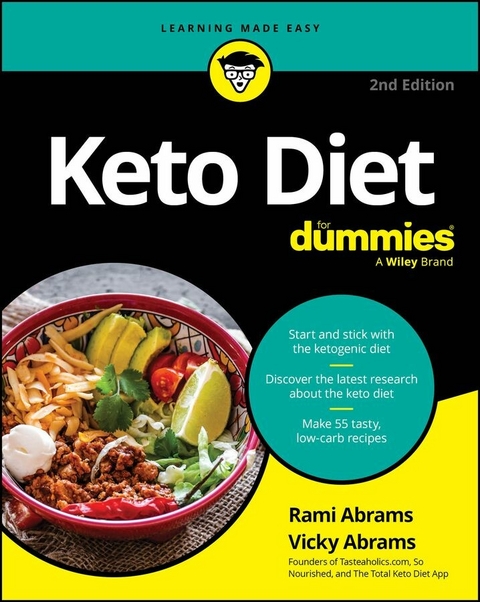
Keto Diet For Dummies (eBook)
484 Seiten
For Dummies (Verlag)
978-1-394-36646-0 (ISBN)
Learn about the benefits of going keto, and boost your health with a personalized diet plan
Keto Diet For Dummies is your updated guide to the low-carb, high-fat ketogenic diet. It's a great time to try this healthful approach, thanks to new research, new recipes, and new keto products on the market. In this book, you'll find easily digestible info on how the keto diet trains your body to rely on fat as its energy source, for weight loss, reduced inflammation, improved mental health, and a host of other benefits. Then, the expert authors help you create the perfect keto plan to be the healthiest version of yourself. You'll even learn how to use AI to help you plan and prep great keto meals. What a time to be alive!
- Discover the latest science on the benefits of a low-carb, high-fat diet
- Get delicious keto recipes and meal planning ideas for every occasion
- Learn how to test your ketones and gently adapt to ketosis
- Find guidance for talking to your doctor about a keto lifestyle
For those who want to learn about the keto diet, get started, and reap the benefits so many others have enjoyed, Keto Diet For Dummies is the perfect place to begin.
Rami and Vicky Abrams are the co-founders of Tasteaholics.com, a popular low-carb diet resource packed with research-heavy articles, recipes, and more. They created the keto cookbook series Keto in Five and are the authors of the bestselling first edition of Keto Diet For Dummies.
Chapter 1
Brushing Up on the Basics
IN THIS CHAPTER
Getting acquainted with keto
Pondering whether you and keto are a good match
Getting to ketosis
Staying positive
Keto has become quite popular over the past several years, but what do you really know about this seemingly trendy dietary lifestyle? Is keto truly worth the hype, and is it really a healthy way to lose weight? We’re here to help you figure out if keto is right for you and the basic steps of following a keto lifestyle safely and effectively. In this chapter, we cover the nuts and bolts of the keto lifestyle and get you ready to go, with a clear sense of the benefits of making a keto choice.
Understanding What the Keto Diet Is
The ketogenic diet (or keto diet for short) is an exceptionally well-researched and proven method to start working with your body, rather than against it, to improve your health. Following the basic rules of the keto lifestyle can help you
- Feel more energized.
- Lose weight faster.
- Improve the health of your heart.
- Sharpen your mental focus.
In addition to these benefits, there are a host of other long-term benefits that will leave you jumping for joy. Though it’s become popular recently, the keto diet has been used for almost a hundred years to heal and prevent disease — that’s a long track record of benefits.
In a nutshell, the keto diet is
- High fat
- Moderate protein
- Very low carbohydrate
Having grains and carbohydrates form the basis of every meal may seem like contemporary wisdom, but for most of human history, this wasn’t the case. Processed and easily digested carbohydrates fuel weight gain and unhealthy spikes in blood sugar with each bite; over the course of a lifetime, this destroys your health.
The keto diet puts your body into ketosis, a process where you use fats, rather than sugars from carbohydrates, to fuel your body. On the keto diet, you learn to turn nutritional powerhouses — fats — into the basis of your meals.
In this chapter, and again in Chapter 3, we allay the fears that are commonly encountered when we talk about eating fat. The truth is that fat really isn’t to blame for the increasingly common problems of obesity and being overweight that you always hear about. Fat is actually very good for you, keeps you feeling fuller longer, helps you lose weight, and improves your health over the long term.
There are a lot of misconceptions about nutrition in general, and the keto diet in particular. In this book, we wade through the incessant chatter about what you should and shouldn’t eat to get to the meat of it all (pun intended). The keto lifestyle is much more than the “bacon wrapped in cheese” memes will have you believe — although you can eat cheese and bacon. It won’t wreak havoc on your heart or blood vessels, nor will it increase your cholesterol levels if you follow a whole-food-based keto lifestyle.
Despite what many of us have been told for decades, we don’t need to eat many carbohydrates as part of a healthy lifestyle. Instead, eating a range of whole keto foods can be the key to healthy living. Keto is a flexible and adventurous lifestyle that isn’t a one-size-fits-all plan; there are several different varieties to fit with your lifestyle and goals.
In the following sections, we look at the various options available, how they’re different, and what each has to offer.
THE HISTORY OF KETO
The ketogenic diet has been around in one form or another for thousands of years; in fact, the first mention of this way of eating was found in Greek medical texts from 400 B.c. The diet was formally created and named a century ago by medical doctors who were seeking an innovative way to treat epilepsy in children. It was very successful, although the medical community didn’t completely understand how it worked — they simply knew that consuming a high-fat, low-carbohydrate diet drastically reduced, and occasionally even eliminated, the number of seizures epileptic patients experienced.
The diet became less popular in the 1930s and 1940s as antiseizure drugs were invented. The primary selling point for these medications was their convenience, not necessarily their effectiveness. Keto is still so effective that it’s nearly always what doctors turn to in cases of intractable epilepsy, a version of the condition that is unaffected by medication. In these cases, keto nearly always works. The primary objection to the diet, and why it fell out of favor in the 1930s and 1940s, is that it requires quite a bit of dedication and discipline to cook in a way that’s completely different from the way the rest of society approaches food. The benefits are undeniable, but it does take effort — and if you can treat epilepsy by simply popping a pill, that’s a much more convenient approach than totally revamping your diet. For the approximately 30 percent of epileptic patients for whom medication has no effect, however, keto offers much-needed relief.
Between the 1940s and the 1990s, the ketogenic diet fell into some level of obscurity. It was still used in the medical community, but sparingly, and it didn’t generate a tremendous amount of discussion. That changed in the mid-1990s when Hollywood director Jim Abrahams discovered the diet as he desperately searched for treatments that would help his epileptic son. The Abrahams found keto to be so effective that Jim created the Charlie Foundation, named after his child, to bring the eating approach back as a mainstream treatment. Abrahams’s efforts marked a resurgence of interest in ketosis, and over the next several decades, thousands of studies were conducted on the ketogenic diet by the medical and scientific community.
As the diet’s resurgence continued, people began to notice that it had uses beyond preventing seizures. In the early 1900s, the prevalence of diabetes was roughly 3 in 100,000; a hundred years later, however, nearly 1 in 10 Americans are diabetic or prediabetic. Those who began trying ketosis were shocked by the results: Not only did it help more than 90 percent of type 2 diabetics reduce their medication, but more than half of type 2 diabetics who stuck with the low-carb, high-fat lifestyle experienced such an incredible reduction in their HbA1C levels (the primary marker of diabetes) that their condition was effectively reversed!
The diabetic community reacted with understandable excitement, and people began to notice other effects. Individuals who stayed on the ketogenic diet watched excess pounds melt away, and they naturally assumed a healthy body weight, regardless of age, gender, race, or ethnicity — it didn’t even seem to matter if someone exercised or not. Keto was conducive to maintaining ideal body fat percentages.
Weight loss is a multibillion-dollar industry, so this discovery spurred a tremendous amount of interest. New research began to discover that this way of eating lowered low-density lipoprotein (LDL) cholesterol (the bad kind) and raised high-density lipoprotein (HDL) cholesterol (the good kind), which completely shocked the diet community of the 1990s. Women who suffered from polycystic ovary syndrome (PCOS) experienced a reduction in symptoms, and studies confirmed that aspiring mothers who struggled with fertility issues had statistically significant improved rates of conception while eating low-carb.
Stories of people beating cancer with keto began to surface, and, as you can imagine, this generated quite the buzz in the medical community. Studies found that keto wasn’t a cure for cancer, but it did have several remarkable effects. The first was that many cancerous tumors feed almost exclusively on glucose but can’t be fueled by ketones; when patients transitioned to a different way of eating, even some aggressive forms of cancer stopped growing, giving traditional medical treatments more time to work. Studies also confirmed that a ketogenic lifestyle made tumors more sensitive to radiation and chemotherapy — not only did the diet give the medical community more time to work, but it actually assisted their efforts.
Standard ketogenic diet
The standard ketogenic diet is the basic version of the keto diet. It’s been around the longest and has the most evidence and research behind it. If you’re thinking about keto, you need to be very familiar with the standard ketogenic diet. It clearly breaks down the sources of your daily calorie intake, as follows:
- Fat: 70 percent
- Protein: 25 percent
- Carbohydrates: 5 percent
Historically, on this diet, you’ll generally eat about 25 grams of carbohydrates per day. However, we live in more flexible times, and some people eat as much as 50 grams per day. That’s okay, because most people stay in ketosis on 50 grams of carbs a day, so they don’t need to limit their carbs anymore. Over time, you’ll figure out what works best for you.
The amount of daily carbs is, at most, only a fifth of what many Americans eat. On the standard American diet, you get about 30 percent of calories from fat, 20 percent from protein, and 50 percent (or more) from carbohydrates. That means most Americans are eating about 250 grams of carbs or more per day. As you can imagine, making such a radical change from a carb-based...
| Erscheint lt. Verlag | 8.10.2025 |
|---|---|
| Sprache | englisch |
| Themenwelt | Sachbuch/Ratgeber ► Gesundheit / Leben / Psychologie ► Ernährung / Diät / Fasten |
| Medizin / Pharmazie | |
| Schlagworte | beginner keto diet • gifts for keto friends • keto diet • keto diet beginners • keto for beginners book • ketogenic cookbook • Ketogenic diet • ketogenic diet food • ketogenic diet for beginners • ketogenic guide • keto guide for beginners • ketosis diet products |
| ISBN-10 | 1-394-36646-9 / 1394366469 |
| ISBN-13 | 978-1-394-36646-0 / 9781394366460 |
| Informationen gemäß Produktsicherheitsverordnung (GPSR) | |
| Haben Sie eine Frage zum Produkt? |
 EPUB (Adobe DRM)
Kopierschutz: Adobe-DRM
Adobe-DRM ist ein Kopierschutz, der das eBook vor Mißbrauch schützen soll. Dabei wird das eBook bereits beim Download auf Ihre persönliche Adobe-ID autorisiert. Lesen können Sie das eBook dann nur auf den Geräten, welche ebenfalls auf Ihre Adobe-ID registriert sind.
Details zum Adobe-DRM
Dateiformat: EPUB (Electronic Publication)
EPUB ist ein offener Standard für eBooks und eignet sich besonders zur Darstellung von Belletristik und Sachbüchern. Der Fließtext wird dynamisch an die Display- und Schriftgröße angepasst. Auch für mobile Lesegeräte ist EPUB daher gut geeignet.
Systemvoraussetzungen:
PC/Mac: Mit einem PC oder Mac können Sie dieses eBook lesen. Sie benötigen eine
eReader: Dieses eBook kann mit (fast) allen eBook-Readern gelesen werden. Mit dem amazon-Kindle ist es aber nicht kompatibel.
Smartphone/Tablet: Egal ob Apple oder Android, dieses eBook können Sie lesen. Sie benötigen eine
Geräteliste und zusätzliche Hinweise
Buying eBooks from abroad
For tax law reasons we can sell eBooks just within Germany and Switzerland. Regrettably we cannot fulfill eBook-orders from other countries.
aus dem Bereich