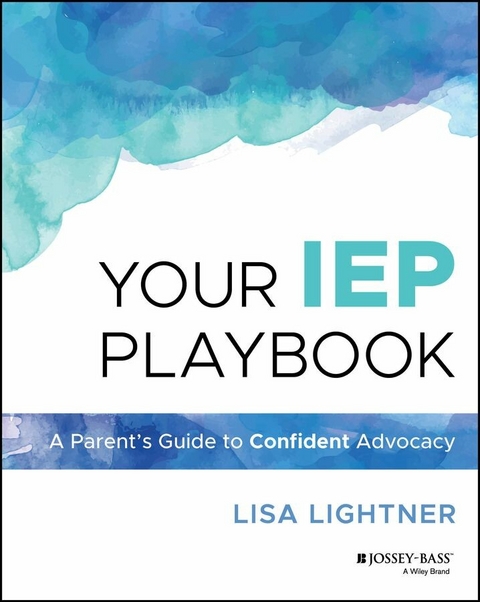
Your IEP Playbook (eBook)
327 Seiten
Jossey-Bass (Verlag)
978-1-394-29448-0 (ISBN)
An easy-to-understand guide to navigating and implementing your child's individualized education plan (IEP)
In Your IEP Playbook: A Parent's Guide to Confident Advocacy, disability parent and special education advocate Lisa Lightner delivers a practical guide for parents and caregivers of children with disabilities doing their best to navigate their individualized education plans (IEPs). This collection of realistic and implementable advice walks you through how to apply federal and state law in your unique situation, develop an advocacy strategy that works, and collaborate with schools and the professionals involved in your child's education.
You'll learn about common mistakes made by people advocating for a child with special education needs and how to avoid them. You'll also discover how to ensure that your child's needs and priorities aren't overlooked or under-supported. The book also contains:
- Advice on how to break down and understand the different parts of an IEP, including what they mean, how to read one, and what to document
- Guidance and reproducible exercises to determine, reach, and monitor progress of IEP goals
- Strategies for composing advocacy letters to your child's school and how to time them for maximum impact
Perfect for the parents and guardians of pre-K to grade 12 children with special needs, Your IEP Playbook is also a must-read for special education teachers, case workers, and people advocating for children in foster care.
Lisa Lightner, disability parent and special education advocate, is founder of A Day in Our Shoes. A Day in Our Shoes helps parents navigate the individualized education program (IEP) for their kids. She has testified in front of state senate committees and been featured in numerous media publications. Visit https://adayinourshoes.com to learn more about her work.
Introduction
“Well behaved women seldom make history.”
—Laurel Thatcher Ulrich
In the 1950s, a mother named Gladys brought her eight-year-old son Billy* to their neighborhood elementary school in a small Pennsylvania town. At the time, state law required children to be enrolled in school by age eight, and since Gladys had not yet enrolled Billy, she faced the possibility of fines or even arrest.
But Gladys wasn’t neglectful or unaware. Billy was intellectually disabled, and she knew—just from living in that community—that the local school had nothing to offer him. There were no special education classrooms, no individualized support, no expectation that children like Billy could learn. In the 1950s, it was assumed that intellectually disabled people were “uneducable” which is a damaging stigma that still exists today. Still, she did what she could: She walked into the principal’s office and said, “I want you to meet my son Billy. He’s eight years old, but I’m not enrolling him. You don’t have anything for him here, and I don’t want to get arrested for not sending him.”
The principal didn’t argue. He didn’t try to convince her otherwise. He simply replied, “You’re right. We don’t have anything for him here. But don’t worry, I won’t report you.”
And that was it. Gladys took Billy home, and he never received a public education. At the time, schools weren’t legally required to serve disabled students, and children like Billy were often labeled “uneducable” by doctors and teachers. There was no IDEA, no FAPE, no system of support. Just doors quietly—and permanently—closed.
The Individuals with Disabilities Education Act (IDEA) wouldn’t become law for another 20 years. By that time, Billy was an adult.
This anecdote is a true story. I heard Gladys share it in person at a fundraising dinner. She has since passed away, but her story has stayed with me. Gladys spent her entire life fighting for children like Billy, and her courage in the face of institutional failure inspires me to this day.
I’ve been a professional Special Education Advocate since 2010, and while I often say that my disabled son is my inspiration, it’s moms like Gladys who keep me going. In most households, the burden of all the “IEP stuff” falls on moms instead of dads. Most special education advocates are women. I sometimes get pushback for pointing this out, but it’s not a criticism of anyone. It’s just what “is.” By and large, all of this is done by women. The PARC decree came about because of women/moms and that is what set the foundation for IDEA and special education as we know it today.
If Gladys could stand up to a system that outright refused to educate her child, despite having no legal protections or allies, then surely I can do something.
So, welcome to my “something.” This book is one way of contributing to the fight for children like Billy, my son, and your child.
In 1972, Pennsylvania finally implemented a special education law, just three years before IDEA was signed into law by President Gerald Ford in 1975. These laws didn’t come about because lawmakers suddenly had a change of heart. They came about because parents like Gladys refused to stay silent. They believed in their children’s potential and demanded that the world see it too.
Progress and Persistent Challenges
As this book goes to print, we are celebrating the 50th anniversary of IDEA. In many ways, we’ve come a long way. Public schools can no longer legally deny children with disabilities the right to an education. We have legal frameworks that outline parents’ rights, the services schools must provide, and the standards they must meet.
But for those of us in the trenches, who live and breathe the realities of the IEP process, it’s clear we still have so far to go.
Kids are still being denied the support and services they need. Schools delay evaluations or provide inadequate ones. Goals are written so vaguely that progress is nearly impossible to measure. And in some of the most heart-wrenching cases, children with disabilities are punished, suspended, arrested, restrained, or secluded, all for behaviors that are manifestations of their disabilities.
The school-to-prison pipeline is a horrifying reality. Kids with learning disabilities, ADHD, autism, or mental health challenges are disproportionately funneled into this pipeline. These are the children who are misunderstood, underserved, and unfairly disciplined, often with life-altering consequences. Fewer than 20% of autistic adults have meaningful employment.
Why Advocacy Matters
Despite 50 years of IDEA, schools are still not set up for success. Funding is inadequate, and while all students feel the effects, disabled students bear the brunt of it. Yet we have the knowledge and tools to do better. We know what curricula work for struggling readers. We know what de-escalation techniques are effective for anxious or autistic students. The data exist. The strategies are out there.
The problem isn’t a lack of solutions; it’s a lack of implementation.
This is where advocacy comes in. As Maya Angelous said, “Once you know better, you do better.”
Most parents don’t understand the IEP process, and that’s not all their fault. The system is intentionally complex and cumbersome. Add in the emotional weight of advocating for your child while facing resistance, and it’s no wonder so many parents feel overwhelmed.
But this lack of understanding can cost your child valuable time and interventions. That’s why I’m here: to help you understand the system so you can navigate it effectively.
A Personal Mantra
When my son was an infant, we received his diagnosis after noticing he wasn’t meeting developmental milestones. Those early days of specialist visits and genetic testing were a blur. Social media wasn’t what it is today: There were no Facebook groups or Instagram accounts dedicated to IEP tips. Parents like me weren’t sharing stories or strategies on Myspace.
But YouTube was gaining traction, and someone sent me a link to Randy Pausch’s “Last Lecture.” If you’ve never seen it, I highly recommend watching it. Randy was a professor at Carnegie Mellon who, after being diagnosed with terminal cancer, gave a speech that’s become legendary.
One line from that lecture has stuck with me ever since: “I cannot change the cards I’ve been dealt, but I can choose how I play the hand.”
Those words became my mantra. My son’s diagnosis felt like a devastating hand, but I realized that I had the power to decide how to play it. That’s why I call this book a playbook because I want to help you figure out how to play the hand you’ve been dealt.
You’ll also find many sports references and analogies, hence the playbook reference. While IEPs are a huge part of both my personal and professional life, so are sports. My youngest son plays basketball, and we watch a lot of baseball and football in our house. As of 2024, I can add “Fantasy Football Champion” to my resume. Also, go Birds!
The IEP as a Tool for Change
An IEP is more than just a legal document. It’s a road map for your child’s education and, by extension, their future. But like any road map, it’s only useful if it’s accurate and well-designed.
Too many children are still being left behind because their IEPs are vague, incomplete, or ignored altogether. Even though we no longer live in a world where children like Billy are turned away at the schoolhouse door, the reality is that many disabled kids are still being denied meaningful access to education.
Here’s the good news: You have more power than you realize. You don’t need to be a lawyer or an educator to be an effective advocate. What you need is knowledge, persistence, and the willingness to assert your rights.
We’ve made progress, but there’s still so much work to do. Kids like Billy deserve better. Your child deserves better. And, together, we can make that happen.
If you bought this book (thank you, by the way!), you have a disabled child. Those are the cards that we all were dealt. This is the team we’ve been drafted to. Do you ever watch the NBA or NFL draft, or know how it works?
In both leagues, in an effort to provide fairness and balance, the worst performing teams get to draft players first. So, the best college players, the ones at the top of their game, go to the worst teams.
No, I’m not saying that our kids are the worst. Most IEP parents would agree that the IEP process and meetings are the worst. Not only are we on a team we didn’t ask to be on, we have to play all the positions, sometimes simultaneously. We play offense, we play defense, we play special teams.
Not only do we have to play all the positions, but we also are kind of playing on two teams. Because not only do we have to learn the IEP process and advocate for our kids, but we also have to become experts in our kids’ specific condition(s). Learning the IEP process puts us on a learning curve. And parenting a child with any type of disability—mild to significant—also puts us on a learning curve. No wonder we feel overwhelmed at...
| Erscheint lt. Verlag | 6.10.2025 |
|---|---|
| Sprache | englisch |
| Themenwelt | Sachbuch/Ratgeber ► Gesundheit / Leben / Psychologie ► Familie / Erziehung |
| Schlagworte | child disability advocacy • Children with Special Needs • how do I get an iep? • IEP book • IEP guide • individualized education plan guide • Individualized Education Plans • parenting • Special education • Special Needs Education • understanding ieps • what is an iep? • what's in an iep? |
| ISBN-10 | 1-394-29448-4 / 1394294484 |
| ISBN-13 | 978-1-394-29448-0 / 9781394294480 |
| Informationen gemäß Produktsicherheitsverordnung (GPSR) | |
| Haben Sie eine Frage zum Produkt? |
 EPUB (Adobe DRM)
Kopierschutz: Adobe-DRM
Adobe-DRM ist ein Kopierschutz, der das eBook vor Mißbrauch schützen soll. Dabei wird das eBook bereits beim Download auf Ihre persönliche Adobe-ID autorisiert. Lesen können Sie das eBook dann nur auf den Geräten, welche ebenfalls auf Ihre Adobe-ID registriert sind.
Details zum Adobe-DRM
Dateiformat: EPUB (Electronic Publication)
EPUB ist ein offener Standard für eBooks und eignet sich besonders zur Darstellung von Belletristik und Sachbüchern. Der Fließtext wird dynamisch an die Display- und Schriftgröße angepasst. Auch für mobile Lesegeräte ist EPUB daher gut geeignet.
Systemvoraussetzungen:
PC/Mac: Mit einem PC oder Mac können Sie dieses eBook lesen. Sie benötigen eine
eReader: Dieses eBook kann mit (fast) allen eBook-Readern gelesen werden. Mit dem amazon-Kindle ist es aber nicht kompatibel.
Smartphone/Tablet: Egal ob Apple oder Android, dieses eBook können Sie lesen. Sie benötigen eine
Geräteliste und zusätzliche Hinweise
Buying eBooks from abroad
For tax law reasons we can sell eBooks just within Germany and Switzerland. Regrettably we cannot fulfill eBook-orders from other countries.
aus dem Bereich