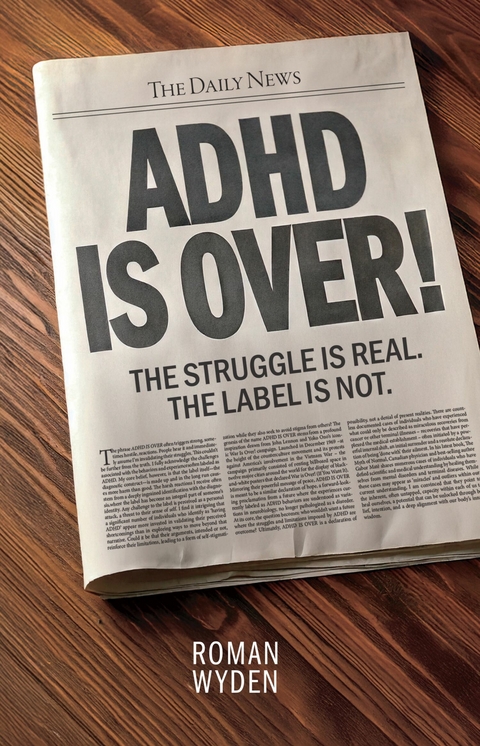
ADHD IS OVER! (eBook)
160 Seiten
Bookbaby (Verlag)
979-8-3178-1602-5 (ISBN)
Roman Wyden, an award-winning filmmaker, entrepreneur, and life coach, has established a multifaceted career marked by diverse and impactful projects. His creative portfolio includes the Eleanor Roosevelt Award-winning documentary 'Ageless Wisdom,' the Palm Springs International Short Film Festival winner 'Deface,' feature films 'Quail Lake' and 'Seven Days,' and other high-quality narrative content produced for multinational clients like Chrysler, Procter & Gamble, Kimberly Clark, and the VA. Currently, Roman is developing the documentary 'ADHD IS OVER!' which aims to address what he perceives as a one-sided and incomplete narrative surrounding ADHD. Additionally, he is the creator and host of the 'ADHD IS OVER!' podcast, where he has interviewed leading experts in the field, including Dr. Gabo Maté, Dr. Bruce Lipton, Dr. Bessel van der Kolk, Dr. Erica Komisar, and Dr. Stephen W. Porges. In addition to 'ADHD IS OVER!' Roman is a certified conscious parenting coach, with a particular focus on empowering parents of 'neuro-unique' children to lead more authentic and fulfilling lives. He understands the unique struggles and triumphs these families experience, and he's driven by a deep desire to offer personalized guidance and unwavering support.
In "e;ADHD IS OVER!"e; Roman Wyden critically examines the prevailing 'crisis mode' approach to ADHD, particularly by educators, parents, and society. Wyden contends that the fast-paced, high-stakes treatment mentality is detrimental and ultimately ineffective. Instead, he proposes viewing ADHD as an integral part of an individual's unique neurological makeup, necessitating understanding, patience, and tailored strategies. Wyden highlights the crucial distinction that, unlike typical medical disorders such as diabetes, there are currently no definitive blood tests or biomarkers to diagnose ADHD; diagnosis relies instead on subjective behavioral assessment. Wyden critiques the pervasive stigma surrounding ADHD, highlighting how societal perceptions often frame the condition as an emergency requiring an immediate 'fix.' This urgency to 'solve' ADHD frequently leads to frustration and a sense of failure for both individuals with ADHD and their support systems. The book underscores that while managing ADHD requires attention, it doesn't demand drastic, crisis-driven interventions. Moving beyond quick fixes and lifelong symptom management, Wyden advocates for a comprehensive, holistic approach to family healing. This book serves as an unofficial 'ADHD diagnosis survival guide' for conscious parents committed to cultivating healthier, more productive environments for their children. It aims to foster autonomy, self-acceptance, and an improved quality of life experience. Ultimately, Wyden encourages parents to adopt a proactive, critical stance toward an ADHD diagnosis, exploring alternative solutions before resorting to medication. He emphasizes 'radical responsibility' empowering parents to investigate root causes, trust their instincts, and create supportive environments where their children can truly thrive.
CHAPTER ONE
JUDGE THIS BOOK BY ITS COVER
The phrase ADHD IS OVER often triggers strong, sometimes hostile, reactions. People hear it and immediately assume I’m invalidating their struggles. This couldn’t be further from the truth. I fully acknowledge the challenges associated with the behaviors and experiences often labeled as ADHD. My core belief, however, is that the label itself—the diagnostic construct—is made up and in the long run causes more harm than good. The harsh reactions I receive often stem from a deeply ingrained identification with the diagnosis, where the label has become an integral part of someone’s identity. Any challenge to the label is perceived as a personal attack, a threat to their sense of self. I find it intriguing that a significant number of individuals who identify as “having ADHD” appear more invested in validating their perceived shortcomings than in exploring ways to move beyond that narrative. Could it be that their arguments, intended or not, reinforce their limitations, leading to a form of self-stigmatization while they also seek to avoid stigma from others?
The genesis of the name ADHD IS OVER stems from a profound inspiration drawn from John Lennon and Yoko Ono’s iconic War Is Over! campaign. Launched in December 1969—at the height of the counterculture movement and its protests against America’s involvement in the Vietnam War—the campaign primarily consisted of renting billboard space in twelve major cities around the world for the display of black-and-white posters that declared War Is Over! (If You Want It). Mirroring their powerful message of peace, ADHD IS OVER is meant to be a similar declaration of hope, a forward-looking proclamation from a future where the experiences currently labeled as ADHD behaviors are understood as variations in neurobiology, no longer pathologized as a disorder. At its core, the question becomes: who wouldn’t want a future where the struggles and limitations imposed by ADHD are overcome? Ultimately, ADHD IS OVER is a declaration of possibility, not a denial of present realities. There are countless documented cases of individuals who have experienced what could only be described as miraculous recoveries from cancer or other terminal illnesses—recoveries that have perplexed the medical establishment— often initiated by a powerful internal shift, an initial surrender and a resolute declaration of being “done with” their ailment. In his latest book, The Myth of Normal, Canadian physician and best-selling author Gabor Maté shares numerous cases of individuals who have defied scientific and medical understanding by healing themselves from mental disorders and terminal diseases. While these cases may appear as “miracles” and outliers within our current understanding, I am convinced that they point to the inherent, often untapped, capacity within each of us to heal ourselves, a potential that can be unlocked through belief, intention, and a deep alignment with our body’s innate wisdom.
If you’re on the journey of understanding ADHD, whether navigating the complexities of a child’s recent diagnosis, processing a past diagnosis, or simply grappling with suspicions that your child might have ADHD, this book is for you. In 2016 when our oldest son Khai’s ADHD diagnosis disrupted our own family, uncertainty, sadness, confusion, and anger inevitably arose. We quickly turned to the internet and eventually a handful of trusted advisors, seeking answers. But it was overwhelming, and at first, I froze, desperately wanting it all to disappear. But I knew I had to keep going.
This book is the resource I desperately wish someone had handed us after receiving our son’s diagnosis. We were already navigating the complexities of busy, stressful lives, and the prospect of endless research felt overwhelming. Like countless parents, we were confronted with the dominant narrative: label our son “disordered,” deem him “special needs,” and medicate him for a “good life.” The first question that haunted our nights, a question I know plagues every parent facing an ADHD diagnosis, was: “Will my child be okay?” We desperately sought mainstream solutions, driven by the fear that inaction or alternative approaches would irrevocably harm our son. At the same time, we feared that this label would derail his future, triggering a slow-burning anxiety that hummed beneath the surface, a constant, nagging worry. The second question, “should we medicate?” became a relentless battleground. Pressured and guilt-tripped by teachers, principals, and experts, we felt rushed, compelled to make a hasty decision. This artificial urgency is one of the main reasons why I wrote this book: to create a space for parents to stop, breathe, and recognize that what we call ADHD is not an emergency. This book is designed to be a diagnosis survival guide, a pause button, or an invisible wedge thoughtfully inserted after the diagnosis but before any action, providing parents with the opportunity to begin their family’s healing journey with clarity and intention.
From the moment our son received his diagnosis, we made a conscious decision to reframe our understanding of ADHD. Instead of accepting it as a fixed, defining label, we eventually declared that ADHD IS OVER for him. This wasn’t about ignoring his real challenges; it was about refusing to let a potentially disempowering label form and dictate his identity. Our goal was to cultivate his agency and empower him to discover his own ways of interacting with the world, minimizing friction and maximizing harmony. And I am incredibly proud to say that our approach has been a resounding success. Today, ADHD is truly absent from his self-concept. He never mentions it, nor does he identify as someone with ADHD. Were it not for my ADHD research, that four-letter word would receive absolutely no attention in our lives. Essentially, we have “unlabeled” him, or “undiagnosed” him, if you will, in the sense that the label no longer holds any weight in his life. We have given him the space and support to become a self-directed learner, and he is excelling. He is now free to address his individual challenges on his own terms, with our unwavering support. We have been diligently working on rewiring his brain, actively engaging in strategies to modify behaviors that were previously hindering his progress. This is not about denying his “neuro-uniqueness” but instead understanding that labels can be limiting, and that with the right support, individuals can learn to manage their challenges in a way that empowers them to thrive. I strongly believe that the very force which can entrap children within a limiting label can also be used to set them free.
The market is saturated with books from ADHD experts and coaches, offering coping mechanisms and quick fixes for ADHD children—strategies for life-long symptom management. While these resources have their place, this book takes a much different approach. I wanted to create a perspective-shifting research companion designed to empower parents to connect their own dots and to take full responsibility for their children’s well-being. My objective was to distill hundreds of hours of my own ADHD research into a readily digestible pocketbook, furnishing parents with balanced talking points to facilitate informed discussions with experts about their children’s needs. Most ADHD books I reviewed during my own research were lengthy, often exceeding 200 to 300 pages. Personally, I struggle with completing such extensive works, and I suspected parents would feel similarly. Recognizing the time constraints and attention spans of busy parents, I opted for a concise book, under 150 pages. The purpose of each chapter is to provide a compact overview of my research and the insights I’ve gleaned from it. My intention is to spark your curiosity and empower you to delve further into these topics if you feel compelled to explore them in greater depth. To reinforce key takeaways, each chapter features a concluding summary and a list of suggested online search terms. To facilitate further exploration, I also included a section with links to studies and a recommended reading list at the end of the book. Because mainstream ADHD information is so readily available on the first few pages of online search results, I decided against including references or links to those sources. My goal was to create an alternative, easily digestible resource, not a dense scientific or medical mainstream text. I believe that concise, well-supported information, backed by real accounts and scientific studies, delivers greater value for busy parents.
After the initial shock of my son’s diagnosis and a few weeks of avoidance, I eventually was ready to absorb as much information as possible. It’s been over nine years since I felt compelled to create a podcast and begin interviewing leading experts in the multifaceted world of mental health. The wealth of invaluable knowledge I’ve gained through these interviews is something I’m excited to share with you. Much like many of the experts I’ve interviewed, I’ve discovered countless cracks in the Western medical narrative, obvious conflicts of interests, and suspicious cover-up practices that did not align with what I thought science and medicine were all about. It became clear to me that this information needed to be brought to light, made readily available for parents worldwide.
This book is for those who are ready to shift their perspective around ADHD and take matters into their own hands. Of...
| Erscheint lt. Verlag | 3.10.2025 |
|---|---|
| Sprache | englisch |
| Themenwelt | Sachbuch/Ratgeber ► Gesundheit / Leben / Psychologie ► Familie / Erziehung |
| ISBN-13 | 979-8-3178-1602-5 / 9798317816025 |
| Informationen gemäß Produktsicherheitsverordnung (GPSR) | |
| Haben Sie eine Frage zum Produkt? |
 EPUB (Ohne DRM)
Größe: 3,5 MB
Digital Rights Management: ohne DRM
Dieses eBook enthält kein DRM oder Kopierschutz. Eine Weitergabe an Dritte ist jedoch rechtlich nicht zulässig, weil Sie beim Kauf nur die Rechte an der persönlichen Nutzung erwerben.
Dateiformat: EPUB (Electronic Publication)
EPUB ist ein offener Standard für eBooks und eignet sich besonders zur Darstellung von Belletristik und Sachbüchern. Der Fließtext wird dynamisch an die Display- und Schriftgröße angepasst. Auch für mobile Lesegeräte ist EPUB daher gut geeignet.
Systemvoraussetzungen:
PC/Mac: Mit einem PC oder Mac können Sie dieses eBook lesen. Sie benötigen dafür die kostenlose Software Adobe Digital Editions.
eReader: Dieses eBook kann mit (fast) allen eBook-Readern gelesen werden. Mit dem amazon-Kindle ist es aber nicht kompatibel.
Smartphone/Tablet: Egal ob Apple oder Android, dieses eBook können Sie lesen. Sie benötigen dafür eine kostenlose App.
Geräteliste und zusätzliche Hinweise
Buying eBooks from abroad
For tax law reasons we can sell eBooks just within Germany and Switzerland. Regrettably we cannot fulfill eBook-orders from other countries.
aus dem Bereich