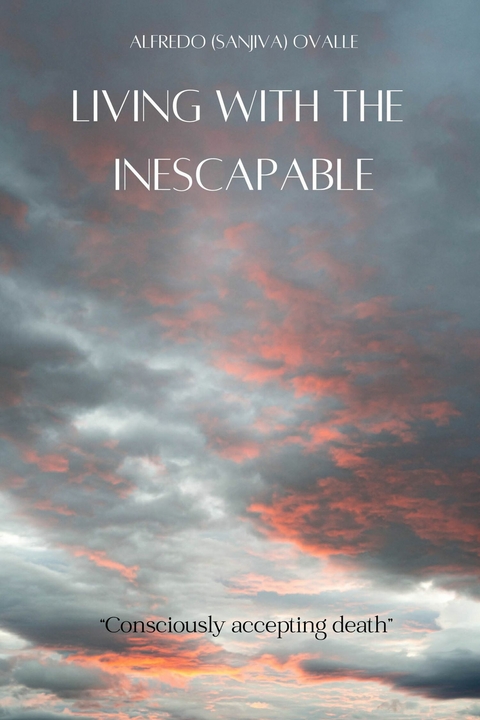
Living With The Inescapable (eBook)
196 Seiten
Bookbaby (Verlag)
979-8-3178-1583-7 (ISBN)
Alfredo Ovalle (Sanjiva) was born in Chile, study in his country, in England, USA and Canada. Currently he lives in Serenbe where he works in business and facilitate in issues like to live and die consciously. He travels quite often around the world to connect with teachers of non-dualism. Philosophy, Religion and Spirituality have motivate him all his life. This book is a testimony of his permanent work, where death and dying have been essential; is not only about preparing yourself to help your loved ones, is also to understand deeply what is our own mortality in a way that is a to a tool of unique personal transformation. This have been used by all past and present mystics and masters, to live with the inescapable every day of our existence.
Are we conscious that we live with the inescapable since we where born?Do we consider death in our daily life?Normally we are so afraid that we avoid thinking about it and we don't live life with the respect it deserves. We waste our time in pitiful and little things instead of appreciating the time we have left and facilitate in a loving way the life to others. This book is an alert, calling the attention to stop living as it death doesn't exist. To help us to live a more fulfill and significative life. Our attitude towards death affects the way we live, and for sure will affect the way we will die. We are all in the same boat: at the moment we are born, death is somewhere in our agenda in some place!However, facing that fact is terrifying for most of us; or we simply don't understand why it's necessary to see what death means now, while we're so busy living. If you look a little closer, you'll notice that, in fact, living and dying are not separate.
CHAPTER ONE
Brief review of the current situation
Ars Moriendi or “the art of dying” … were texts in Latin that were published between the years 1415 and 1450. In them, suggestions and protocols were given for the process to follow to have a good death.
Although it had Catholic bias, it was nevertheless a very valid guide for a good life and death at that time. These are the first known attempts in the West to confront death. They occurred at a special time: after the Black Death had caused more than 100 million deaths on the European continent. This tragedy generated profound changes in the society of that time.
Recently in November 2016, the Catholic Church updated the topic of how to die well, and it is a good attempt to put the issue on the table and to have it discussed more properly as well as in a more natural way. Especially in the United Kingdom, there has been a lot of work to ensure that the end of life in this world is addressed with more information and detail.
When we talk about death, as we know, we necessarily tend to talk about religion. I wanted to leave those visions aside, since the journey I want to invite you to through this book is to go deeper, trying to avoid the bias or conditioning that may come from the religious education we have all received during our lives, especially at an early age. We spend our time praying to God, but that is equivalent to anesthetizing yourself or being told a bedtime story where everything is adorn so that, finally, we can sleep happily...
Every person with some degree of sensitivity (like all of us) is affected by the subject, and some find quick solutions inherited by generations, from the religion and culture in which we were raised. If this is what someone needs to stay calm and not look for more answers, that’s fine. These are dogmas and acts of faith with which some feel comfortable to end doubts and anguish. Is it necessary to go further? For many the answer is no... in my case the answer is YES.
I prefer to start off doubting everything, even what is told here.
Society is built on myths and superstitions. It is increasingly difficult to find the truth. We are bombarded with ideas about death, in which it is shown as something tragic and terrible; but also distant. And I do not dispute that it has these elements incorporated, but the core is omitted. We are all going to die. This last thing is the only thing we all have in common.
The art of dying means facing it… not like today, when it happens unconsciously. Over time this has increased. We avoid it more and more. Our society is more materialistic in every sense: it is a fact that we are leaving behind what is essential in life itself. So much so that death is increasingly hidden and becomes a very, very distant subject. When it happens, a shock occurs, from which we want to get out as quickly as possible. In this case, only time is our ally.
The fear of death
Most people die with fear, before and during the process, with unfinished business. Without saying the necessary “I love you,” the “I forgive you,” and most importantly, forgiving themselves. Doing so beforehand is very healing and brings deep peace. But all of this is often avoided or ignored. The end should be filled with gratitude, peace, and light. Can this be achieved?
It has powerfully caught my attention since I was very young—the fear that exists, the fact that the problem is never discussed, that it is always something terrible, better avoided, that everything is taboo, very sorrowful, and even heartbreaking. Is it not possible to celebrate that person who has lived a full life? Is it possible to change what exists today?
The Vietnamese Zen monk, Thich Nhat Hanh, said in a talk, “our greatest fear is that when the moment of death comes, we will become nothing.” A great majority believes that our existence is only a fleeting moment, which begins at the moment of conception or birth and ends at the moment of death. They believe that they are born from nothing and that when they die, they will become nothing again. And they are terrified of that annihilation...
Perhaps it is the inevitability and unpredictability of death that causes so much fear. One never knows when it may come or why... except if you reach an older age and your body goes through its natural disintegration phase.
People are not afraid of death itself; they are afraid of losing their separation, they are afraid of losing their ego. You will no longer be separate - what will happen to your identity, your personality? And we have cultivated the personality so carefully, with so much effort; we have polished it all our lives, and death will come and destroy all our work…
The fear of death is the refusal to cease to exist in this world. We see how death approaches us long before our time comes, we see impermanence in the changes that occur in us, with the arrival of old age and the suffering of losing our youth.
“If you understand, if you see, if you can feel and experience that you are not separate from existence, that you are one with it, all fear of death disappears because there is nobody to die inside you. In the first place, there is no one at all - existence lives through you.”, the mystic Osho tells us.
Death is an intense reminder of the fragility of life and the fact that, at some point, it will happen to us as well. This shock often lasts only a short while; life goes on and we watch in awe as the world continues to function as it always has.
Many people think that merely just talking about death can bring it closer before its time... That’s why many think that it is even in bad taste to discuss such a relevant topic...
Yes, it creates fear - the possible pain in the process, the attachment we have to our bodies, to our loved ones and friends... But in the end, all of this is, to a large extent, a mental game...
Now, the issue of death is much more transcendental than being afraid of it or not. As the American psychiatrist Elisabeth Kübler-Ross and many others say, although death happens every day, we ignore it, we avoid it, we deny it. Something happens in our mind that diverts us, makes us numb, we press the button of unconsciousness so that we can continue functioning in daily life. Some may say that if it were not so, we could not function. That is possible… but we must make some effort, out of respect for our passage through this life and the moment in which we happened to exist.
We clearly have survival mechanisms: the desire to live is very powerful and it is good that it is so, but it is imperative not to ignore that everything is transitory. Today, there is the possibility of being aware of this reality, transforming our world and those around us. That is at least what I aspire to and I am sure that it is possible to achieve with a little work… How could it not be fascinating to invest energy in knowing to support oneself on this subject?
The German philosopher Martin Heidegger said, “If I take death into my life, recognize it and face it in all its dimensions, I will be free from anxiety and suffering, and only then will I be free to be myself.”
This fear that has society in a permanent neurosis, the subject of death produces the classic signs of disorders: anxiety, depression, hypochondria, insecurity, etc. The list is long and from time to time, they manifest themselves, generally unconsciously.
The big wake-up call
Death is an alarm clock: the individual who begins to relate with death begins to search for what does not die… and it is at this point where the key to each person’s spiritual path lies. A teacher told me, “What remains?” after discarding all the labels and roles that we carry with us during this life.
The Indian mystic Ramana Maharshi always asked his disciples the same question: “Who are you?” It is a wonderful way to understand the mind and to know if those thoughts have any value, beyond the finite body.
What is it that does not die? Is there really something in our being that does not die? Could it be our divine consciousness, which is infinite within a finite body? Not many people ask themselves this question, and we are always - but always - very busy with more “important” matters.
When the day of our death comes, we will have an awakening, something like what happens to the caterpillar... which at the moment, when everything seems finished, turns into a butterfly. Now, why not provoke that awakening before? That is why one of my workshops is named “Dying before Dying.”
That is what it is all about, at least in my case, the spiritual search that manifests itself constantly in my life... It is a daily, intense topic. For me, it is not just about sharing this in a one-day workshop, a weekend, in a café, or at a meal.
“Consciousness is eternal, it knows no death. Only unconsciousness dies. So, if you remain unconscious, asleep, you will have to die again. If you want to get rid of all this suffering of being born and dying again and again, if you want to get rid of the wheel of birth and death, you will have to be alert. You will have to go higher and higher into...
| Erscheint lt. Verlag | 4.10.2025 |
|---|---|
| Sprache | englisch |
| Themenwelt | Sachbuch/Ratgeber ► Gesundheit / Leben / Psychologie ► Lebenshilfe / Lebensführung |
| ISBN-13 | 979-8-3178-1583-7 / 9798317815837 |
| Informationen gemäß Produktsicherheitsverordnung (GPSR) | |
| Haben Sie eine Frage zum Produkt? |
 EPUB (Ohne DRM)
Größe: 793 KB
Digital Rights Management: ohne DRM
Dieses eBook enthält kein DRM oder Kopierschutz. Eine Weitergabe an Dritte ist jedoch rechtlich nicht zulässig, weil Sie beim Kauf nur die Rechte an der persönlichen Nutzung erwerben.
Dateiformat: EPUB (Electronic Publication)
EPUB ist ein offener Standard für eBooks und eignet sich besonders zur Darstellung von Belletristik und Sachbüchern. Der Fließtext wird dynamisch an die Display- und Schriftgröße angepasst. Auch für mobile Lesegeräte ist EPUB daher gut geeignet.
Systemvoraussetzungen:
PC/Mac: Mit einem PC oder Mac können Sie dieses eBook lesen. Sie benötigen dafür die kostenlose Software Adobe Digital Editions.
eReader: Dieses eBook kann mit (fast) allen eBook-Readern gelesen werden. Mit dem amazon-Kindle ist es aber nicht kompatibel.
Smartphone/Tablet: Egal ob Apple oder Android, dieses eBook können Sie lesen. Sie benötigen dafür eine kostenlose App.
Geräteliste und zusätzliche Hinweise
Buying eBooks from abroad
For tax law reasons we can sell eBooks just within Germany and Switzerland. Regrettably we cannot fulfill eBook-orders from other countries.
aus dem Bereich