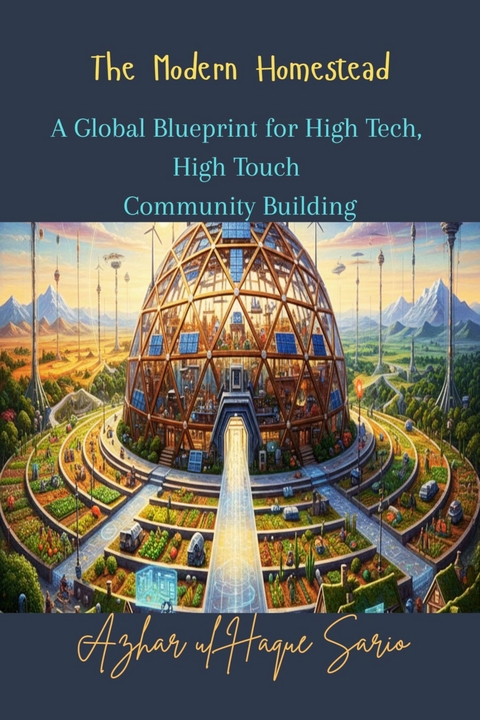
The Modern Homestead (eBook)
118 Seiten
Azhar Sario Hungary (Verlag)
978-3-384-71810-5 (ISBN)
Have you ever felt there must be a better way to live together-to build a true community, not just a row of houses?
This book is your world tour of community-led housing. Our journey starts in Europe, the cradle of these modern movements. You'll discover Denmark's famous 'Andel' cohousing model. We explore Germany's Baugruppen revolution, where people build cities without developers. In Spain, you'll see how projects like La Borda use public land for collective ownership. We then visit the United Kingdom for its grassroots financial innovations and the Netherlands for its state-supported urban co-ops. Sweden's intergenerational 'Kollektivhus' shows us how to design for deep connection. The tour then crosses the Atlantic to the Americas. We navigate the mosaic of legal frameworks in the United States, from TICs to co-ops. You will learn from Canada's codified and thriving cooperative movement. We'll be inspired by Uruguay's powerful FUCVAM mutual-aid model. Colombia teaches us how to build resilient ecovillages in harmony with nature. Finally, we visit global innovators. See Australia's rise of deliberative development in cities. Learn how Japan's share houses are tackling urban affordability. Discover how New Zealand beautifully weaves indigenous values into modern intentional community living. This is your global blueprint.
So, what makes this book different? While many books romanticize community, The Modern Homestead provides a practical, global toolkit. It moves beyond a single philosophy to give you a comparative look at what's working right now, all over the world. It's the only guide that connects Denmark's cooperative financing with Uruguay's mutual-aid labor and Japan's high-density urban solutions in one place. We bridge the gap between 'high tech' innovation and the 'high touch' human connection we all crave. This book doesn't just show you inspiring pictures; it dissects the legal structures, financial models, and social agreements that make these communities successful and resilient. It is a resource for doers, dreamers, and urban planners who want to stop talking about building community and start creating it.
Disclaimer: This author has no affiliation with the boards or organizations mentioned. This book is independently produced under nominative fair use.
Part I: The European Vanguard - Pioneering New Models of Living
Denmark – The Genesis of Cohousing: A Deep Dive into the 'Andel' Cooperative Model
Denmark stands as the undisputed genesis of the modern cohousing movement, offering a mature and scalable model that has been refined over five decades. The Danish experience provides the essential starting point for any exploration of intentional communities, demonstrating how a supportive political and legal climate can foster non-speculative, community-oriented housing on a national scale. At the heart of this success is the Andel cooperative model, a unique form of tenure that has profoundly shaped the country's housing landscape, particularly in its urban centers. This chapter deconstructs the legal, financial, and governance mechanics of the Danish model, exploring its evolution from a grassroots, counter-cultural phenomenon to a mainstream housing option now being adapted by commercial developers.
The Historical Roots and Philosophical Underpinnings
The story of Danish cohousing doesn’t begin with blueprints or financial models. It starts with a feeling. In the late 1960s, a quiet dissatisfaction was simmering in the neat suburban landscapes of Denmark. The post-war dream of the single-family home, with its perfect lawn and white picket fence, was beginning to feel less like a dream and more like an isolation chamber. Families, particularly mothers, felt disconnected. Children lacked a diverse community of playmates and caregivers. Life was becoming a series of commutes between private, sealed-off boxes. People craved something more, a middle ground between the solitude of the suburban home and the anonymity of the urban apartment block.
This collective yearning found its voice in 1967. Bodil Graae, a Danish journalist, penned a newspaper article titled "Children Should Have One Hundred Parents." It wasn't a literal suggestion, but a powerful metaphor for a village-like environment where responsibility and joy are shared. The article struck a chord deep within the Danish psyche. It was a lightning bolt of an idea, sparking conversations in living rooms and coffee shops across the country. A group of about 50 families, inspired by this vision, came together. They weren't architects or developers; they were teachers, writers, and artists who wanted to build a better way to live.
Their efforts gave birth to the world's first modern cohousing community, Sættedammen, completed in 1972. It was a radical experiment. The design deliberately balanced private life with community interaction. Each family had its own small, private home, but they all opened onto extensive common facilities, most importantly a central common house with a large kitchen and dining area. This wasn't just about sharing a lawnmower; it was about re-weaving the social fabric of daily life. It was a physical manifestation of a new philosophy: that life is richer, easier, and more sustainable when lived together.
Deconstructing the 'Andel' Model: Legal and Financial Mechanics
To make this communal dream a reality, the pioneers needed a special kind of ownership structure. The answer was found in the Andel model, or more formally, the andelsboligforening (cooperative housing association). This legal and financial framework is the engine that has powered Danish cohousing for half a century, making it accessible and protecting it from the whims of the speculative property market.
Here’s how it works in simple terms: you don’t buy your apartment or house in the traditional sense. Instead, you buy a share in a cooperative association. This association is a legal entity that owns the entire property—the land, the buildings, all of it. Your share, called an andelsbevis, gives you the exclusive right to live in a specific unit within that property. You are part-owner of everything, from the roof over your head to the trees in the common garden.
The financial side is equally unique. The entire cooperative association takes out a single, large mortgage to buy or build the property. When you join, you pay for your share. The price of this share isn't determined by what the market will bear. Instead, it is legally capped. The maximum price is calculated based on the association's overall financial health—its assets and its debt. This revolutionary step takes the profit motive out of housing. The goal is to provide a stable home, not a get-rich-quick investment.
In addition to buying your share, you pay a monthly fee, the boligafgift. This isn't rent. It’s your proportional contribution to the community's shared expenses. It covers your slice of the collective mortgage payment, property taxes, insurance, funds for future maintenance, and the operating costs of all the wonderful common spaces. This creates a beautifully simple and predictable financial life for the residents, shielding them from volatile interest rates and the boom-and-bust cycles of the open housing market.
Governance and Community Life Within an Andel
The true genius of the Andel model extends beyond its finances; it lies in its deeply democratic and social structure. Living in a Danish cohousing community is an active exercise in collaboration. It is governed not by a distant landlord or a faceless management company, but by the residents themselves. This is where the legal structure blossoms into a vibrant, living community.
The ultimate authority in any Andel association is the generalforsamling, or general assembly. This is typically an annual meeting where every share—every household—has one vote. It is here that the big decisions are made: approving the annual budget, planning major renovations, or changing the community’s bylaws. It is direct democracy in action, applied to the place you call home. For day-to-day management, the residents elect a board, the bestyrelse, from among their neighbors. The board handles administrative tasks, oversees maintenance, and ensures the decisions of the general assembly are carried out.
But the heart of the community beats in the fælleshus, the common house. This is the central hub for the social life that residents intentionally chose. The most defining feature of this life is the shared meal. Most communities organize common dinners several times a week. Small cooking teams of residents take turns preparing meals for everyone. This simple act of breaking bread together transforms neighbors into friends. It alleviates the daily burden of cooking for individual families and creates a natural, easy forum for conversation and connection. This shared commitment is the glue that binds the community together, turning a collection of houses into a genuine neighborhood. The responsibilities extend beyond the kitchen, with residents often forming work groups for gardening, simple maintenance, or organizing social events, further strengthening their bonds.
Evolution and Mainstreaming: From Grassroots to Commercial Development
For decades, the cohousing movement remained a grassroots phenomenon. It was driven by passionate groups of individuals who managed the entire complex process themselves—from finding land and securing financing to designing their future homes. It was a labor of love, born from a desire for a different way of life. However, as the benefits of the Andel model became more apparent—affordability, stability, and a built-in social network—its appeal began to broaden far beyond its counter-cultural origins. It started to look less like a radical experiment and more like a very smart solution to modern urban living.
In the last couple of decades, cohousing has decisively entered the mainstream in Denmark. It is now seen as a practical and desirable housing option for a wide range of people, from young families and single professionals to active seniors. This surge in popularity has not gone unnoticed by commercial developers. They saw a market for community-oriented living but recognized that not everyone has the time or energy to build a community from scratch.
This has led to a new wave of "cohousing-lite" projects. Developers now build entire communities designed with shared amenities—like fitness centers, rooftop terraces, and communal lounges—and sell the units through the Andel model or other ownership forms. These projects successfully market the concept of community. However, they often represent a significant philosophical shift. The deep, resident-driven democracy and mandatory social participation, like the common meals, are often diluted or made optional. The community is presented more as an amenity, a feature you pay for, rather than a social contract you actively build and maintain with your neighbors. This evolution presents a fascinating question for the future: Is this a natural adaptation that makes the benefits of shared living accessible to more people, or does it risk losing the very soul that made Danish cohousing so revolutionary in the first place?
The Danish Approach to Home: An In-depth Look at the Andelsbolig Model
1.1 The Legal Blueprint: Understanding the 'Andelsbolig'
Imagine a way of living where your home isn't quite a rental, but it's not something you traditionally own either. This is the fascinating middle ground where the Danish cooperative home, or Andelsbolig, exists. It’s a concept built on community, shared responsibility, and a deep-seated belief that housing should be, first and foremost, for people to live in. The entire system rests on a legal...
| Erscheint lt. Verlag | 28.9.2025 |
|---|---|
| Sprache | englisch |
| Themenwelt | Sachbuch/Ratgeber ► Freizeit / Hobby |
| Schlagworte | cohousing • Collaborative Housing • Community Led Development • Ecovillage Living • Housing Cooperatives • intentional community • sustainable urbanism |
| ISBN-10 | 3-384-71810-0 / 3384718100 |
| ISBN-13 | 978-3-384-71810-5 / 9783384718105 |
| Informationen gemäß Produktsicherheitsverordnung (GPSR) | |
| Haben Sie eine Frage zum Produkt? |
 EPUB (Ohne DRM)
Digital Rights Management: ohne DRM
Dieses eBook enthält kein DRM oder Kopierschutz. Eine Weitergabe an Dritte ist jedoch rechtlich nicht zulässig, weil Sie beim Kauf nur die Rechte an der persönlichen Nutzung erwerben.
Dateiformat: EPUB (Electronic Publication)
EPUB ist ein offener Standard für eBooks und eignet sich besonders zur Darstellung von Belletristik und Sachbüchern. Der Fließtext wird dynamisch an die Display- und Schriftgröße angepasst. Auch für mobile Lesegeräte ist EPUB daher gut geeignet.
Systemvoraussetzungen:
PC/Mac: Mit einem PC oder Mac können Sie dieses eBook lesen. Sie benötigen dafür die kostenlose Software Adobe Digital Editions.
eReader: Dieses eBook kann mit (fast) allen eBook-Readern gelesen werden. Mit dem amazon-Kindle ist es aber nicht kompatibel.
Smartphone/Tablet: Egal ob Apple oder Android, dieses eBook können Sie lesen. Sie benötigen dafür eine kostenlose App.
Geräteliste und zusätzliche Hinweise
Buying eBooks from abroad
For tax law reasons we can sell eBooks just within Germany and Switzerland. Regrettably we cannot fulfill eBook-orders from other countries.
aus dem Bereich