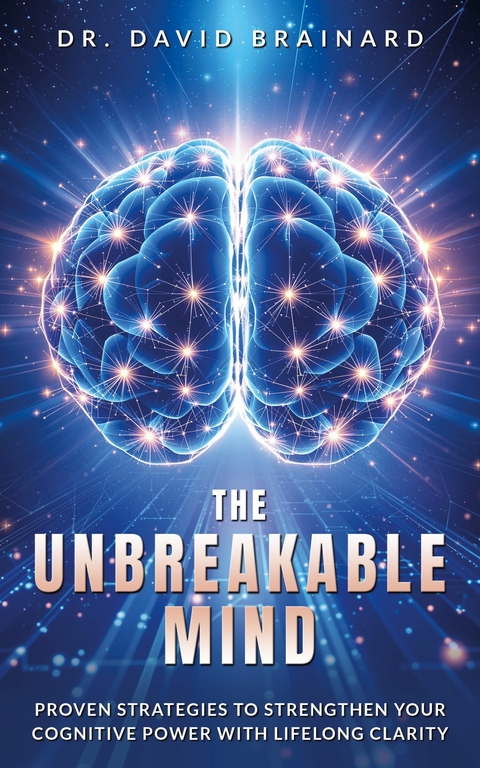
The Unbreakable Mind (eBook)
202 Seiten
Publishdrive (Verlag)
978-0-00-105854-5 (ISBN)
The Unbreakable Mind: Proven Strategies to Strengthen Your Cognitive Power with Lifelong Clarity
By Dr. David Brainard
Do you want a sharper memory, stronger focus, and lasting mental clarity? The Unbreakable Mind reveals the proven, science-backed strategies to unlock your brain’s full potential at any age.
Drawing on cutting-edge research in neuroplasticity and cognitive performance, Dr. David Brainard delivers a practical, step-by-step guide to rewiring your mind for greater resilience, productivity, and lifelong brain health.
Inside, you’ll discover how to:
✅ Rewire Your Brain with Neuroplasticity – Train your mind for peak performance
✅ Boost Memory & Recall – Proven techniques to retain information with ease
✅ Master Focus & Mental Clarity – Eliminate distractions and sharpen concentration
✅ Fuel Your Brain with Nutrition – The best foods and habits for cognitive health
✅ Harness the Power of Sleep – Rest smarter to think faster and clearer
✅ Build Stress Resilience – Thrive under pressure with brain-strengthening tools
✅ Stay Sharp as You Age – Debunk myths and keep your mind strong for life
From the connection between exercise and creativity to the surprising role of positivity, genetics, and social interaction, this book explores every key factor that shapes brain performance—giving you the tools to think, learn, and thrive like never before.
Perfect for professionals, students, lifelong learners, and anyone seeking mental clarity, The Unbreakable Mind is your blueprint for a resilient, focused, and unstoppable brain.
Say goodbye to brain fog—and hello to an unbreakable mind.
Chapter 1
Understanding Neuroplasticity
In the fascinating landscape of the human brain, neuroplasticity stands out as a beacon of hope and potential. It's our brain's extraordinary ability to adjust, reorganize, and form new connections, even as we age. Picture this: we have within us the capability to reshape our minds based on experiences and learning. It's like an internal workout, where our neurons are the weights, and with each 'rep'—whether it's acquiring a new skill or adapting to a change—we strengthen our cognitive muscles.
Understanding neuroplasticity not only explains why we can bounce back from setbacks but also highlights the endless possibilities for personal growth and cognitive enhancement. By harnessing this potential, we can improve our brain health, enhance our capacities, and truly transform our lives. It's less about being stuck with what we've been given and more about unleashing the power we all hold within.
The Science of Neuroplasticity
Neuroplasticity, a term that might sound more at home in a lab than a living room, is a captivating, transformative force within our brains.
At its core, neuroplasticity is the brain's astonishing ability to reorganize itself. This incredible capacity for change allows our central nervous system to adapt to new experiences, environments, and learning processes, essentially enabling the brain to rewire itself. It's the scientific underpinning of how we learn new skills, recover from brain injury, and form both short-term and long-term memories. In recent years, scientists have begun to appreciate just how powerful and pervasive this capability truly is, pointing toward numerous applications in cognitive enhancement and personal development.
Let's peel back the layers of neuroplasticity a bit further. To understand the cellular ballet that allows for such dynamic change, we must look at neurons, the brain's building blocks. Neurons are interconnected through synapses, which are like tiny bridges over which information traverses. Each time we learn something new or have a novel experience, these synaptic connections either strengthen or form anew. This is synaptic plasticity, a critical component of neuroplasticity, playing a big role in memory and learning. Through repeated activation, some neural pathways become more efficient while others weaken due to lack of activity. This synaptic reshaping equips us with the ability to adapt our skills and memories as life's demands evolve.
The idea of a "hard-wired" brain is now antiquated, thanks to groundbreaking research illuminating the ways neuroplasticity operates across our lifespan. Previously, it was thought that significant brain change was confined to childhood, after which the brain was set in a fixed pattern. Modern neuroscience has shattered this myth, revealing that adults, too, possess a high degree of plasticity. This means rapid learning, adaptation to new environments, and recovery from injury are possible long after the brain's formative years. This ongoing capability provides hope and potential avenues for interventions in conditions like stroke and degenerative diseases.
Despite its robust nature, neuroplasticity isn't always a friend. In some instances, it can foster negative patterns. For example, when exposed to stress or trauma, the brain can adapt by strengthening pathways related to fear or anxiety. Similarly, maladaptive habits may become ingrained, as the brain efficiently wires itself to prioritize familiar, albeit harmful, behaviors. Recognizing these potential pitfalls of neuroplasticity is just as important as understanding its positive aspects because it helps us find ways to influence it beneficially.
This quirky brain rewriting feature doesn't operate in isolation. It's part of an intricate dance involving chemical signals known as neurotransmitters. Dopamine, for instance, plays a vital role in motivation and reward- driven learning. When you're learning something intriguing or achieving a goal, dopamine floods the synapses, reinforcing the patterns that led to these outcomes and encouraging the brain to repeat them. This dopamine- related boost can make learning addictive in the best possible sense.
Likewise, acetylcholine helps direct attention, enhancing the ability to learn and remember new information. These chemicals are the brain's internal cheerleaders, guiding the process of neuroplastic change.
A particularly exciting area of study within neuroplasticity involves its implications for recovery. Consider stroke rehabilitation. When a stroke damages part of the brain, regions that were once responsible for functions like speech or movement can be compromised. Through targeted therapy and exercises, other parts of the brain can be retrained to take over these roles, a process made possible by the brain’s innate plasticity. This adaptability underscores the importance of creating supportive and stimulating environments for individuals seeking recovery, as these can catalyze the brain's healing processes.
Another fascinating element of neuroplasticity is its enhancement through various lifestyle choices and practices. Cognitive exercises and new learning experiences, of course, encourage neuroplasticity, but so do meditation and mindfulness practices. Research indicates they can boost cortical areas involved in attention and emotional regulation, thanks to the brain's reorganization ability. Physical exercise also enhances neuroplasticity, promoting neurogenesis — the creation of new neurons — particularly in areas associated with memory and learning. What we eat plays a role, too, as certain nutrients and superfoods can fuel and support structural changes in the brain, enhancing plasticity.
So, why is understanding neuroplasticity so essential? The awareness of its mechanisms and potential opens doors to cognitive enhancement that can transform personal and professional lives. By intentionally engaging in activities that promote positive neural rewiring, individuals can sculpt their brains, thus expanding capabilities in focus, memory, and reasoning. It becomes a proactive endeavor, shaping the architecture of our minds to better handle the complexities of modern life, all while fostering resilience against cognitive decline.
In summary, neuroplasticity is more than a scientific curiosity; it's a fundamental principle of change, adaptation, and growth within our brains. As we delve deeper into understanding this incredible capability, the potential for improved brain health and cognitive function becomes not just an aspiration but an accessible reality. Through adaptive learning, deliberate practice, and lifestyle choices, we hold the remarkable power to influence the ways our minds function, proving that, indeed, it's never too late to teach an old dog new tricks.
Benefits of Neuroplasticity
Neuroplasticity, the brain's remarkable ability to reorganize itself by forming new neural connections, stands at the forefront of brain health and cognitive enhancement. Understanding its benefits can be transformational. Before diving into specifics, it's important to grasp the sheer potential that lies within our brains. This dynamic process not only shapes who we are but also empowers us with an unparalleled capacity for growth and change.
One of the immediate benefits of neuroplasticity is cognitive flexibility. Imagine your brain like a complex city with highways and backroads.
When one route becomes unavailable, another opens, allowing traffic to flow to its destination. Similarly, neuroplasticity helps your brain reroute information, adapt to new situations, and learn novel tasks. This capability can significantly enhance problem-solving abilities and creativity, turning challenges into opportunities for innovation.
For those facing recovery from injury or illness, neuroplasticity is a beacon of hope. When areas of the brain are damaged, whether from trauma, stroke, or degenerative diseases, other parts of the brain can learn to take over lost functions. This compensatory mechanism enables recovery by forging new pathways and reinforcing different areas to support cognitive functions, providing a pathway to regain lost abilities and independence.
Memory is another domain where neuroplasticity provides profound benefits. By regularly engaging in activities that promote brain plasticity, such as learning a new language or playing a musical instrument, individuals can improve their memory retention and recall skills. This enhancement isn't just temporary. Continued engagement ensures long- lasting improvements, maintaining a sharp and agile mind for years to come.
The advantages of neuroplasticity also extend to emotional health. The brain's ability to change doesn't only apply to cognitive processes; it affects emotional regulation as well. Through practices like mindfulness and meditation, individuals can actively rewire their brains to foster a greater sense of well-being, reduce stress, and enhance emotional resilience. This transformation leads to healthier relationships and an improved overall quality of life.
On a broader scale, neuroplasticity supports lifelong learning. It is the foundation of education, giving our brains the capacity to absorb new information and skills at any age. Contrary to previous beliefs that cognitive decline is an inevitable part of aging, neuroplasticity proves that the brain remains capable of growth throughout life. This capacity empowers individuals to pursue new interests, embark on different career paths, or simply continue to learn for personal enrichment, making lifelong learning a reality rather than just a concept.
For those struggling with maladaptive behaviors or ingrained habits, neuroplasticity offers a pathway...
| Erscheint lt. Verlag | 21.9.2025 |
|---|---|
| Sprache | englisch |
| Themenwelt | Sachbuch/Ratgeber ► Gesundheit / Leben / Psychologie ► Lebenshilfe / Lebensführung |
| ISBN-10 | 0-00-105854-1 / 0001058541 |
| ISBN-13 | 978-0-00-105854-5 / 9780001058545 |
| Informationen gemäß Produktsicherheitsverordnung (GPSR) | |
| Haben Sie eine Frage zum Produkt? |
 EPUB (Adobe DRM)
Größe: 4,4 MB
Kopierschutz: Adobe-DRM
Adobe-DRM ist ein Kopierschutz, der das eBook vor Mißbrauch schützen soll. Dabei wird das eBook bereits beim Download auf Ihre persönliche Adobe-ID autorisiert. Lesen können Sie das eBook dann nur auf den Geräten, welche ebenfalls auf Ihre Adobe-ID registriert sind.
Details zum Adobe-DRM
Dateiformat: EPUB (Electronic Publication)
EPUB ist ein offener Standard für eBooks und eignet sich besonders zur Darstellung von Belletristik und Sachbüchern. Der Fließtext wird dynamisch an die Display- und Schriftgröße angepasst. Auch für mobile Lesegeräte ist EPUB daher gut geeignet.
Systemvoraussetzungen:
PC/Mac: Mit einem PC oder Mac können Sie dieses eBook lesen. Sie benötigen eine
eReader: Dieses eBook kann mit (fast) allen eBook-Readern gelesen werden. Mit dem amazon-Kindle ist es aber nicht kompatibel.
Smartphone/Tablet: Egal ob Apple oder Android, dieses eBook können Sie lesen. Sie benötigen eine
Geräteliste und zusätzliche Hinweise
Buying eBooks from abroad
For tax law reasons we can sell eBooks just within Germany and Switzerland. Regrettably we cannot fulfill eBook-orders from other countries.
aus dem Bereich