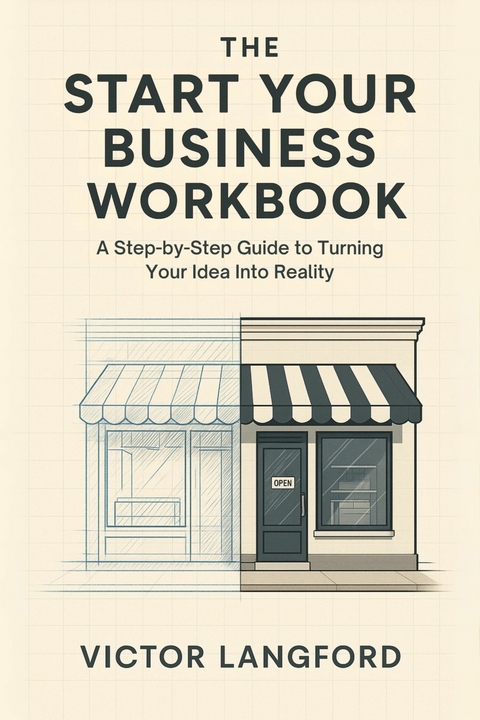
The Start Your Business Workbook (eBook)
150 Seiten
Publishdrive (Verlag)
9780001057746 (ISBN)
Do you have a brilliant business idea but feel overwhelmed about where to actually start? Are you tired of watching others turn their dreams into successful ventures while you remain stuck in the planning phase? Do you want a clear, actionable roadmap that transforms your idea into a thriving business reality?
If you answered YES to at least one of these questions, you MUST KEEP READING...
Unlock the Blueprint to Transform Any Idea Into a Profitable Business
Many aspiring entrepreneurs never make it past the dreaming stage. The frustration of endless research, analysis paralysis, and not knowing which step to take first can be paralyzing. It's no surprise that most people with great ideas give up before they even begin, trapped in a cycle of planning without action that keeps their dreams forever out of reach.
But don't despair-you're not alone in this journey...
Presenting: The Start Your Business Workbook
Introduction: The Start Your Business Workbook
Every successful business began as an idea in someone's mind—a moment of recognition that something could be done better, faster, or more elegantly than existing solutions provided. Perhaps you've experienced that moment yourself: the flash of insight during a frustrating customer service encounter, the realization that a simple tool could solve a problem you face daily, or the recognition that your professional skills could serve others more effectively through your own enterprise.
That moment of entrepreneurial awakening represents both tremendous opportunity and paralyzing uncertainty. The opportunity lies in the potential to create something meaningful while building financial independence and professional fulfillment. The uncertainty emerges from the gap between having an idea and knowing how to transform that concept into a viable, profitable business that serves real customers and creates lasting value.
This workbook bridges that gap through systematic, practical guidance that transforms entrepreneurial dreams into operational reality. Rather than offering generic inspiration or theoretical frameworks, these pages provide step-by-step processes that thousands of entrepreneurs have used successfully to build businesses across diverse industries and market conditions.
The entrepreneurial statistics are simultaneously inspiring and sobering. While millions of new businesses launch each year, demonstrating the enduring appeal of entrepreneurial independence, most fail within their first few years due to preventable mistakes that systematic preparation could have avoided. The businesses that succeed share common characteristics: they validate market demand before investing heavily in product development, they build financial discipline that sustains operations through difficult periods, and they create systematic approaches to customer acquisition rather than relying on luck or heroic individual efforts.
Your entrepreneurial journey doesn't require exceptional talent, substantial initial capital, or revolutionary innovations to achieve meaningful success. However, it does demand systematic thinking, disciplined execution, and the resilience to learn from inevitable setbacks while maintaining focus on long-term objectives. The frameworks in this workbook provide the systematic thinking, while your commitment and persistence will supply the disciplined execution.
The Entrepreneurial Journey: From Dream to Reality
The path from business idea to sustainable enterprise involves several distinct phases, each requiring different skills, mindsets, and strategic approaches. Understanding these phases helps set realistic expectations while providing roadmaps for navigating challenges that overwhelm entrepreneurs who lack preparation for the journey ahead.
The ideation phase often feels the most exciting, as unlimited possibilities seem available while constraints haven't yet imposed themselves on your vision. During this phase, creativity and enthusiasm provide essential energy for the difficult work ahead, but they must be balanced with systematic evaluation of market opportunities and realistic assessment of your capabilities and resources. Many promising entrepreneurial journeys end during ideation because founders either become paralyzed by endless possibilities or commit to concepts that haven't been validated with actual customers.
Validation represents the first major hurdle where entrepreneurial dreams meet market reality. This phase requires transitioning from internal excitement about your solution to honest evaluation of whether customers experience the problems you think you're solving and whether they value your approach enough to pay for it. Validation often produces uncomfortable discoveries that require significant adjustments to original concepts, testing your commitment while building the market knowledge necessary for sustainable business development.
The building phase transforms validated concepts into operational businesses through systematic development of products, services, and operational capabilities that deliver value to customers while generating sustainable revenue. This phase demands balancing perfectionism with practicality, as the desire to create ideal solutions often conflicts with the need to generate customer feedback and revenue that support continued development.
Early operations present unique challenges as you transition from startup activities to running an actual business with customers, revenue, and operational responsibilities that extend beyond product development. This phase tests your ability to maintain quality while managing increasing complexity, often requiring new skills in areas like customer service, financial management, and team leadership that weren't necessary during earlier phases.
Growth and scaling introduce different challenges as successful early operations must expand while maintaining quality and efficiency. Many businesses that succeed during startup phases struggle with scaling because approaches that work for small operations often prove inadequate for larger, more complex enterprises. Growth planning requires systematic thinking about operational systems, team development, and strategic positioning that support sustainable expansion rather than simply doing more of the same activities.
Maturation and potential exit represent the culmination of entrepreneurial efforts, as established businesses either continue operating as lifestyle enterprises or position themselves for acquisition, merger, or public offering opportunities. This phase requires different skills focused on value optimization, operational independence, and strategic positioning rather than the survival-oriented approaches that characterize earlier phases.
Throughout all phases, entrepreneurship demands comfort with uncertainty while maintaining progress toward specific objectives. This balance between adaptability and focus often proves challenging for individuals accustomed to employee roles where objectives and methods are typically defined by others. Entrepreneurial success requires developing internal compass systems that guide decision-making when external guidance isn't available.
How to Use This Workbook Effectively
This workbook functions as both educational resource and practical implementation guide, designed to accompany you through actual business development rather than simply providing information for theoretical understanding. Effective usage requires active engagement with exercises and frameworks while applying concepts directly to your specific business situation.
Begin by reading through the entire workbook quickly to understand the overall framework and identify sections most relevant to your current situation. This initial overview prevents you from getting stuck in early chapters while helping you understand how different business elements connect to create comprehensive entrepreneurial strategies. Some concepts will seem obvious initially but prove more complex during implementation, while others may appear overwhelming but become manageable when broken into systematic steps.
Focus your detailed work on chapters that address your most critical current needs while maintaining awareness of upcoming requirements that will become important as your business develops. If you're still validating your market opportunity, invest most of your time in early chapters while familiarizing yourself with later sections that will become relevant as you progress. If you've already confirmed market demand, you might skim validation sections while concentrating on operational development and customer acquisition strategies.
Treat exercises and frameworks as practical tools rather than academic assignments, adapting them to reflect your specific industry, customer base, and business model while maintaining their core analytical value. The goal is developing business insights rather than completing forms perfectly, so focus on generating actionable intelligence rather than comprehensive documentation that doesn't influence decision-making.
Document your work systematically while building comprehensive understanding of your business that enables confident decision-making and clear communication with potential team members, partners, or investors. Well-documented business development provides both internal clarity and external credibility, but avoid letting documentation become a substitute for actual market engagement and customer development activities.
Implement concepts incrementally rather than trying to execute everything simultaneously, building business capabilities systematically while maintaining focus on activities that provide maximum impact given your current resources and constraints. Entrepreneurial success often depends more on execution quality than comprehensive coverage of all possible business activities, so prioritize actions that directly advance your most critical business objectives.
Review and revise your work regularly as market feedback and business experience provide new insights that should inform strategic adjustments and tactical refinements. Business plans and strategies should evolve based on evidence rather than remaining static regardless of changing conditions, so treat initial work as hypotheses to be tested rather than final answers to be defended.
Connect with other entrepreneurs who can provide perspectives, accountability, and support throughout your business development journey. While this workbook provides comprehensive guidance, entrepreneurship remains fundamentally a social activity that benefits from community involvement and peer learning opportunities that complement individual study and...
| Erscheint lt. Verlag | 19.9.2025 |
|---|---|
| Sprache | englisch |
| Themenwelt | Sachbuch/Ratgeber ► Beruf / Finanzen / Recht / Wirtschaft ► Bewerbung / Karriere |
| ISBN-13 | 9780001057746 / 9780001057746 |
| Informationen gemäß Produktsicherheitsverordnung (GPSR) | |
| Haben Sie eine Frage zum Produkt? |
 EPUB (Adobe DRM)
Größe: 2,6 MB
Kopierschutz: Adobe-DRM
Adobe-DRM ist ein Kopierschutz, der das eBook vor Mißbrauch schützen soll. Dabei wird das eBook bereits beim Download auf Ihre persönliche Adobe-ID autorisiert. Lesen können Sie das eBook dann nur auf den Geräten, welche ebenfalls auf Ihre Adobe-ID registriert sind.
Details zum Adobe-DRM
Dateiformat: EPUB (Electronic Publication)
EPUB ist ein offener Standard für eBooks und eignet sich besonders zur Darstellung von Belletristik und Sachbüchern. Der Fließtext wird dynamisch an die Display- und Schriftgröße angepasst. Auch für mobile Lesegeräte ist EPUB daher gut geeignet.
Systemvoraussetzungen:
PC/Mac: Mit einem PC oder Mac können Sie dieses eBook lesen. Sie benötigen eine
eReader: Dieses eBook kann mit (fast) allen eBook-Readern gelesen werden. Mit dem amazon-Kindle ist es aber nicht kompatibel.
Smartphone/Tablet: Egal ob Apple oder Android, dieses eBook können Sie lesen. Sie benötigen eine
Geräteliste und zusätzliche Hinweise
Buying eBooks from abroad
For tax law reasons we can sell eBooks just within Germany and Switzerland. Regrettably we cannot fulfill eBook-orders from other countries.
aus dem Bereich