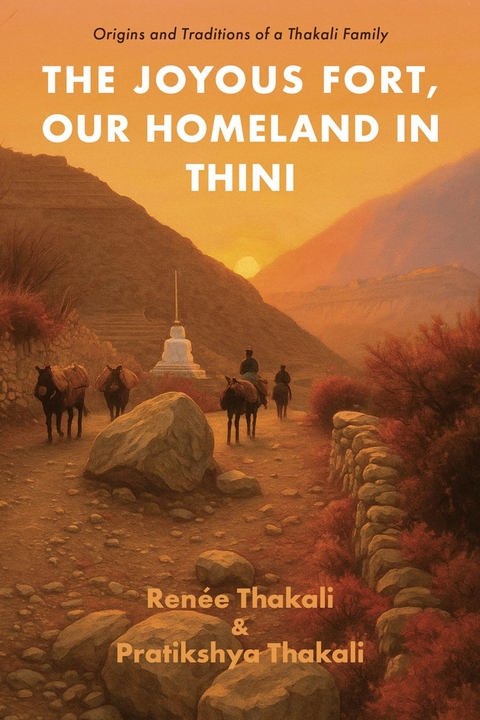
Joyous Fort, Our Homeland in Thini (eBook)
188 Seiten
Bookbaby (Verlag)
979-8-3178-1693-3 (ISBN)
Pratikshya Thakali was born and raised in the mountain village of Thini, located beneath the snowy peaks of Nilgiri and Annapurna in the Himalayan mountains. She spent her early years in a close-knit community that nurtured her understanding of Thakali traditions, language, and cultural values. Throughout her life, Pratikshya was captivated by her Nepali grandfather's stories of his trade journeys across India and Tibet many years ago, which led her to being naturally curious about everything around her. Later, due to Nepal's political turmoil, Pratikshya immigrated to the United States, where she earned a degree in business administration from Baruch College, City University of New York. Now, she is an analyst for a non-profit organization, using her skills and cultural awareness in her professional endeavors. Pratikshya is married and resides in New Jersey with her husband and son. Additionally, she is a history enthusiast, treasures old photographs, enjoys traveling, and prepares Thakali traditional dishes to pass down through generations.
"e;The Joyous Fort, Our Homeland in Thini"e; opens the door to a secret corner of the world and invites you in to learn about the rich history and culture of the Thakali people, who call the small village of Thini their home. Written by two authors-with different perspectives-one born and raised in Thini, knowing all the local customs, language, and ancient traditions; the other discovering Thini while working as an American Peace Corps volunteer. This memoir covers 45 years as Renee Thakali discovers the small village and merges her life with the people through a cross-cultural marriage. Within these pages, she details both the times of joy and sadness with her new family, the Thakali family. At first, she struggled to understand some traditions, but she tried hard to be the best daughter and sister-in-law despite being immersed in an unfamiliar place and culture. Pratikshya Thakali grew up in the Thini village, beneath the snowy peaks of Nilgiri and Annapurna in the Himalayan mountains of Nepal, and was naturally curious about everything around her. Her life was full of listening to her elders and learning to cook delicious food, which allowed Renee to seek insight on how the village society relies on kinship relations. Together, Renee and Pratikshya created this historical document for the younger and future generations to help them remember who they are and who came before them in Thini. The small village in the Himalayan mountains is a fascinating place, with close family ties holding the community together. This photo narrative is a historical document for the younger and future generations to help them remember who they are and who came before them and provide them with background information on important Thakali traditions. Such as the Tygunla New Year, which lasts for 2 weeks and celebrates their ancestors and elders with daily offerings, or the Yak Dance (fala), which brings immense laughter as young men dressed as wild yaks chase and tease the girls. This small village is known by few, but to those who know it, it holds it dear to their heart. Thini is a fascinating place, with close family ties that hold the community together, making everyone feel welcome and as if they are at home.
Ancestral Origins
in Tibet and Nepal
One important resource that has been used to gather the history of Thini and of our Thakali family in Thini is the book, The Thakali, A Himalayan Ethnography, by Michael Vinding (1998), Serindia Publications, London. His book goes into much more detail on all aspects of the early history and lifestyles of the Thakali people and interested readers are encouraged to read it. We highlight key information about Thini’s early ancestors and the history of Thini village based on Vinding’s research that is documented in his book.
Vinding, an anthropologist from Denmark, conducted his research in the 1970’s on the origins of the Thakali people by living with a Thakali family in Syang, a village that lies directly across the Kali Gandaki River from Thini. He collected local oral histories with assistance from Krishna Lal Thakali, who is from Thini. Vinding also researched several ancient written texts. The Thakali language has no written form, but several ancient documents that make reference to Thini or the people from Thini, were written in both the Tibetan script and language and the Devanagari script in the Nepali language.
Michael Vinding wrote that even though it is not certain or proven, he thought that the Thakali people of today may possibly carry some genes from the early cave dwellers who lived in the Mustang area in the first millennium B.C. Our ancestors also include the early indigenous Tamu tribal people, (prior to the more recent Tamang-Gurung-Thakali tribes), who settled in Thak Khola more than 500 years ago. It would be interesting if someone could do research on the DNA of the people living here now using the latest technology to verify Vinding’s hypothesis. There are many caves, mostly in Upper Mustang with some in Lower Mustang, that contain evidence of prehistoric life and artifacts from later periods when the caves were used for grain storage or religious purposes. The early Tamu people spoke a Tibeto-Burmese language that was similar to the Thakali language that is spoken today. No one is exactly sure of the true origins of the Thakali people who settled in Thini centuries ago, but we find it fascinating to read Vinding’s book and his conclusions on the early roots of the Thakali people who live in Thini, Syang, and Chhimang.
The Joyous Fort and King at Gharabjhong
One local historical record that was written in Tibetan many years ago was the bemchag. Several of these were written but only one bemchag was found and translated by Vinding and Ramble in 1987. (Kailash- Journal of Himalayan Studies, Volume 13, Number 1-2, 1987, pp 5-48. Printed by Ratna Pustak Bhandar, Kathmandu, Nepal. Online: https://d1i1jdw69xsqx0.cloudfront.net/digitalhimalaya/collections/journals/kailash/pdf/kailash_13_0102_01.pdf.) This bemchag, or historical record, was found in Chhimang village, which lies a few kilometers south of Thini and is home to many of our relatives. The Chhimang bemchag provides some history of the foundation and boundaries of the old Kingdom of Sum that lies about one kilometer south of where the village of Thini is located today.
Long ago, the Thak Khola area was called Se-rib in some Tibetan dialects. The Thakali language was called Se-kai, and the village of Thini was formerly named Sum. Even centuries ago people traveled great distances on foot or on horse-back across vast lands and climbed over high passes, all in search of a better place to live. Many of Thini’s ancient ancestors also came from Western Tibet. King Thokarcen, a key ancestor of the Ghyalipal clan and several other clans who have descendants living in Thini today, travelled the long distance from Western Tibet to Sum, settled there, and became king of this village some time in the sixteenth century. The bemchag or historical record mentioned that King Thokarcen built the walled fort at Gharabjhong and that he came from Western Tibet looking for a place to rule as king. The English translation for Gharabjhong from Tibetan is “Joyous Fort”. Rulers from Tibet or from other parts of Nepal fought back and forth in endless feudal battles for control of this area for at least several hundred years. Numerous rulers of the small kingdoms in this part of the world fought constantly for dominance and frequently changed their loyalty. (Jackson, David P., Notes on the History of Serib and Nearby Places in the Upper Kali Gandaki Valley, Kailash- Journal of Himalayan Studies, Vol. 6, No. 3, p.195. Printed by Ratna Pustak Bhandar, Kathmandu, Nepal.
Online: https://d1i1jdw69xsqx0.cloudfront.net/digitalhimalaya/collections/journals/kailash/pdf/kailash_06_03_03.pdf.)
The need to protect the inhabitants of Gharabjhong from outside invaders was absolutely necessary during this period. Remnants of the fortress and old village of Gharabjhong still stand today, perched atop a high cliff with a view that looks far up and down the Kali Gandaki River as well as in every direction. With this strategically positioned walled fortress, it would have been difficult for any invader to sneak up and attack Gharabjhong by surprise. King Thokarcen’s small kingdom included the five villages known today as Thini, Chhimang, and Syang, plus Marpha and Chhairo. This group of villages is often referred to as Pacgau or Panchgaon in Nepali, meaning five villages. To honor this history, the municipality for this area was recently named Gharabjhong and now includes the large and small villages of Thini, Jomsom, Dhumba, Samle, Syang, Marpha, Chhairo, and Chhimang.
Gharabjhong was home for Thini’s ancestors for centuries. In the 1990s, archaeologists from Europe and Nepal recovered sections of wooden poles that had been used to construct the ancient buildings. Using modern methods to count the visible tree rings in the old wooden poles, they were able to figure out the age of the wood and concluded that Gharabjhong was probably constructed around 1,534 A.D., almost 500 years ago. Archaeological excavations and research discovered an even older fortress had been built there before the construction of Gharabjhong, so our ancestors have been living here for many many years. (Schmidt, B., Dendrochronological Research in South Mustang. Ancient Nepal, Journal of the Department of Archaeology, No. 130-133, June-January 1992-1993. pp. 20-33. Printed at Matribhoomi Press, Kamal Pokhari, Kathmandu, Nepal.
Online at: https://giwmscdntwo.gov.np/media/pdf_upload/ancient_nepal_130-133_full_1497849032_1581401425.pdf.)
Remnants of the Ancestral Walled Fortress Gharabjhong. (2017)
Only a few remnants of the ancient walls of Gharabjhong village still stand today. One wall has a window opening that looks out to where Thini is located. Right outside that ancient window frame and wall, the slope falls straight down more than fifty feet. The few remnants of several homes are situated close together on this small hilltop. The old pathway is still visible, and it is a very steep, rocky climb up from the Thini River to Gharabjhong. It is so steep that I had to climb up using both my hands and feet in several places just to pull myself up to the top. I can’t imagine having to climb up that narrow path while carrying a large clay pot full of water or a heavy load of firewood on my back every day or several times a day. Those who lived in Gharabjhong long ago had to walk down to the Thini River for water and cross the river and climb up to the plateau to reach their cultivated fields. Their pastures and forests were much higher up on the mountains. They had to have been very hardy, strong, and resilient to survive and thrive in this harsh, often cold environment during those difficult times long ago.
Remains of old building foundations in Gharabjhong. (2017)
Based on stories from Aita’s father, Chhyang Nurpu, we know that a few families still lived in Gharabjhong as late as the beginning of the twentieth century. Aita Bahadur’s father, Chhyang Nurpu, was most likely born in Gharabjhong, probably in the early 1900’s. Many years ago he told us about when he lived there as a small boy and he remembered his family moving to present-day Thini village. The old fortress was eventually abandoned and the existing village of Thini was constructed more than 100 years ago. We explored the old ruins of Gharabjhong several times when visiting Thini to show our young daughters where their Thakali ancestors had once lived. Scattered relics and foundation remnants still remain in place and we roamed around speculating who lived there and what their life must have been like. There is one large flat rock that has a fist-sized divot or hole; it was probably used to pound grain kernels into flour or pound salt and hot spices into timurko chop, a favorite Thakali seasoning.
There was much less need for a fortress and protection from intruders by the late sixteenth century, once the numerous small kingdoms across Nepal were conquered by a new, powerful ruler—Prithivi Narayan Shah—who was from Gorkha, which lies far to the east. The new Kingdom of Nepal was then ruled from Kathmandu, as it still is to this day, though Nepal is no longer under a monarchy system as it was for a few hundred years.
By the late 1800s, it was relatively more peaceful,...
| Erscheint lt. Verlag | 25.9.2025 |
|---|---|
| Sprache | englisch |
| Themenwelt | Sachbuch/Ratgeber ► Gesundheit / Leben / Psychologie ► Familie / Erziehung |
| ISBN-13 | 979-8-3178-1693-3 / 9798317816933 |
| Informationen gemäß Produktsicherheitsverordnung (GPSR) | |
| Haben Sie eine Frage zum Produkt? |
 EPUB (Ohne DRM)
Größe: 41,0 MB
Digital Rights Management: ohne DRM
Dieses eBook enthält kein DRM oder Kopierschutz. Eine Weitergabe an Dritte ist jedoch rechtlich nicht zulässig, weil Sie beim Kauf nur die Rechte an der persönlichen Nutzung erwerben.
Dateiformat: EPUB (Electronic Publication)
EPUB ist ein offener Standard für eBooks und eignet sich besonders zur Darstellung von Belletristik und Sachbüchern. Der Fließtext wird dynamisch an die Display- und Schriftgröße angepasst. Auch für mobile Lesegeräte ist EPUB daher gut geeignet.
Systemvoraussetzungen:
PC/Mac: Mit einem PC oder Mac können Sie dieses eBook lesen. Sie benötigen dafür die kostenlose Software Adobe Digital Editions.
eReader: Dieses eBook kann mit (fast) allen eBook-Readern gelesen werden. Mit dem amazon-Kindle ist es aber nicht kompatibel.
Smartphone/Tablet: Egal ob Apple oder Android, dieses eBook können Sie lesen. Sie benötigen dafür eine kostenlose App.
Geräteliste und zusätzliche Hinweise
Buying eBooks from abroad
For tax law reasons we can sell eBooks just within Germany and Switzerland. Regrettably we cannot fulfill eBook-orders from other countries.
aus dem Bereich