


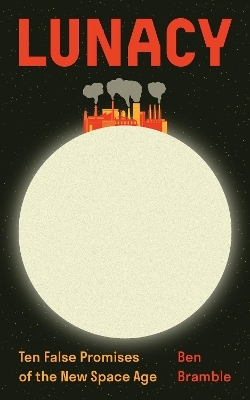
Lunacy
Ten False Promises of the New Space Age
Seiten
2026
Princeton University Press (Verlag)
978-0-691-28128-5 (ISBN)
Princeton University Press (Verlag)
978-0-691-28128-5 (ISBN)
- Noch nicht erschienen (ca. Juli 2026)
- Portofrei ab CHF 40
- Auch auf Rechnung
- Artikel merken
Why we shouldn’t colonize Mars or the Moon, or even vacation there
If certain business titans, corporations, and governments have their way, humans will someday be living, working, and vacationing in space. This is the much-vaunted New Space Age, and in Lunacy, philosopher Ben Bramble explains why it is a giant mistake. Bramble systematically refutes each of the ten most influential reasons given for this new generation of space exploration (and habitation), from the idea of Mars as a backup plan in case Earth meets an untimely end to the charms of friendship with extraterrestrials. Doing so, he reflects on deeper issues, exploring such questions as what the point of the human story is and what a good future for humanity would truly involve. (Spoiler alert: it includes solving problems on Earth.)
Bramble does not think we should get out of space entirely. On the contrary, he thinks that there is an important and exciting future in space science. Our activities in space, he tells us, should be animated by a curiosity about space itself rather than narrow economic or military interests.
If certain business titans, corporations, and governments have their way, humans will someday be living, working, and vacationing in space. This is the much-vaunted New Space Age, and in Lunacy, philosopher Ben Bramble explains why it is a giant mistake. Bramble systematically refutes each of the ten most influential reasons given for this new generation of space exploration (and habitation), from the idea of Mars as a backup plan in case Earth meets an untimely end to the charms of friendship with extraterrestrials. Doing so, he reflects on deeper issues, exploring such questions as what the point of the human story is and what a good future for humanity would truly involve. (Spoiler alert: it includes solving problems on Earth.)
Bramble does not think we should get out of space entirely. On the contrary, he thinks that there is an important and exciting future in space science. Our activities in space, he tells us, should be animated by a curiosity about space itself rather than narrow economic or military interests.
Ben Bramble is lecturer in philosophy in the Fenner School of Environment and Society at the Australian National University and a mission specialist at ANU’s Institute for Space. He is the author of The Passing of Momentary Well-Being and Pandemic Ethics: 8 Big Questions of COVID-19. His op-eds have appeared in The New York Times, The Guardian, and The Sydney Morning Herald.
| Erscheint lt. Verlag | 14.7.2026 |
|---|---|
| Verlagsort | New Jersey |
| Sprache | englisch |
| Maße | 127 x 203 mm |
| Themenwelt | Sachbuch/Ratgeber ► Natur / Technik ► Weltraum / Astronomie |
| Technik ► Luft- / Raumfahrttechnik | |
| ISBN-10 | 0-691-28128-9 / 0691281289 |
| ISBN-13 | 978-0-691-28128-5 / 9780691281285 |
| Zustand | Neuware |
| Informationen gemäß Produktsicherheitsverordnung (GPSR) | |
| Haben Sie eine Frage zum Produkt? |
Mehr entdecken
aus dem Bereich
aus dem Bereich
das aktuelle Raumfahrt-Jahrbuch mit allen Starts
Buch | Softcover (2025)
Verein zur Förderung der Raumfahrt (Verlag)
CHF 27,85
die Suche nach der Urkraft des Universums
Buch | Hardcover (2023)
Klett-Cotta (Verlag)
CHF 34,95


